
Navigation
Install the app
How to install the app on iOS
Follow along with the video below to see how to install our site as a web app on your home screen.
Note: This feature may not be available in some browsers.
More options
You are using an out of date browser. It may not display this or other websites correctly.
You should upgrade or use an alternative browser.
You should upgrade or use an alternative browser.
death during assesment
- Thread starter blue
- Start date
- Location
- Buckinghamshire. UK
Hi Blue
Do you have any further details, how,when, where & why?
Cheers
Nod
Do you have any further details, how,when, where & why?
Cheers
Nod
Blue,
There was an accident at capel manor college (end of october) luckly the student involved was not killed, seriously injured with broken ribs, collasped lung and broken collar bone, since spent some time in hospital after an air lift out of the incident and is well on the road to recovery.
The details, very simply two students were out with a PI (Practical instructor) at the college on a sunday wanting to gain some more experience before they went for there NPTC ticket, the climb was authroised by the college. Climbing with the two students the PI watched both undergo a series of changeovers (swapping between lanyard and main lifeline) to gain height within the canopy, after watching climber A complete a changeover, take the slack from his lifeline and take a bodythrust PI truned his attention to climber B, whilst talking to him he heard a click and then proeceeded to watch climber A take a straight fall 20/25ft to the floor.
An emergency plan was put straight into place, with first aid facilites on site, evacuation was organsied and the emergency services by all acounts were on site within 10 minutes.
So what caused it? All down to a Petzl Ball lock karabiner, it seems to be apparant that the karabiner had become slightly cross loaded in some way, whether it was the climber moving in his harness or the splice of his lifeline but very simply the biner opened, i have since been told that it actually only takes 1/8 of a turn to open the krab when the ball is depressed so the jury is out as to whether the rope caused this or movement of the harness?? It has been determined it was not operator error, and well documentated equipment checks (LOLER inpsection two months prior) show the gear was ok.
An immediate college investigation was launched with no climbing and the withdrawal of all PBL krabs, the HSE were informed and they have made comment that the documentation is terms of generic risk assessment, site specific RA, emergency contingencies and emergency planning were of a very high standard, the college have introduced there own procedures to prevent this happening again (Withdrawal of kit and looking at teaching practices).
The final paper conclusion has not yet been drwan up, but it very simply looks like it was just an accident.
There was an accident at capel manor college (end of october) luckly the student involved was not killed, seriously injured with broken ribs, collasped lung and broken collar bone, since spent some time in hospital after an air lift out of the incident and is well on the road to recovery.
The details, very simply two students were out with a PI (Practical instructor) at the college on a sunday wanting to gain some more experience before they went for there NPTC ticket, the climb was authroised by the college. Climbing with the two students the PI watched both undergo a series of changeovers (swapping between lanyard and main lifeline) to gain height within the canopy, after watching climber A complete a changeover, take the slack from his lifeline and take a bodythrust PI truned his attention to climber B, whilst talking to him he heard a click and then proeceeded to watch climber A take a straight fall 20/25ft to the floor.
An emergency plan was put straight into place, with first aid facilites on site, evacuation was organsied and the emergency services by all acounts were on site within 10 minutes.
So what caused it? All down to a Petzl Ball lock karabiner, it seems to be apparant that the karabiner had become slightly cross loaded in some way, whether it was the climber moving in his harness or the splice of his lifeline but very simply the biner opened, i have since been told that it actually only takes 1/8 of a turn to open the krab when the ball is depressed so the jury is out as to whether the rope caused this or movement of the harness?? It has been determined it was not operator error, and well documentated equipment checks (LOLER inpsection two months prior) show the gear was ok.
An immediate college investigation was launched with no climbing and the withdrawal of all PBL krabs, the HSE were informed and they have made comment that the documentation is terms of generic risk assessment, site specific RA, emergency contingencies and emergency planning were of a very high standard, the college have introduced there own procedures to prevent this happening again (Withdrawal of kit and looking at teaching practices).
The final paper conclusion has not yet been drwan up, but it very simply looks like it was just an accident.

- Location
- Ontario, Canada
What type of saddle was the student wearing?
i'm glad to hear the climber was not killed and wish for a speedy recovery.it's amazing how things get disstorted as they pass down the line.thankx for posting the facts as they sound very accurate.i used to have a ball lock biner on my strop afew years ago and can remember throwing it for being to much of a pain in the arse to use.i do seem to remember seing a HSE paper on the offending article at around the same time saying that people should be aware of the dangers of crap getting into the workings of the gate and the chance of it rubbing on your harness or clothing and coming open.i could be wrong and if i am please correct me.i now only use screw lock for my life line and 3way twist lock on my strop.
The saddle type i am unsure of, i'll check on that and get back to you.
Blue, many stories in the industry are disorted or 'bent', at the end of the day if others can learn from the incident then it is a good thing all round. Many Uk climbers have ditched the PBL krab, yet problems have also been experienced with the ISC Mongoose - a lot of it does come down to inspection and maintenance, HSE did release a press note about twelve months ago, follwoing an incident during a training excerise where the three way action krab did not close properly and the climber sustained a fall. I find graphite powder the best for cleaning my krabs and i'm sure of you look back there is a thread on this very topic.
As far your own choice of krabs for your lifeline, can i just ask what you mean by screwlock? Do you mean the krab is a screwgate? or does it require three distinct movements to open and close the gate? Commonly known as three way action krabs. I'll post more when confirmed, but the use of screwgate krabs for the main lifeline is no longer acceptable as far as Uk indusrty best practice, and legal formalities are concerned. (AFAG 401, LOLER 1998).
Blue, many stories in the industry are disorted or 'bent', at the end of the day if others can learn from the incident then it is a good thing all round. Many Uk climbers have ditched the PBL krab, yet problems have also been experienced with the ISC Mongoose - a lot of it does come down to inspection and maintenance, HSE did release a press note about twelve months ago, follwoing an incident during a training excerise where the three way action krab did not close properly and the climber sustained a fall. I find graphite powder the best for cleaning my krabs and i'm sure of you look back there is a thread on this very topic.
As far your own choice of krabs for your lifeline, can i just ask what you mean by screwlock? Do you mean the krab is a screwgate? or does it require three distinct movements to open and close the gate? Commonly known as three way action krabs. I'll post more when confirmed, but the use of screwgate krabs for the main lifeline is no longer acceptable as far as Uk indusrty best practice, and legal formalities are concerned. (AFAG 401, LOLER 1998).

- Location
- Hole,Norge
As far as I know Chris its ok to use them but you must use two back to back so the gates go in opposite directions.So you might as well use a single triple action.
Would be intersted to know if this is still accepted??
Didj
Would be intersted to know if this is still accepted??
Didj
- Location
- Hole,Norge
NO I'm wrong,,,,,
Only triples are accepted
Only triples are accepted
The main lifeline krab should be a three way action, three distinct movements to operate the gate. have you seen the new Arboricultural Forestry Advisory Group (AFAG) leaflets on Industry Best Practice, replacing the old FASTCo leaflets? Other documentation worth a view would be the AA/FASTCo Guide to Good Climbing Practice, and the HSE Agricultural Information Sheet (AIS) 30, LOLER: how the regulations apply to arboriculture.
In a nut shell those lines which are in constant use during the day such as lifelines and lanyards, where constant clipping in and out is experienced should be utilised with a 3 way action Krab, a double locking snap is also acceptable.
In a nut shell those lines which are in constant use during the day such as lifelines and lanyards, where constant clipping in and out is experienced should be utilised with a 3 way action Krab, a double locking snap is also acceptable.
- Location
- Devonport Tasmania
Petzl William Ball locks
I have noticed a few times that they havent closed properly during change overs...but mine are getting old I put it down to the springs tiring. What life expectancy is normal for these biners in normal use..any ideas for replacements?
I have noticed a few times that they havent closed properly during change overs...but mine are getting old I put it down to the springs tiring. What life expectancy is normal for these biners in normal use..any ideas for replacements?

- Location
- United Kingdom
Re: Petzl William Ball locks
Hi Rob. The springs do wear out in time and the krab should be chucked. In the UK we have to have all gear inspected by a qualified loler inspector every 6 months (rigging gear every 12) But also carry out daily inspections ourselves. If you can make a gate stick by closing it real slowly and allowing the barrel to turn slightly before closing then try blowing it out with an airline, then lubing with graphite or similar WD40 works well, if you have that. If the gate still sticks then bin it. For constant use you might get one year out if it two at the most. Replace with any triple action krab that suits the purpose. How easy is it to get gear where you are?
Hi Rob. The springs do wear out in time and the krab should be chucked. In the UK we have to have all gear inspected by a qualified loler inspector every 6 months (rigging gear every 12) But also carry out daily inspections ourselves. If you can make a gate stick by closing it real slowly and allowing the barrel to turn slightly before closing then try blowing it out with an airline, then lubing with graphite or similar WD40 works well, if you have that. If the gate still sticks then bin it. For constant use you might get one year out if it two at the most. Replace with any triple action krab that suits the purpose. How easy is it to get gear where you are?

Re: Petzl William Ball locks
anyone know if the dmm belay master is legal then?
although its a screwgate, seems to me with the safety clip on there its safer than a 3way krab.
Also that clip keeps gear nicely in place
anyone know if the dmm belay master is legal then?
although its a screwgate, seems to me with the safety clip on there its safer than a 3way krab.
Also that clip keeps gear nicely in place
Re: Petzl William Ball locks
Steve,
Am I right in thinking that the belay master is just a screwgate krab with the black holding plate over the top, which locks the screwgate in positon, if i'm right these krabs where utilised by many outdoor pursuit centres/ youth organisations during climbing/absailing training to prevent interested hands from unscrewing them during descent. But to answer your question your risk assessment would have to justify the use of these krabs, i know most LOLER inspectors/NPTC assessors and Lantra instructors would get very twitchy about climbers using these. It is a fine line that you are walking if you choose to continue to use the belay master, you have to take into consideration what reccommendations are made through AFAG 401, even though this is not a legal document it would be reference material in a court of law, the wording of a guide to good climbing practice, LOLER 1998 and also British Standard EN 362 (1992) Which states that in additon the instructions for use shall state that manual locking hooks and karabiners shall be acceptable only in cases where the user does not have to attatch and remove the hook or karabiner many times during the working day.
BS EN 362 = PPE against falls from height - connectors
All of this combined with the impending Working at Height regulations, would advise me to say that you should strongly consider changing your karabiners, but saying that i have not seen your health and safety policy or generic risk assessment.
Chris
Steve,
Am I right in thinking that the belay master is just a screwgate krab with the black holding plate over the top, which locks the screwgate in positon, if i'm right these krabs where utilised by many outdoor pursuit centres/ youth organisations during climbing/absailing training to prevent interested hands from unscrewing them during descent. But to answer your question your risk assessment would have to justify the use of these krabs, i know most LOLER inspectors/NPTC assessors and Lantra instructors would get very twitchy about climbers using these. It is a fine line that you are walking if you choose to continue to use the belay master, you have to take into consideration what reccommendations are made through AFAG 401, even though this is not a legal document it would be reference material in a court of law, the wording of a guide to good climbing practice, LOLER 1998 and also British Standard EN 362 (1992) Which states that in additon the instructions for use shall state that manual locking hooks and karabiners shall be acceptable only in cases where the user does not have to attatch and remove the hook or karabiner many times during the working day.
BS EN 362 = PPE against falls from height - connectors
All of this combined with the impending Working at Height regulations, would advise me to say that you should strongly consider changing your karabiners, but saying that i have not seen your health and safety policy or generic risk assessment.
Chris
Re: Petzl William Ball locks
thanks for your response.
When i pick my climbing gear i do tend to pick what i feel most comfortable and confident with, and not what is recommended.
I know when i close this biner up i feel more confident than i do with a 3way.
Not that i distrust 3way biners at all. the belay master lends itself better to the system i climb with too.
I dont think i would change from using these so long as im using my current set up regardless of wether they were legal to use or not. but then my set up is frowned upon by the nptc anyhow, regardless of what biner im using so i guess im screwed regardless
thanks for your response.
When i pick my climbing gear i do tend to pick what i feel most comfortable and confident with, and not what is recommended.
I know when i close this biner up i feel more confident than i do with a 3way.
Not that i distrust 3way biners at all. the belay master lends itself better to the system i climb with too.
I dont think i would change from using these so long as im using my current set up regardless of wether they were legal to use or not. but then my set up is frowned upon by the nptc anyhow, regardless of what biner im using so i guess im screwed regardless
Re: Petzl William Ball locks
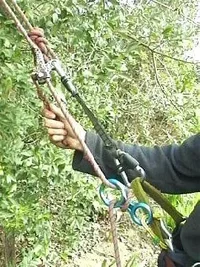
well i climb drt with a petzl shunt instead of a friction hitch. A mate of mine uses a similar set-up and recently did a weeks course followed by an assessment. The guy taking the course wouldn't let him use it.
I'll post a pic........its got the tail running through a fig8 which is not how i nbormally have it set, just took that pic to show someone. Normally i have the tail ruinning through the yellow krab on the aluminium ring on the harness and use it to control my descent.
well i climb drt with a petzl shunt instead of a friction hitch. A mate of mine uses a similar set-up and recently did a weeks course followed by an assessment. The guy taking the course wouldn't let him use it.
I'll post a pic........its got the tail running through a fig8 which is not how i nbormally have it set, just took that pic to show someone. Normally i have the tail ruinning through the yellow krab on the aluminium ring on the harness and use it to control my descent.
Attachments
Re: Petzl William Ball locks
Descent is controlled by applying downward force to the stunt cam? In your case you have added a length of cord which acts like the tail on a lockjack so when you want to descend you simply pull the cord? I am presuming that the shunt is a closed unit and you have to thread the rope through the casing and the cam rather than being able to actaully remove the cam place in the rope and replace cam? Can i ask what rope is being used in the photo? Did the trainer give his reasons for not allowing it's use?
Descent is controlled by applying downward force to the stunt cam? In your case you have added a length of cord which acts like the tail on a lockjack so when you want to descend you simply pull the cord? I am presuming that the shunt is a closed unit and you have to thread the rope through the casing and the cam rather than being able to actaully remove the cam place in the rope and replace cam? Can i ask what rope is being used in the photo? Did the trainer give his reasons for not allowing it's use?
New threads New posts
-
test
-
What's on your mind? TCI Magazine wants to know
- Started by Tree Care Industry Assoc.
- Replies: 7
-
 Apr 09 (Free CEUs) & May 07 - 'Urban Forestry Today' Webcasts @ Noon (Eastern)
- Started by UFT
- Replies: 0
-

-
-

-


