- Location
- central texas
This is sort of a revival of a post by Marden back in January. I just tried my first "real" splice (not counting brummels in hollow braid). From what I saw on that thread, maybe poison ivy calamine wasn't the wisest choice, but I had one I bought from Tree Stuff that was nicely spliced on one end. I had heard that that line milks and so splicing on both ends is not recommended. Then I heard, no, it's tight enough that it won't.
So I decided to use just one end of this 150 footer for a few months, then milk it and try splicing the other end. Over 50 feet of this rope never left my bag. It was pristine and limp, and I milked about two inches off of it and began my journey.
I used the Samson splicing instructions and borrowed a fid that is marked 7/16 - 10mm (strangely, the fid package calls it a 7/16 - 11mm fid). Just like Marden, I could not for the world get that fid through the throat (this could be why Nick Bonner at TreeStuff says he doesn't use tube fids for this splice), and ended up devising a wire fid from an EHS cable strand. Even with that, pulling the core tail through was a BEAR.
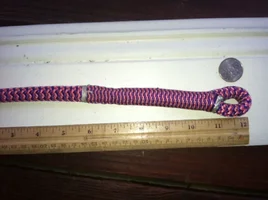
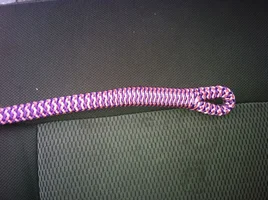
I followed the instructions with absolute precision. Or so I thought. When I got to the bury, I milked and yanked and squeezed and bent and hammered, but that last tiny bulge of the cross over just would not go in. Picture attached. The throat of the splice is rock hard and as you can see, very stretched out and fat.
I did not try any lubing, as Nick A. suggests in some threads, and I honestly didn't hammer too aggressively, as it just doesn't seem like something I want to do to a life support line, but I tried yanking/ snapping the line with the fid in the eye, and milking the eye, and every other trick I could find. Spent over 30 minutes, easy.
My questions: First, why did this happen? My tapering was exactly as the instructions called for. Is lubing and/or hammering standard for splicing this rope? And any ideas on how to bury the rest of this crossover? My whipstitching is not very thorough as I will remove if I get a solution to finishing this bury and I intentionally kept a bit of milked cover just above the whipstitch for this same reason.
And finally, what is the structural integrity impact of not finishing this bury?
If I learned anything from this, it is that you splicing experts have a far greater understanding of spatial relations than I'll ever have!
So I decided to use just one end of this 150 footer for a few months, then milk it and try splicing the other end. Over 50 feet of this rope never left my bag. It was pristine and limp, and I milked about two inches off of it and began my journey.
I used the Samson splicing instructions and borrowed a fid that is marked 7/16 - 10mm (strangely, the fid package calls it a 7/16 - 11mm fid). Just like Marden, I could not for the world get that fid through the throat (this could be why Nick Bonner at TreeStuff says he doesn't use tube fids for this splice), and ended up devising a wire fid from an EHS cable strand. Even with that, pulling the core tail through was a BEAR.
I followed the instructions with absolute precision. Or so I thought. When I got to the bury, I milked and yanked and squeezed and bent and hammered, but that last tiny bulge of the cross over just would not go in. Picture attached. The throat of the splice is rock hard and as you can see, very stretched out and fat.
I did not try any lubing, as Nick A. suggests in some threads, and I honestly didn't hammer too aggressively, as it just doesn't seem like something I want to do to a life support line, but I tried yanking/ snapping the line with the fid in the eye, and milking the eye, and every other trick I could find. Spent over 30 minutes, easy.
My questions: First, why did this happen? My tapering was exactly as the instructions called for. Is lubing and/or hammering standard for splicing this rope? And any ideas on how to bury the rest of this crossover? My whipstitching is not very thorough as I will remove if I get a solution to finishing this bury and I intentionally kept a bit of milked cover just above the whipstitch for this same reason.
And finally, what is the structural integrity impact of not finishing this bury?
If I learned anything from this, it is that you splicing experts have a far greater understanding of spatial relations than I'll ever have!