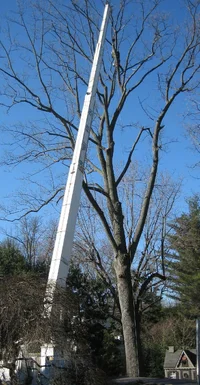
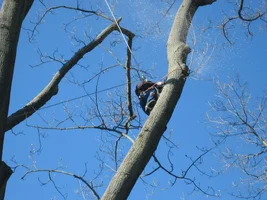
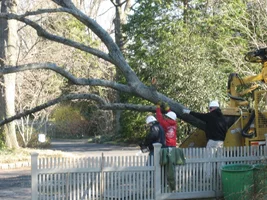
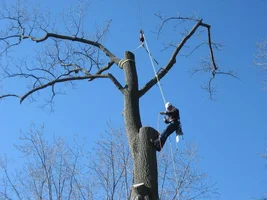
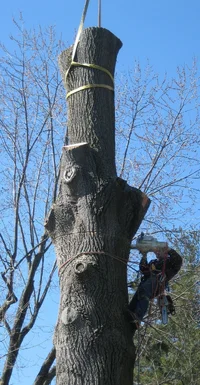
Thought I'd post some pictures off a 4' DBH tulip poplar tree we took down last week. Reason for removal: Doesn't help when you build an inground pool 15' away, change the grade, and run a swale of water right next to base of tree. Tree was declining so it was removed.

Navigation
Install the app
How to install the app on iOS
Follow along with the video below to see how to install our site as a web app on your home screen.
Note: This feature may not be available in some browsers.
More options
You are using an out of date browser. It may not display this or other websites correctly.
You should upgrade or use an alternative browser.
You should upgrade or use an alternative browser.
Crane Removal-Tulip Poplar
- Thread starter Cameron
- Start date

- Location
- Retired in Minneapolis
Check your pic uploads. You're missing some.

- Location
- Home of the New Jersey Devils
Cameron, the pics that didn't load are probably a little large. Maybe try to resize and then repost?
Then I'll ask some questions. /forum/images/graemlins/grin.gif
Then I'll ask some questions. /forum/images/graemlins/grin.gif
- Location
- Retired in Minneapolis
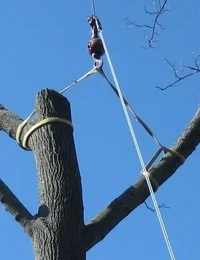
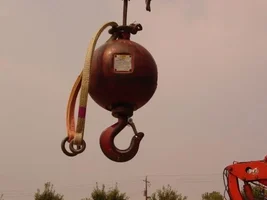
In the "pics of rigging" you have the hook facing left with the left sling close to the hook. Since that sling angle is quite accute wouldn't it be a bit more secure to swivel the hook and have the slings interchanged? The more vertical right sling would help capture the other sling and reduce the chance of the sling sliding up towards the gate in case the load tipped or moved.
Attachments


RogerM
Carpal tunnel level member
- Location
- Louisville,KY USA
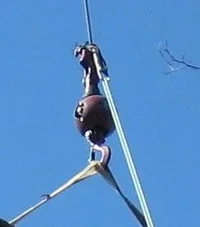
COuld you explain a bit the way your tied in to the load line? I tried to zoom in a bit but couldn't really make any thing out. MAybe someone with more savy could crop and lighten the "tie in" some. Not to distract from the sling issue. thanks
We have two peices of cord there. One supporting is an eye an eye Tenex set up as a prusik around the wire and above that is a back up of eye an eye ultra tech. Both cords eyes are placed in the biner. Rope through the biner. I've only had one question with this method though. Is the rope getting damaged going over a tight radius it makes over the biner? Problem is if you put a pulley on the biner, you have problems pulling out you line sometimes. Have been doing it this way for years but I am always up for suggestions. Didn't really care for the giant schakle on top of the ball in another post. Will try to post a close up.
Attachments

[ QUOTE ]
I've only had one question with this method though. Is the rope getting damaged going over a tight radius it makes over the biner?
[/ QUOTE ]
Definitely.
Check out the bottom of this attachment. Near as I can recall it was from a document I fetched from Samson's website some time ago.
I've only had one question with this method though. Is the rope getting damaged going over a tight radius it makes over the biner?
[/ QUOTE ]
Definitely.
Check out the bottom of this attachment. Near as I can recall it was from a document I fetched from Samson's website some time ago.
Attachments
Is anyone really worried about? I don't think so. The manufactures at buckingham and some others dont care. I don't know of a friction saver on the markey yet that meets a 4:1 bend ratio. I asked them at buckingham a few years about this in and they gave me the cold shoulder. It may be more a concern when the ropes are used at a maximum work load and closer to the tensile strength.
I personally am more concerned about running a rope over aluminum. A dirty rope can do some nasty things to aluminum. I have a figure 8 that I used one time to come down on a dirty 16 strand new england rope and wore 1/4 inch groves in it. It was only a descent of about 40 feet. Imagine using a dirty rope on an aluminum biner on a crane to tie into all day and not be aware of what is happening. I bet I can wear through one pretty darn quick with a dirty rope. I'm sure this is an accident out there waiting to happen.
I personally am more concerned about running a rope over aluminum. A dirty rope can do some nasty things to aluminum. I have a figure 8 that I used one time to come down on a dirty 16 strand new england rope and wore 1/4 inch groves in it. It was only a descent of about 40 feet. Imagine using a dirty rope on an aluminum biner on a crane to tie into all day and not be aware of what is happening. I bet I can wear through one pretty darn quick with a dirty rope. I'm sure this is an accident out there waiting to happen.

- Location
- Bloomington, Indiana
[ QUOTE ]
We have two peices of cord there. One supporting is an eye an eye Tenex set up as a prusik around the wire and above that is a back up of eye an eye ultra tech. Both cords eyes are placed in the biner. Rope through the biner.....Problem is if you put a pulley on the biner, you have problems pulling out you line sometimes. Have been doing it this way for years but I am always up for suggestions. Didn't really care for the giant schakle on top of the ball in another post. Will try to post a close up.
[/ QUOTE ]
I think I understand how what you mean, but, if you can, I'd like to see a closeup of your tie-in.
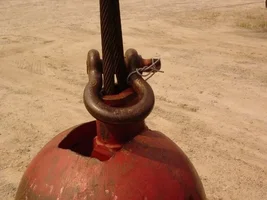
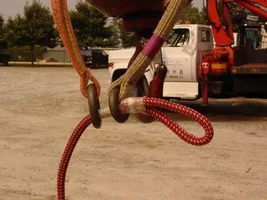
We place a smaller shackle on the cable and secure the pin with a piece of wire...
We have two peices of cord there. One supporting is an eye an eye Tenex set up as a prusik around the wire and above that is a back up of eye an eye ultra tech. Both cords eyes are placed in the biner. Rope through the biner.....Problem is if you put a pulley on the biner, you have problems pulling out you line sometimes. Have been doing it this way for years but I am always up for suggestions. Didn't really care for the giant schakle on top of the ball in another post. Will try to post a close up.
[/ QUOTE ]
I think I understand how what you mean, but, if you can, I'd like to see a closeup of your tie-in.
We place a smaller shackle on the cable and secure the pin with a piece of wire...
Attachments
- Location
- Bloomington, Indiana
- Location
- Bloomington, Indiana
...and a climbing line is placed through the friction saver.
Note that the eye of the climbing line goes through the big ring first, then the small ring. This is the just the reverse of when a friction saver is used in a tree, in which case the rope goes through the small ring first, then the big ring. The reason for reversing the procedure is that the splice of the climbing line sometimes hangs up on the small ring when the line is being retrieved. If the rope is threaded through the small ring first (as you would in a tree) then, if, on retrieval, you have to tug on the rope to get the splice through the small ring, you could pull the FS up to and even through the shackle. If the climbing line is threaded through the big ring first, then, if the splice hangs on the small ring, you can give a good tug on the rope and the small ring will be backed up by the large ring.
We place the FS in the shackle when the climber is first placed in the tree and leave the FS in the shackle for the entire removal.
Note that the eye of the climbing line goes through the big ring first, then the small ring. This is the just the reverse of when a friction saver is used in a tree, in which case the rope goes through the small ring first, then the big ring. The reason for reversing the procedure is that the splice of the climbing line sometimes hangs up on the small ring when the line is being retrieved. If the rope is threaded through the small ring first (as you would in a tree) then, if, on retrieval, you have to tug on the rope to get the splice through the small ring, you could pull the FS up to and even through the shackle. If the climbing line is threaded through the big ring first, then, if the splice hangs on the small ring, you can give a good tug on the rope and the small ring will be backed up by the large ring.
We place the FS in the shackle when the climber is first placed in the tree and leave the FS in the shackle for the entire removal.
Attachments
New threads New posts
-
test
-
What's on your mind? TCI Magazine wants to know
- Started by Tree Care Industry Assoc.
- Replies: 5
-
 Apr 09 (Free CEUs) & May 07 - 'Urban Forestry Today' Webcasts @ Noon (Eastern)
- Started by UFT
- Replies: 0
-

-
-

-
