
Navigation
Install the app
How to install the app on iOS
Follow along with the video below to see how to install our site as a web app on your home screen.
Note: This feature may not be available in some browsers.
More options
You are using an out of date browser. It may not display this or other websites correctly.
You should upgrade or use an alternative browser.
You should upgrade or use an alternative browser.
Crane removal staying attached to the ball
- Thread starter Norm_Hall
- Start date


- Location
- Montg. Co. PA
Norm,
That was an awesome job in one ugly tree!!!!!!!! I don't see any other way of doing that removal safely.
That was an awesome job in one ugly tree!!!!!!!! I don't see any other way of doing that removal safely.

KentuckySawyer
Participating member
- Location
- Louisville
And to think that Norm can do that after having a six pack of Bud for breakfast! ....or was it five? Regardless, hell of a job man!
- Location
- St.Louis Mo/Florida
I think that even with a void in the trunk like that and not to mention to V rig I would just assume tip tie the limbs to the crane 3/4 the way up the limb if the wood was good let the opperator swing the limbs AWAY from me and the trunk, not a big fan of useing the crane as my Primary tie in point with the load! How was the root sys?

Norm_Hall
New member
- Location
- Wauconda, (Chicago),IL,USA
We used a probe to check the root system, and nothing unusual was found. The client wanted a 3 foot stump left for a shelf as a planter. At the 3 foot height, it was solid. The only real defect was the cavity 25 feet up. I have used this crane operator for 12 years. He is extremely safe and we respect each other. I wouldn't have done this job without Scotty as the operator. Rock on Scotty.
- Location
- Montg. Co. PA
[ QUOTE ]
not a big fan of useing the crane as my Primary tie in point with the load!
[/ QUOTE ]
So you would rather tie into that p.o.s. tree instead of the crane? What is more likely to fail? The tree or the crane?
not a big fan of useing the crane as my Primary tie in point with the load!
[/ QUOTE ]
So you would rather tie into that p.o.s. tree instead of the crane? What is more likely to fail? The tree or the crane?
- Location
- St.Louis Mo/Florida
At that point the POS was loseing weight!! Check out www.craneaccidents.com! I wasnt there, just an observation!


allmark
Participating member
I think I would not ride the load once suspended by the crane,I would repel to the ground.I would also consider making the cut repelling then lifting if the situation allowed for that.
I still think it was nice work done,just my thoughts.Thanks Norm.
I still think it was nice work done,just my thoughts.Thanks Norm.
Norm_Hall
New member
- Location
- Wauconda, (Chicago),IL,USA
[ QUOTE ]
I plead ignorance on the legalities of the technique,
[/ QUOTE ]
Kevin, according to ANSI Z133.1-2006;
5.7.9.12 When the qualified arborist is attached to the crane while it is under load, the total weight shall not exceed 50 percent of the load capacity for the radius and configuration of the crane. I personally phoned the crane company and told them of our dilemma, and told the dispatcher (a former crane operator himself) what we wanted to do. He was OK with it as long as I faxed him the ANSI Z regs. So, when Scotty arrived at the site, he already knew what our plan was.
This is only the 2nd time we have had to do this in 21 years of crane use.
I plead ignorance on the legalities of the technique,
[/ QUOTE ]
Kevin, according to ANSI Z133.1-2006;
5.7.9.12 When the qualified arborist is attached to the crane while it is under load, the total weight shall not exceed 50 percent of the load capacity for the radius and configuration of the crane. I personally phoned the crane company and told them of our dilemma, and told the dispatcher (a former crane operator himself) what we wanted to do. He was OK with it as long as I faxed him the ANSI Z regs. So, when Scotty arrived at the site, he already knew what our plan was.
This is only the 2nd time we have had to do this in 21 years of crane use.

- Location
- Longmont, CO
Norm: I am no expert, but I do have a couple of questions.
I understand you didn't feel the tree was safe to tie into during the removal. I understand that feeling. When I saw the videos I was wondering why you didn't "fly" with the loads if you had that concern. I am aware of the 50% rule if it is necessary to "fly" with the load. So, this is where I am leading up to...
You were already tied into the ball. Were the loads exceeding the 50% rule? If they were, then why would you be tied into the ball (with the load) in the first place? Would a second crane for a T.I.P. been more safe?
Perhaps the answer is; you were comfortable with doing it the way you did. If so, I'm okay with that. You still did a good job.

Just asking. I'm just learning. Not criticizing.

I understand you didn't feel the tree was safe to tie into during the removal. I understand that feeling. When I saw the videos I was wondering why you didn't "fly" with the loads if you had that concern. I am aware of the 50% rule if it is necessary to "fly" with the load. So, this is where I am leading up to...
You were already tied into the ball. Were the loads exceeding the 50% rule? If they were, then why would you be tied into the ball (with the load) in the first place? Would a second crane for a T.I.P. been more safe?
Perhaps the answer is; you were comfortable with doing it the way you did. If so, I'm okay with that. You still did a good job.
Just asking. I'm just learning. Not criticizing.

TreeCo
Carpal tunnel level member
Great work and video!
Thanks for sharing.
Thanks for sharing.

Mangoes
Participating member
- Location
- Greater Toronto Area
Thanks Norm!
You wouldn't get a union operator any where near that technique/method in Ontario. I really wish I had 4 years to spare to go and get into a crane op. apprenticeship.
You wouldn't get a union operator any where near that technique/method in Ontario. I really wish I had 4 years to spare to go and get into a crane op. apprenticeship.
Norm_Hall
New member
- Location
- Wauconda, (Chicago),IL,USA
[ QUOTE ]
Norm: I am no expert, but I do have a couple of questions.
I understand you didn't feel the tree was safe to tie into during the removal. I understand that feeling. When I saw the videos I was wondering why you didn't "fly" with the loads if you had that concern.
Just asking. I'm just learning. Not criticizing.
[/ QUOTE ]
Jamin, if you read my 1st post, I chose to ride the load to the chipper in the front yard. The co-worker in the vids chose to descend after making the cut. Just his personal preference.
At that radius the crane was good for 4,000 lbs. Scotty wanted to keep the loads at around 1,500 pounds. Like I said earlier, we respect each other, so I trust his opinion. All but 1 pick was 1,500 or less. The last pick was 1,600. But, I told the cutter where to make the cut. I was off by 100 pounds. Scotty didn't have an issue with it.
Excellent observation Jamin.
Norm: I am no expert, but I do have a couple of questions.
I understand you didn't feel the tree was safe to tie into during the removal. I understand that feeling. When I saw the videos I was wondering why you didn't "fly" with the loads if you had that concern.
Just asking. I'm just learning. Not criticizing.
[/ QUOTE ]
Jamin, if you read my 1st post, I chose to ride the load to the chipper in the front yard. The co-worker in the vids chose to descend after making the cut. Just his personal preference.
At that radius the crane was good for 4,000 lbs. Scotty wanted to keep the loads at around 1,500 pounds. Like I said earlier, we respect each other, so I trust his opinion. All but 1 pick was 1,500 or less. The last pick was 1,600. But, I told the cutter where to make the cut. I was off by 100 pounds. Scotty didn't have an issue with it.
Excellent observation Jamin.

- Location
- Minneapolis, Minnesota, USA
[ QUOTE ]
OR he coulda been slower on the final cut and let the natural tear hinge allow the load to settle slower and more peacefully into it's final position.
[/ QUOTE ]
Remember, not all types of trees have a good hinge factor, and even between trees of the same species there can be significant differences of hinge factor.
OR he coulda been slower on the final cut and let the natural tear hinge allow the load to settle slower and more peacefully into it's final position.
[/ QUOTE ]
Remember, not all types of trees have a good hinge factor, and even between trees of the same species there can be significant differences of hinge factor.
- Location
- Minneapolis, Minnesota, USA
You are right. That is why I quoted you. I think that it would be safe to say that that the cutter learned a little from that cut. Maybe he can tell us what the plan was.
Norm_Hall
New member
- Location
- Wauconda, (Chicago),IL,USA
[ QUOTE ]
Norm could you possibly post how your worker or yourself tied into the crane. Do you have any pictures of that setup. I want to see how you guys do it.
Thanks.
[/ QUOTE ]
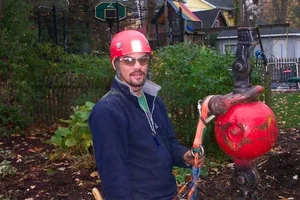
Here is how we usually do it.
17 ton screw pin shackle resting on top of the ball.
A 2' friction saver is laced over the shackle 'pin'.
A steel locking carabiner is inserted in the shackle pin 'eye' and captures the friction saver, to prevent the shackle pin from unthreading.
Norm could you possibly post how your worker or yourself tied into the crane. Do you have any pictures of that setup. I want to see how you guys do it.
Thanks.
[/ QUOTE ]
Here is how we usually do it.
17 ton screw pin shackle resting on top of the ball.
A 2' friction saver is laced over the shackle 'pin'.
A steel locking carabiner is inserted in the shackle pin 'eye' and captures the friction saver, to prevent the shackle pin from unthreading.
Attachments
New threads New posts
-
test
-

-
-

-
First time rope and harness tree climber shows the best attitude
- Started by moss
- Replies: 7
-

-


