cow hitch vs. timber hitch?

I'm sure this has been discussed before, but i can't find it. Does the cow hitch have a stronger braking strength then the timber hitch?

I know the CH is a very secure hitch....if your anker point would to twist around it does'nt come lose very easily compeared to the TH.

Jelte
 
I would expect both hitches to be the same strength.

I learned the Stilson Hitch back around 1990. I've since learned the cow hitch and the Stilson are the same hitch. Am I correct?

Dan
 
i think of a Stilson as a muled Cow.

i think Dan is write on the strenght point; more security in stilson, but a well placed finish on timber could be more secure than unmuled-cow.

Timber security is best i think if from a standing part pull at 12o'clock that traces CW, wraps around 12 and reverses (Backhand/Muenter) and then cylces around CCW to get main tightness pinch/security at ~ 5o'clock. from a 12oclock pull, 6 being greates pinch, 5 &7 next runners up, but secured at 5o'clock, to slip out bitters would have to loosen about tighest positon, travel uphill and to a point of greater tighteness at 6; so jammed well! If secured at 6, freedom is down hill, to a less tight position at 7. secured at 7, is on downhill side of 6, and able to move towards 8,9 of less tightness. This is given convex host anchor at these points.

i take both of the hitches to be of the Backhand Hitch (Muenter on anchor) family; but with different finishes for the bitters.
 
[ QUOTE ]
I learned the Stilson Hitch back around 1990. I've since learned the cow hitch and the Stilson are the same hitch. Am I correct?


[/ QUOTE ]

Yes. Ashley shows the cow hitch in several places (eg. #1802), but I couldn't find any instance where he showed it backed up with a half hitch. I <u>think</u> that ArborMaster first introduced that.

The story that I heard about the name 'Stilson" is that someone by the name of Stilson tied the hitch, thought that he was the first to have done this, and named it after himself. The name got some publicity, but was denounced by guys who had known it for many years prior as the cow hitch. I remember Don Blair railing about the name Stilson in talks and private conversation.

Funny, I also 'invented' that hitch years ago to use instead of a clove hitch for tying on gear in the middle of a line.
 
Interesting

The only way you'd really know would be to set it up and test it in the appropriate machine.

Personally, I think they breaking strength would be the same but for security the CH would be infront.
 
[ QUOTE ]


Yes. Ashley shows the cow hitch in several places (eg. #1802), but I couldn't find any instance where he showed it backed up with a half hitch. I think that ArborMaster first introduced that.


[/ QUOTE ]

If I remember correctly in 1990 I was told that the name 'Stilson' came from bastardizing the two words 'still set'.

Was ArborMasters around in 1990? I didn't think they were. At any rate I was taught the Stilson which includes the half hitch, sometimes called the 'better half'.

Dan
 
[ QUOTE ]
I think that Ron Denise (sp?) from Charlotte Rigging started the whole 1/2 hitch Stilson Hitch thing. I too remember Don Blair talking about the whole fiasco.

[/ QUOTE ]

A week ago I spent some time with Don. He said that Ron used the name because the learned it from Stillson and didn't do any name-research.
 
i kinda maid up a story that Stilson meant "Still set Son" to some guys around 'ere, from that rumor about the name you were talking of!

i all ways thought that the better half deal was about trapping the half/bitters under the main line pull; that pinches into the tree/anchor/host. Whereby, it is generally shown as half hitches around the 'loose' tail/standing part/throat to the device (porty/pulley etc.).

Using a round turn and 2 half hitches as thumbrule standard for security; generally recomend 2 half hitches behind any turnset of a round turn (which could be a roundturn, crossed turn, or backhand hitch strategy base as all the same amount of turns as roundturn). But, like a muenter, a backhand hitch about snubs out any force, so extending it to a cow, is about there, and a single half, instead of 2 half hitches (like for locking off other strategies) seem to be the standard.
 
Tree co wrote:

[ QUOTE ]
Was ArborMasters around in 1990? I didn't think they were. At any rate I was taught the Stilson which includes the half hitch, sometimes called the 'better half'.

Dan


[/ QUOTE ]


Tom D. wrote:

[ QUOTE ]
[ QUOTE ]
I think that Ron Denise (sp?) from Charlotte Rigging started the whole 1/2 hitch Stilson Hitch thing. I too remember Don Blair talking about the whole fiasco.

[/ QUOTE ]

A week ago I spent some time with Don. He said that Ron used the name because the learned it from Stillson and didn't do any name-research.

[/ QUOTE ]

I don't think AMT was around in 1990. Any idea when the half hitch was introduced and/or who introduced it? Was it called 'a better half' in 1990? Or was the cow hitch just terminated with 'a half hitch'? I did think that AMT had introduced the term 'better half'. But maybe not. I'd be interested in any references. 'Better half' means that the half hitch is tied so that the tail of the half hitch finishes in the opposite direction from which the tail came through the bight.
 
i think mostly just the first loaded bend gives the weak link in chain.... The point of most load X most bend. Whereby, the same load feeding into the same BackHand Hitch/Muenter that is the base configuration of the Timber and Cow; would give same braking tension. Just as in rapelling, the amount of force after the muenter is minimal. The BackHand Hitch base strategy having a larger host mount, for stronger and more force reduction.

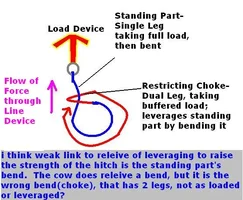
i think the bend that we would watch is the standing part's bend, forced by the backhand choke's leverage over it. i don't see how that changes the teepee here. As the teepee flattens to bend standing part more, then leverage is raised.

i don't think that the larger turn of the choking bight of the BackHand hitch around an extra rope diameter is determinant in most cases. As it doesn't affect the angle fo the standing part, but rather the choke that has leverabge over the standing part.
 
[ QUOTE ]
Like Jelte said, because the cow hitch bight bends around 2 parts of rope, I think it would have a higher breaking strength. Foe me, it's also easier and faster to tie while in a tree.

[/ QUOTE ]

I would think the same Norm. I always thought that more parts of rope in the middle of the "pinch" means a better WLL?
 
Good concept, but here i don't think it softens the leveraging of where hitch will fail.

The line pull force from device enters cow at standing part, the choke leg bends that standing part leveveraging standing part. Also the choke leg is dual against vs. single leg standing part.

i would think standing part that is single leg, more loaded and bent by choke would be fail point. i think the extra leg of cow increases diameter, releiving leveraging agianst the choke. But, the choke doesn't carry the primary/full loading, the standing part does. The choke siezes/secures the standing part, and bends it in doing so. Scenario true, until Standing Part bends greater than 120; giving it more than 1x pull on choke(?)

If both legs carried the primary/full load-were of leverageable consideration of failure, that would be a linear or basket strategy i think. Not this choke or simialr backhand hitch.

Just my ever so humble opinion;
-KC
 

Attachments

  • 33665-CowLeveraging.webp
    33665-CowLeveraging.webp
    48.9 KB · Views: 145
Another way to see this, is a tensionless hitch. It doesn't matter if the size of the host anchor/mount is 4' or 5' in diameter, or how small a diameter the 'finishing post' is. What makes the superiour/ sometimes 100% tensile strength of the tensionless hitch is that the loaded standing part is not bent/leveraged.

Given that the primary host anchor/mount is not tooo small. The softening or elimination of an arc, to reduce the leveraging against the rope device, must be at the weakest link/position. This position is usually at full tension of the standing part's initial tensions, entering the first arc/bend; not subsequent ones.

i think the finishing bitters threading thru the choking bight of the cow, softens the choking bight's bend/arc; but this is not weakest link, where lacing breaks. The standing part's full loaded, then bent leg; is most leveraging/fail point. The choke, serves perpendicular to this loaded force in single standing part leg of line. So, the choke has leverage over the standing part; and is also a dual line; so i think is not the weak link.

Orrrrrrrrrrrr something like that!
/forum/images/graemlins/propeller.gif
 
[ QUOTE ]
I'm sure this has been discussed before, but i can't find it. Does the cow hitch have a stronger braking strength then the timber hitch?

I know the CH is a very secure hitch....if your anker point would to twist around it does'nt come lose very easily compeared to the TH.


[/ QUOTE ]
Were this a rockclimbing forum, one might find "braking" meaningful, as a belay
mechanism's aspect; the Crossing Knot / Demi-Capstan / Munter Hitch is used.
As for "breaking", in both cases (Timber/Cow), the SPart passes through a bight,
where greatest pressure is exerted. That 2nd dia of the Cow perhaps help round
out the bight, depending on what additional structure is added to the Cow,
and maybe this reduces the cutting pressure on the SPart. But note that it's,
as TreeSpyder argues, the bend of the SPart that's important, as well as what
pressures come to bear upon it.
To this point, I'd like to see the Timber H. version (Ashley's #1669) where the end
makes a round turn before it gets dogged under itself. This round turn should
spread the pressure on the SPart, and also--Prusik-like--provide some grip of
the SPart enabling the structure to be brought up snug to the object; AND it
would reduce the pull on the end working to UNdog it (recalling LuvNik's account
of dropping a load on a Timber H. that promptly spilled and really dropped the
load, fortunately to the owner's pleasure at such a dramatic landing (while LuvNik
needed a change of undies :-)).

Frankly, I find it amazing that Ashley shows NO securing of the end of the Cow H.,
although he does for the Clove, as the Cow will slip out quite quickly, unless
tied in pretty frictive rope (and around a non-slick object) or a ring vs. spar
or pile--the latter being of most concern to arborist use (i.e., relatively
large-dia object). Or if the hitch is tied in webbing, with the orientation such that
the end is aligned (beneath or atop) the SPart.
It's also a hoot to think someone might think the Cow a modern invention--a knot
so simple!

The "Cow &amp; Better Half" shown here:
www.treebuzz.com/forum/images/upload/9073-cow%20hitch2.JPG
can be made more secure by having the finish "Half" hitch encompass the Cow's
collar bight (so, bitter end backwards the crossings would be: over-over, under
(itself--red under red--), &amp; then UNDER the Cow bight to come around the block's
line. And no more tying, or at least NOT the dogging of the end that's shown above.
Untying this version best begins with prying off (away &amp; down from pile/tree) the
upper Cow collar leg, and then things should loosen up pretty easily.

Along these lines, let me here (you see it first?! :o) introduce what I'll call the
"Collared Clove" hitch. Easiest way to reach the knot (though NOT how to tie it)
might be to work from this image:
gpvec.unl.edu/files/ Knots/CloveHitchQrelease.JPG

With this slipped Clove, give the slip-tuck (bight) a half twist such that the left leg
is brought over the other, positioning the end thus between the wraps of the
Clove; now just reeve the SPart up through this slip-tuck eye, and snug up the bight.
As with the Better Half, the end here gets pretty well nipped by other parts, when
loaded.

*knudeNoggin*

 

New threads New posts

Back
Top Bottom