cougar rope diameter change

I just bought a new piece of cougar. 150 foot, pre-spliced with a tight eye. So I get the rope and think, boy this sure seems skinnier than I remember it. And sure enough, I compare it to a lightly used piece of cougar from a different source, same length and splice, and it is absolutely skinnier than the used piece. Looks like maybe 1/8th of an inch.

I call the vendor and eventually they tell me this is normal, that with manipulation any piece of rope is going to get fatter. In fact they say it happens almost instantly, yet the end of this new rope (just beyond the spliced part) is not fatter than the unspliced end.

Now I realize that some fuzzing of the outer fibers may make a rope appear slightly fatter, but the used cougar isn't fuzzy, and this is a significant difference. I can't say exactly how much because I don't have a way to measure it precisely in mm.

In my 30 plus years of experience I have never noticed any type of rope get significantly fatter with use. Does anyone out there know if this is normal?
 
Hey there buddy!

Were both ropes the same color? Sometimes the same rope in different colors needs to change diamater in order to maintain the same specifications. It has to do with the strength of each individual fiber strand when they're dyed certain colors. This was explained to me by sales reps from two rope manufacturers.

I've never had and ropes show up with significantly different diameters.
 
Thanks, guys. I thought my supplier was reaching on that one. I'll see how they treat me. I just can't use a climbing line that is as narrow as this one.

The ropes were the same color - the yellow and grey one.
 
[ QUOTE ]
......... Looks like maybe 1/8th of an inch.

I call the vendor and eventually they tell me this is normal, that with manipulation any piece of rope is going to get fatter. ........... I can't say exactly how much because I don't have a way to measure it precisely in mm.


[/ QUOTE ]

Ok, this has set off my BS alert, just need some more info.
First of all you are talking about the rope itself, not where the splice is right? In other words maybe some sample areas in the middle of the rope?
1/8 inch is about 3mm, if your rope spec is 11.7 when you purchased it that is huge. That would be like a 12.7 going to a 10! 25%??? Where did it go? Did your rope get 25% longer? or other way, 25% shorter? Ropes just don't fluff up 25% cause you took it out of the bag. Sleeping bags maybe but not a rope. Even that much fuzz would be huge but could create the illusion.

It would really help to have an actual measurement and I think you can do it. Take a dollar bill or paper about that shape, wrap it around the rope and mark it, measure that length and divide by 3.14 (pi). That will give you the diameter. We can easily take that number and convert it to mm. Do it to both ropes and see what the difference is. Maybe you got the wrong rope, or it was a manufacture defect etc.??? (unlikely but?) Something does not add up here. Maybe it just appears that way to you but until you actually measure it we will not know and inquiring minds want to know.
 
When a climb-line cover milks towards one end, the difference of the diameter in the line can be dramatic. I also know that ropes under the same name are sometimes built to different specifications depending on the country they are sold in. This is apparently due to varied standards that ropes must meet in other parts of the world.
 
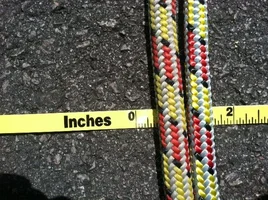
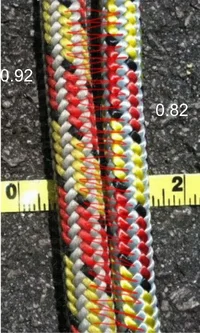
My estimates of the difference may well be wrong when I said 1/8 inch, and I am not very good at converting fractions to mm's, but attached is a photo and you can see it is very obvious. Thanks for the suggestion YoYo, and I will try to do an exact measurement.

Of course, I did take the photo from sections of both ropes that were not near the splices or near the other ends either ropes.
 

Attachments

  • 366303-cougardiam.webp
    366303-cougardiam.webp
    115 KB · Views: 130
Those do look like different diameters.

And easy way to get diameters is to hang the rope, add some weight to tension it a little then use a Crescent wrench or even metric/standard open end wrenches as calipers.

Is the weave pattern the same on both ropes? It looks a little different but it might be that you don't have them rolled so that the weave is UP in both.
 
Guy,

When looking at the two ropes, everything appears the same until you look closely at the length of the patterns created by the weaving process. To my eyes, the rope on the right looks thicker in diameter, but also "shorter" by the pattern. This could be from some milking, or normal usage.

Of course when a rope is bunched up to be shorter, it gets fatter. Could that be a potential cause? That beginning of the third pattern begins much earlier on the fatter tope than it does on the thinner in the photo.
 
You really have me curious now!


this is the rope, right?

Hanging a weight on the rope and then measuring is a great way to get a fair test. Maybe 10 pounds just to make sure it is straight etc.
The reason I recommend the wrap is that it will not be subject to flat spots or uneven rounding of the rope.
Plus I find it easier to compare as you are multiplying the dimension difference as well. 10mm vs 9mm = 31.4 mm vs 28.26.

Your rope is spec at 11.7 mm. On that paper it should measure less than 1/16 inch shy of 1 1/2 inches.

This just reminds me of when they tried to sell a little less than a quart of ice cream for the same price, hoping you would not notice it was no longer a quart. It is still a quart of ice cream, right?

So if the new rope is 11.7 we can go back to all the reasons a rope might get fat.
 
is your used rope spliced on both ends? Can you milk the cover at all? Anchor the rope by tying a butterfly in the middle (ish) and then pull on the rope letting your hands slide down the rope while maintaining a firm grip. Dose the cover milk on the core?

If both ropes are spliced on both ends could one cover be bunchier than the other?
 
I'm learning some interesting things here, you splicing experts are way ahead of me so indulge me in my learning curve.

Just did a few measurements on some different ropes.
Spent all my dollar bills tonight so I measured with a post it note, worked better anyway as you can pull it a little snug and get a good accurate measurement. Used a a digital micrometer for the actual measurement.
Poison Ivy, specs at 11.7 used measures 12.3
ArborMaster Blue Streak Line by Samson 12mm, used measures 13mm.
Sterling HTP 11mm used measures 11.7.

So I suspect that the new rope is as advertised and not stretched or made smaller.

Seems there was a conversation about the size of a rope specified for competitions a while back. It would be interesting to see what the judges say.
 
Keep in mind that all rope specs, one of the most important being breaking strength, are averages. Hence, safe working load measurements.

This is one of the reasons it is important when splicing and/or just using rope to stick close to the manufactures recommendations. They test numerous combinations to come up with the average to generate the performance criteria.

Be careful with averages. Half the people reading this are below average, on average that is!
wink.gif
smile.gif
 
Thanks to everyone trying to help me with this. The rope IS the grey/yellow/red Donaghy Cougar. The used rope and new rope are the same in terms of length (150) and only spliced on one end.

The used rope looks larger in diameter than the new one pretty much along its entire course. I specifically took the picture of these ropes away from all four ends to avoid any distortion from splicing or milking. And as you can see in the photo, the used rope is not fuzzed from use.

The used one has not milked, but probably hasn't been used to a height of 70 feet very often (in other words, has not had its entire length stretched often). I haven't tried to milk the new rope or use it in any way because I am going to return it.

I find your study very interesting YoYo, regarding the increased diameter on three different brands of rope. Can't say that is something I ever noticed, and it sounds like for Nick and Tom it is very rare. I also appreciate your help with the math on converting the inches to mm. Don't wanna know how you lost all your dollar bills, though!
grin.gif


The good news is the vendor (who I will now say is Sherrill) has been totally agreeable to switching this rope out for me. Let me add that years ago I had problems with herniating 10mm Beeline and they made that right too.

I will measure both ropes and post the results.
 
I've handled many kilometres of cougar and would say the one on the right looks normal to me, as it generally would off the reel. The ratio of the patterns just look right.

That said i do think it's a "small" 11.7....as in more like 11.5.

I do think they tightened it up though, a few years back it seemed bigger.
 

New threads New posts

Back
Top Bottom