Come along vs block & tackle

Which do you prefer?

  • Come along

    Votes: 11 61.1%
  • B&t

    Votes: 7 38.9%

  • Total voters
    18
3:1 and 5:1 gets used more than maasdam for me.
I like the maasdam but I have a hard time guesstimating when I’m approaching that 1500lb limit and I worry about breaking a tooth off that little cast aluminum wheel or gear on it. I don’t remember where, but I know I’ve seen pics of broken maasdam before.
If I use the maasdam, it’s pulling on a 3:1 or 5:1 with a prusik on the MA for progress capture. If the maasdam completely fails, the tension won’t be lost.
 
We pulled a couple overhanging primaries with a 12:1 a week ago and have been way down the rabbit hole of what to buy/make for future sketchy shit. Photos won't load as per usual.
 
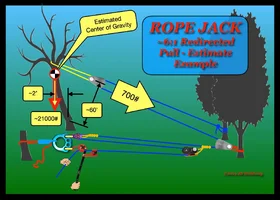
Example of one Pull-line force estimation method: estimated weight of tree 21,000#, horizontal distance from estimated center of gravity to hinge 2', estimated perpendicular distance from pull-line to hinge 60'.

The tree rigged in this manner is similar to a lever at approximately 30:1 (60/2) moving the 21000# with 700# pull. A Rope Jack through a 6:1 Mechanical Advantage is capable of approximately 3000# pull. So, the pull in this example was deemed adequately safe and well within the capacity of the rigging lines and the Rope Jack.

So far, over the years, this has proven to be the simplest RJ/MA "max-pull" kit to ease a heavy-back-leaner to the 'lay'. DWT x Z-rig = 6:1 (redirected)

This is my preferred pull for a heavy back leaner or for pulling a tree though a thick canopy. Rope Jack x 6:1 (redirected) = 30:1. So, 100 pound pull on the Rope Jack yields ~3000 pounds pull on the bare tree, on the left.

I use variations of this for pulling over heavy back-leaners. The 3:1, or the 2:1, or both are eliminated if not necessary for lighter loads.

Note: I make the yellow sling, in the diagram. It is a long hank of rigging line tied with a Zeppelin Bend and is long enough so the hardware is usually out of the way when the tree hits.

I use to use a base tie. But, half the time the tree would roll onto the rope and bury it deep under heavy wood. The yellow "long-sling" is long enough, so, even if the tree rolls, it usually does not seriously trap the rope since it's at the lighter-end of the tree.

Another advantage of a long-sling is it can include several branches to good effect. This is especially useful in a thick conifer. Simply throw the line high around both sides and tie the ZB on the far-side; install the block & pull. rj.webp
 
Example of one Pull-line force estimation method: estimated weight of tree 21,000#, horizontal distance from estimated center of gravity to hinge 2', estimated perpendicular distance from pull-line to hinge 60'.

The tree rigged in this manner is similar to a lever at approximately 30:1 (60/2) moving the 21000# with 700# pull. A Rope Jack through a 6:1 Mechanical Advantage is capable of approximately 3000# pull. So, the pull in this example was deemed adequately safe and well within the capacity of the rigging lines and the Rope Jack.

So far, over the years, this has proven to be the simplest RJ/MA "max-pull" kit to ease a heavy-back-leaner to the 'lay'. DWT x Z-rig = 6:1 (redirected)

This is my preferred pull for a heavy back leaner or for pulling a tree though a thick canopy. Rope Jack x 6:1 (redirected) = 30:1. So, 100 pound pull on the Rope Jack yields ~3000 pounds pull on the bare tree, on the left.

I use variations of this for pulling over heavy back-leaners. The 3:1, or the 2:1, or both are eliminated if not necessary for lighter loads.

Note: I make the yellow sling, in the diagram. It is a long hank of rigging line tied with a Zeppelin Bend and is long enough so the hardware is usually out of the way when the tree hits.

I use to use a base tie. But, half the time the tree would roll onto the rope and bury it deep under heavy wood. The yellow "long-sling" is long enough, so, even if the tree rolls, it usually does not seriously trap the rope since it's at the lighter-end of the tree.

Another advantage of a long-sling is it can include several branches to good effect. This is especially useful in a thick conifer. Simply throw the line high around both sides and tie the ZB on the far-side; install the block & pull. View attachment 62391

Great illustration!

What is the relationship between the 21000lbs. downward force of the tree, 2 ft. horizontal between cog and base, and 700 lbs. applied MA? How do you know how much ma you will need and how much force the tree is putting out on the opposite vector?
 
Great illustration!

What is the relationship between the 21000lbs. downward force of the tree, 2 ft. horizontal between cog and base, and 700 lbs. applied MA? How do you know how much ma you will need and how much force the tree is putting out on the opposite vector?

It's fairly simple mechanics. The perpendicular distance from the "gravity-vector" of 21,000 lbs to the pivot-point (hinge) is 2'. That can be expressed as a counter-clockwise moment of -42,000 lb-ft . That is balanced with a "pull-vector" of 700 lbs at perpendicular distance of 60' to the same pivot-point. That is a clockwise moment of +42,000 lb-ft. So, anything over 700 lbs on the pull-line will 'ease' the tree to the intended lay.
 
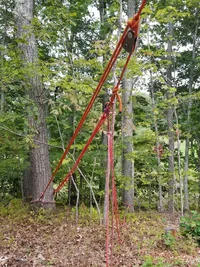
20190914_110921.webp

20190914_111042.webp

Whaddya think the MA is?

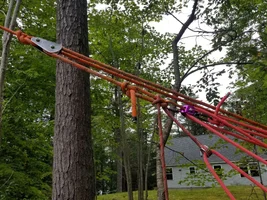
Orange line tied to victim tree, down to pulley at base , up to pulley midline. Then pink line is 5:1 with the rigging ring set up incase more power was needed.
 
Last edited:
It's fairly simple mechanics. The perpendicular distance from the "gravity-vector" of 21,000 lbs to the pivot-point (hinge) is 2'. That can be expressed as a counter-clockwise moment of -42,000 lb-ft . That is balanced with a "pull-vector" of 700 lbs at perpendicular distance of 60' to the same pivot-point. That is a clockwise moment of +42,000 lb-ft. So, anything over 700 lbs on the pull-line will 'ease' the tree to the intended lay.

Where did you learn that? Is this a Beranek thing?
 
Very nice SingleJack !

Do you have a toolkit can share for making that drawing?
i try to view as hinge as pivot
tree as weightless lever
CoG as force needs fought.
>>wedge, rope as added inputs thru framework of tree as force points to fight/join etc. CoG
.
Backleaner must crank CoG uphill until peaks over hinge pivot;
>>so can ride down on the splash down side, down hill from hinge pivot
>>height of tie off matters(increasing multiplier height from pivot), and angle of pull line(decreasing multiplier < 1)
.
Benchmark @ Hinge compressed pivot part as central command that itself bears more than any other point:
pure inline downward 1 dimensional forces directly down it (cosine of CoG)
+leverage of lean(sine of CoG x potential length from pivot)
+leverage fighting lean (simple motionless model)
>>pull line decreases(or increases if not back leaner) this factor as takes over fight gradually
That is in now a 2 dimension model lean across round stump
.
Specialize support to strip hinge that is not magic round, equal leverage both dimensions across
AND then put in side lean brings problem to 3 dimensional.
>>cosine only used on column upward against gravity straight over pivot of 1 dimensional forces
>>all else, the other 2 dimensions is it's 'non' of cosine inline column forces, use sine for other 2 dimensions and include potential length from pivot.
 
Pulling rig only (even with truck) w/o come-along, has advantages of feel and continuous direction; not 're-loading' anti-target , free-spool direction of come-along etc.
.
Prefer prussic more for safety than rope connection if can; unless taking over a tensioned line.
OR other tensioned line like compounding pulley systems by insetting one inside other rather than that pull pulling outside of system on separate anchor.
>>prefer pull from termination of eye, bend etc. rather than friction hitch for lengthening lines.
>>if prussic as extension refer safety knot 'below' prussic.
.
Have system for setting prussic of dressing well, pulling hard at right angle to host, then against proposed angle of pull, then folding down, perhaps even grooming looser to start in proper direction of pull. If on slack line like slip knot below, then even cheat to give prussic slight support, especially after internals of prussic seated so well previously.
Prefer Prussic duall pull to harder tension host, for prussic to be 50-75% and perhaps stiffer cord to grab tighter tensioned line.
.
Truck pull into 3:1 usually plenty of horses into leveraged arm multiplier.
>>truck should be loaded with weight over rear drive, and gas on good ground with clear run
>>favor lower redirect so pull forward doesn't pull upward on truck losing traction as trying to increase tension so must fight both with truck. lower angle during pull to truck asserts truck force to line more than upward.
5:1 pulled by 1 or 2 ton truck rating into long arm would take to crane etc. as next move; possibly before. If 3:1 to strong truck good traction w/run into 40' arm lever not doing it probably time to back off and go to other strategy; rather than tweak up i'd think. Even if can do it, way out of the league ..
 
Last edited:

New threads New posts

Kask Stihl NORTHEASTERN Arborists Wesspur TreeStuff.com Teufelberger Westminster X-Rigging Teufelberger
Back
Top Bottom