CoDominate Branches

trees do need pruning. Suburban trees... they will reach for the sun and keep on reaching, til they can't support themselves if someone doesn't stop them..

That'd be YOU! REDUCTION PRUNING...

nasty year it was for summer limb drop... almost killed a few of my clients and their children/grandchildren..
 
So many "expert" arborists that are so convinced they know better than the tree what's good for it, and can "help" it with a chainsaw.

When the brutal truth is they're far better off without us around at all.

jomoco
 
[ QUOTE ]
So many "expert" arborists that are so convinced they know better than the tree what's good for it, and can "help" it with a chainsaw.

When the brutal truth is they're far better off without us around at all.

jomoco

[/ QUOTE ]

in many cases yes... We all see it.. trees with big white cuts made by someone who either has no idea how much harm he has just done or doesn't care.. he's just in it for the $$$... I have a friend that readily admits, he cares nothing for trees... such is (his) life...

But trees like this one have simply had too much room to grow for their own good... this one could have easily been saved with a good cable and regular pruning.. say every 4-5 years..

http://youtu.be/BbM5KcyIa5c
 
Thanks Kevin; that was it. One reason (Objective) that is nearly constant is: Maintain structural integrity (aka avoid damage). But maintaining other contributions does weigh in.

At this point, the thread gets pointless without pics; other variables affecting decision include exposure, condition, compartmentability of species, and objectives like wildlife, screen, timeframe (are we thinking 1 year or 100?), future mtc etc etc.

mattheck sells a gizmo now--attached--with a 25 degree angle that supposedly defines the max. problem angle for codoms. Our (human?) desire to rely on numbers in lieu of systematic thinking is disconcerting.

Daniel's vid shows a typical example of why urban TREES NEED PRUNING, FOR THEIR OWN SAKE so they do not fall apart. When the canopy is not closed, sprawl and instability happen. We make these edge trees by clearing. We are responsible for the consequences.
 
[ QUOTE ]
So many "expert" arborists that are so convinced they know better than the tree what's good for it, and can "help" it with a chainsaw.

When the brutal truth is they're far better off without us around at all.

jomoco

[/ QUOTE ]

I hear what you're saying, jomoco, though I would say that the 'forest' would be better without SOME of our influence. Individual tree defects are part of a healthy forest because of the habitat they can/do create, though once these issues exist where a target is present, then we suddenly DO know best.

I would suggest reduction if cabling is not an option. Consider CODIT and keep wounding at minimal diameter over a broad area.

The nature of a codom has me interested when I think of the possibility of grafting the tissue together, leaving the inclusion behind. Might be a good idea to keep some of these 'defects' around until new knowledge and technique shakes things up!

Got Wulk?
 
[ QUOTE ]


[/ QUOTE ]
Without a good reason there is never a reason to prune a tree.
Pruning a tree just because of having co-dominant branches is NOT a good reason.
Most trees rely on multiple or co-dominant branches as their natural form factor.

So, can you tell us what the real reason is for pruning? That way we can help you finding the correct answer.

[/ QUOTE ]

The first sentence is dead on. Pruning to make money does not make sense for the tree, but rather for the businessman.

As for natural growth form, multi leaders are associated with various species and open grown trees. As arborists we are often dealing with trees very different from "natural".

I like the idea of pruning a tree at planting and then every 3 to 5 years after. This helps to insure your cuts are of minimal size and in active wood.

Unfortunately the reality is that many (most?) people only call after the problems have developed and too much time has passed. Thus the decision to make large cuts, prune, or leave well enough alone.

[/ QUOTE ]


^^^Bingo! This is what I tell my clients all of the time. Proper structural pruning should be done from planting to ensure well developed branch balance and compartmentalization of pruning cuts in the long-term. If you want to thin out some smaller co-doms on say a 25-30 foot Autumn Blaze or Linden(which are notorious for many co-doms, and heals faster than most trees) then fine. But getting into total subordination of anything larger than 4" is bad arborcare IMHO. A well placed cable(s) is far more beneficial to the tree long-term in most situations when confronted with larger co-doms/weak crotches.
 
Thanks again KTSmith, Guy and others.
I was hoping to see more variables reduced in both studies. Lots off good info.

I will be more considerate of my pruning this winter.

On a veteran tree in less than typical vigor, I still see the response is better when pruned in the winter than if I were to prune it in the growing season. Hazard prune/crown reduction.
I know we are still missing alot of science. In time.
I plan on getting into the "Hollowed Old Silver video" Silver this winter. I will guess everything will be fine just like many of the trees I have reduced over the years.
Lil to no decay and no dieback at the wound.

Stem traces I do on occassion almost always dissappear.

Guy have you been experimenting at all with stem traces?
Stem tracing a competing codom is a valid practice imo.
Cheers
 
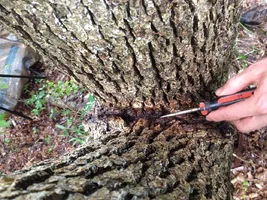
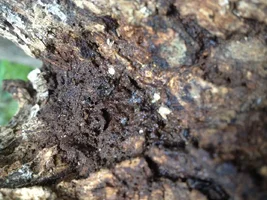
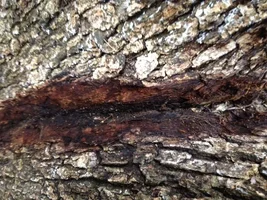
"stem tracing"? ok; accurate enough...i prefer "scarification" but that term is not familiar to many. here's a codom q alba that got flux infection last summer so i had 2 reasons to trace the inclusion. i'll get a new pic tomorrow tho i doubt there has been much response since aug 18.
 

Attachments

  • 347782-stemscrapebefore.webp
    347782-stemscrapebefore.webp
    243.3 KB · Views: 70
Guywanker you really should stop taking terms that have specific definitions and creating new ones for them.

People with forestry and propagation backgrounds know what scarification is.
 
I think reduction of codominant leaders and overextended limbs is the most important pruning we can do. There is a big difference between the forests our trees evolved to exist in and the sites we grow them in. Codominance and inclusions are not as big a problem within a protected canopy as they are in an open grown tree in the landscape. And that is without even taking the risk associated with potential targets into account.
Guy, is stem tracing mentioned in ANSI standards?
 
[ QUOTE ]
...the benefits to the tree of leaving the stub or subordinated limb... sometimes HEAVILY subordinated..


[/ QUOTE ]

I'll happily go for this option.
 
Specific,...to who?

To a planter, scarification is done to a planting hole to to help make the tree roots grow.

To a propagator, scarification is scratching a seed to make it grow.

To a woody plant technician, scarification is scratching off dead bark to make the tissue underneath grow. but Ropeshjield is right; it is simply tracing! Thanks, eh! lightbulb moment

To a dermatologist, well...
but still, many terms have different uses to different users.
funny we wrote same thing same time. "Tracing inclusions" which "removal of (compression-) damaged tissue" is really a kind of crown cleaning, pruning, tracing is what we are talking about; A300 terminology, anyone can follow.

here's the bubbly "frothy flux"; a bit late for the new year.
 

Attachments

  • 347796-stemscrapebeforeoozecorner.webp
    347796-stemscrapebeforeoozecorner.webp
    152.4 KB · Views: 51

New threads New posts

Back
Top Bottom