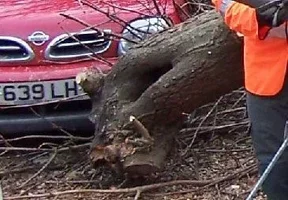
Pollarded my a**.
That thing wasn't pollarded.
It looks like it was repeatedly topped and the topping it is what did rot out the tree.
People doing topping like to try to use the term pollarding to describe topping. Because true pollarding is an excepted (but intensive) form of trimming. Topping is not.
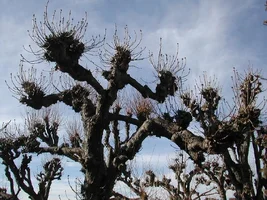
True pollarding, creates a tree with NO rot or large wounds. I true pollarded tree will have large round "heads" at the end of the branches.
The very first time the tree is cut, the cut is made to the material that is no bigger than like 1 1/2 inch diameter. (I think that's the size anyway, going from my memory). This diameter is small enough, that it heals over, and resprouts from that stubbed end. You cut these sprouts off at where they emerge at their collar, in like two years, before they get too big in diameter also. Then they heal over quickly. After this is repeated over time, the tree has huge looking "heads" at the ends. No rot gets in the tree.
Pollarding is very labor intensive. These art like trees are healthy and can live 400-500 years or more if the process is repeated all that time.
I'm tired of hearing people call topping as pollarding .
Topping is wrong.
Pollarding is not (although labor intensive and constant care needed).
I have never done or seen a true pollarded tree in person, only in pictures.
I'd like to try two Crape Myrtles or two London Plain trees sometime at my house though. And I just hope my kin and grandchildren continue with them.