Catalpa help

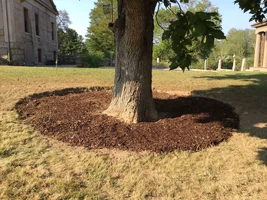
I have a question...can Verticillium Wilt be introduced through landscape mulch? I know you don't want to mulch with chips from a tree with V.W. ...but what if those chips go to the grinder and so on.
I don't want to highjack this thread, but I am curious what peoples thoughts are...

Oceans, Now that you have that branch in your hand you can grind it up and spread it around 1 of the other 3 Catalpas to see if it develops Verticillium Wilt. It's always nice when you have some test subjects on the same property.

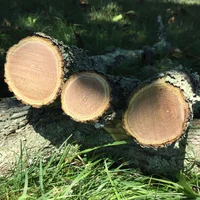
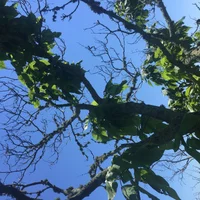
I'm not seeing any sign of VW in those cuts, but that picture of the limb in the tree... is that new growth out there on the tips?
Yes, that is new growth, but it has been chlorotic and slowish to do anything.

I can't imagine how many roots this tree has lost this year due to the changes. Kind of heartbreaking, Jon.

I'm going in for a cleaner cut for Kevin to observe. I pruned out material on Sunday and it's been staged to chip, so both pieces are still available for diag.

Maybe I need to put a new blade on the handsaw for that mirror cut. I hope to be air spading by the end of next week.
 
Thanks, Guy, though perhaps my post wasn't clear enough...The crack is in a lateral branch, and that branch is located halfway up the defoliated parent stem.

But this is why I put that previous post together. Perhaps the physical damage may be related to the defoliation of the lateral branch and the parent stem?
 
Alright guys, thanks for everyone's input this far. Here's an update.

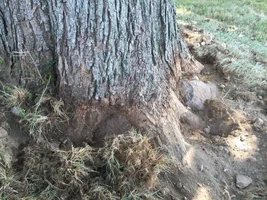
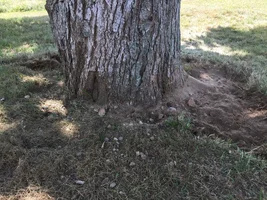
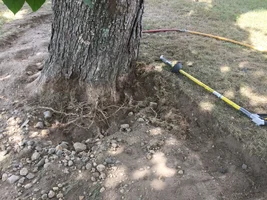
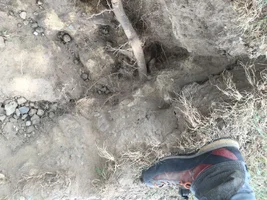
I spent a couple days finding the root system and evaluating the overall grade change. This tree has had at least 1/2 of the root system smothered with severely compacted material. I can't imagine any water getting to the roots beneath this at all. In some areas, I've removed over a foot of fill to reach the previous layer of turf. I cut trough and removed the buried layer and de-compacted further below. I've mulched with composted wood chip.

After this dose, I've discussed the potential for uncovering more of the roots in the most impacted areas. Much is hinging on the input from the landscape architect and client.

Exposing the South side:
image.webp

Working around to the North side (Callus is due North). West side was not terrible:
image.webp
Working around the East side (E and NE were covered most):
image.webp

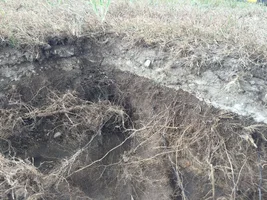
Soil profile on the North side. Over a foot of fill above previous turf. Fill was dense 8" layer with 4" loam above:
image.webp

Gross!:
image.webp

Looking much better. View from South:
image.webp
 
Last edited:
Looks great. That should work wonders.

It appears that the contractor used fill to raise the grade. I bet the grass is struggling. If you can sell it, offer an application of composted cow manure or a high quality topsoil to amend the grass at a depth of 1/4 per year, raked in. Lots of work. Great results. If anything, try to do this around the tree. Use 2 yards and that should cover a 15-20' radius.
 
Eric, this is fantastic. I appreciate you sharing these photos and details. That one photo of the fill on top of the original turf should be published! It's an incredible example!
 
airspade catalpa.webp

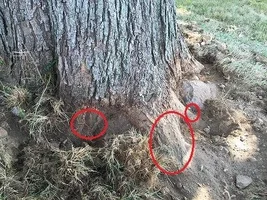
What did this injury circled?

Horrible looking fill--the less, the better!

Is that as far out as you went? Making holes every 1-2' to the dripline might be just as important as what you did already.
 
Last edited:
What's really gross is that the clients are tree lovers, and Eric has been caring for their trees for years. Somehow they just let this happen without an arborist' input. GROSS!

Tom
 
View attachment 33251

What did this injury circled?

Is that as far out as you went? Making holes every 1-2' to the dripline might be just as important as what you did already.

Injuries you circled? Hard to tell for sure. A good portion of the film material was coarse, jagged stone. I also found brick. Pretty gnarly stuff. There's possibility for all sorts of cause from the contractor pushing it into place with a dozer to me getting behind bark with the air spade at a bad angle. The process only brought up one small fleck that I noticed but it is possible I did it all. The site was very dusty...enough to make overall visibility difficult during the process. I was as careful as I reasonably could be. Hopefully I did more good than harm.

As far as de-compacting further out by means of popping holes, I'm awaiting further word from the client and their landscape architect. I'm told they will discuss the issue and decide how much further to go with re-grading. If I can't go any further, simple hole popping will be next.

Sadly, the altered driveway entrance elsewhere on the property has impacted a Walnut and Elm tree. Word is the designer thought these trees accentuated the entrance. I don't know what sort of plan there was to follow, but both those trees are presently smothered in soil. Not pointing fingers, just sad when so many contractors designing and working in a landscape can create some reduced value to the very things they tried to enhance.

Looks great. That should work wonders.

It appears that the contractor used fill to raise the grade. I bet the grass is struggling. If you can sell it, offer an application of composted cow manure or a high quality topsoil to amend the grass at a depth of 1/4 per year, raked in. Lots of work. Great results. If anything, try to do this around the tree. Use 2 yards and that should cover a 15-20' radius.

In the areas with such poor fill material, I can't imagine any moisture making it down to the roots below without significant decompaction, even with a top dressing of compost to boost tree root health. The fill is so uniform in dimension that it seems to pack tightly. I'm uncertain as to how many of these roots will ever survive this situation without uplifting all that was put down. Though I can imagine that compost over turf will work very well in areas without altered grade. We've had good results with compost in the past, though it was more often amended into the soil during backfill. Thanks, Tree Frog.

What might be nice is seriously deep vertical mulching here.

What's really gross is that the clients are tree lovers, and Eric has been caring for their trees for years. Somehow they just let this happen without an arborist' input. GROSS!

Tom

Hopefully situations like these are good wake up calls for everyone involved. Sad that trees take the brunt of it all.

 
" There's possibility for all sorts of cause from the contractor pushing it into place with a dozer to me getting behind bark with the air spade at a bad angle. The process only brought up one small fleck that I noticed but it is possible I did it all. The site was very dusty...enough to make overall visibility difficult during the process. I was as careful as I reasonably could be. Hopefully I did more good than harm."

I expect so but yes that looks like airspade damage. Best to clear the flare manually first. Despite resistance from the corporate crowd, who just wanted to say "follow air tool mfr directions", that's why A300 Part 8 (I think you got a copy a couple of years ago ;) courtesy of ShelterTree) has :
Sample specifications Root Collar Examinations using hand tools
Scope: Trees with fill contacting the trunk.
Objective: Avoid damage to the tree from the effects of fill on the trunk. Lessen risk and maintenance needs, improve health. Provide maximum vitality health and safety.
Specifications:
  1. Rake any coarse woody debris or fresh mulch away from the root collar area.
  2. Press the blade of a shovel or a trowel against the trunk. Slide it carefully downward until resistance is met.
  3. Push the handle toward the trunk, moving the blade away from the trunk.
  4. Remove individual adventitious roots <1 cm and stem-girdling roots <1/10 trunk diameter. Manage larger roots per A300 (Part 8), 83.4 and 84.4. Avoid contact between the trunk and any remaining adventitious, girdling, and circling roots.
  5. Lift the fertile material away from the trunk and set aside.
  6. Separate and dispose of any infertile soil and debris. Retain the fertile soil, fine roots, mycorrhizae, and decomposed mulch.
  7. Repeat until trunk and flare are clear, down to the root collar, where buttress roots divide. Use hand tools, or compressed water or air, to clear the root collar.
 
Thanks for posting this information, Guy. You are the man. Though I might add that even the shovel technique can put sensitive tissue at risk. I can imagine the tip of a shovel getting underneath a fleck of bark and causing damage while prying away. We do our best, with what we know and what we have, and we learn as we go. Thanks for being here through my process.
 
I thing you are right about the fill being a serious barrier. How about getting a sod cutter over there and doing some radial trenching with vertical mulching between the spokes. You could back fill with a course sand and topsoil/compost mix.

Side note: Has anyone tried radial trenching using just the width of the airspade? This way you do not have to remove turf just backfill and tamp. Instead of a Mag wheel you get an actual spoke wheel.

Keep up the good work!
 
Has anyone tried radial trenching using just the width of the airspade? This way you do not have to remove turf just backfill and tamp. Instead of a Mag wheel you get an actual spoke wheel.

Thanks for the input. I haven't tried Radial trenching with a spade though I imagine it to be fairly easy.

It's hard to explain the technique I use with the Spade, but I'll try...I use the 45 degree angled tip at the end of the Spade. I cut a sweep from left to right. The first cut gets me ALL jacked up with soil and dust, but once I have a "wall" established, I slowly walk backwards and the soil is deflected off the wall and away from me.

It's counter intuitive at first, but if the Spade tip points away from you, soil gets deflected right back into your face. I can imagine the other method working for a thin trench.
 
Still seeing some dieback this year, and perhaps it's expected if the tree is finding a balance with a certain percentage of root loss. I had another local arborist take a look and he suggested Verticillium Wilt.

I'm not seeing any discoloration beneath the bark that would suggest V. Wilt, but thought I'd post up again. Any questions or comments are welcome, especially from the likes of @KTSmith and @guymayor.

I'll post up some photos ASAP.
 
Again, maybe I'm just blind but I'm not seeing any discoloration that would truly indicate V. Wilt, unless it can be very subtle. I do have a color weakness of my eyes...

Also, areas that were bare last year have sprouted back with a bit of vigor...glad I left things alone that were somewhat questionable. I'm still hoping this is just a response to root loss and not a pathogen brought in with the imported soil.

If anyone sees anything worth noting, please chime in! :)

image.webp image.webp
 
Verticillium is not always accompanied with vascular streaking.
Thanks for chiming in, Mr Tree. In your experience, what might be some other tell-tale signs to look for that may or may not be published?
 

New threads New posts

Back
Top Bottom