Break Testing

[ QUOTE ]
Hello again,
Tested a few more Bowline variations in something of a hurry yesterday. You'll find a video of one of the tests at:
http://www.youtube.com/watch?v=fpt6nxgAOEI

[/ QUOTE ]
Thanks much for your efforts. It's eye-opening to watch these videos
(ditto for the OP's).

[ QUOTE ]
and a "Mirror" Bowline at the top. This latter is a Locked Bowline variation in which the end emerges from and reenters a Ring Hitch structure, instead of a simple loop.

[/ QUOTE ]
An only partially fair description; and, alas, what is shown bears little
resemblance to that. The loading --esp. the initial, light loading--
should show the Cow hitch (ring hitch) in obvious form, spread open
by the tensioned ends of it going opposite directions; but there is
nothing like that in the video.
(cf. e.g. the photo shown by Gary Storrick:
http://storrick.cnchost.com/VerticalDevicesPage/Ascender/KnotPages/KnotHitchSeries.html
-- see how the blue cord's Cow hitches are oriented?!)
And my photo above presenting it showed a clear form, which in that
same grey 5/16" Spectra (900?) I've loaded to my most w/the crummy
5:1 pulley and can attest to the form's stability of geometry/appearance
(that shown & just loaded even w/o the finishing, 3rd tail tuck).

Moreover, one can see the moving S.Part turning around the higher
surrounding of the end, which isn't the case in the Mirrored Bowline.
So, I can't make out what IS in the video, but I more surely can't make
it be a Mirrored Bowline.
As for the "partial" fairness of that description, the name is "Mirrored"
and chosen because in fact the knot is as though mirrored along its
axis of tension by a mirror placed perpendicular to it at its center,
which requires its construction include a third tucking/pass of the
tail through the two turns of the Cow hitch, forming a collar around
the one eye leg, and emerging in the direction of the S.Part
(also clearly not the case of the tested knot).

As for the lower end, that is shown only late in its demise.

[ QUOTE ]
the much-vaunted "Enhanced" variation is crawling right out. ...
So first, the mushy term "Enhanced Bowline" really means, in this context, "Extremely-complex-to-tie-but-with-no-advantages-Bowline".

[/ QUOTE ]

To be clear, I'll reiterate: the "Enhanced Bowline" is H. Asher's name
for what you described as being the knot subject of your first video;
though, in fact, what you showed there was Ashley's #1013, Dbl.Bowline.
It's an agreeably apt appellation for any bowlinesque knot such as we've
explored here (though I'm trying to myself be consistent in using the
term "bowline" specifically for a certain kind of structure, and seeing
how well I can manage with that).

*kN*
 
Allmark, your bust-the-Amsteel video shows a nice long piece
now broken (somewhat) with maybe 20' towards an eye splice(?)
and then a longer (?) tail. Just to be sure, is there something left
that could endure some further test? (You seemed to say "no", but... .)

I've found the Oregon State U. report on the Investigation of
Synthetic Rope End Connections and Terminations in Timber Harvesting
Applications
and see that Whoopee slings are included. And here
is a list of some summary testing of knots. I see that I enquired
about the details (e.g., whaTHEck do you mean, "Dbl.Stevedore"?)
and have yet to get an answer. Time to renew the chase, and I
think I've located the author.
One can only guess at the actual knots -- names are quite
misleading, and then, as we've seen, tying can go its own way.
On the "Double Stevedore", I'm guessing its a combination of
(1) mistaken image of the Stevedore (one half wrap too few,
so a "Fig.9" vs. "Fig.10" in climber-speak) and (2) the use of
"double" to indicate the "halving"/folding/"doubling" of the
line before tying the knot form (derived from the simple,
stopper knot); .:. ergo, what rockclimbers et al. know as
the "Figure 9" eye knot. NB: it chalked up a knot-too-shabby
50% -- in the overall scheme of things, well better than the
bad-news reports so far received. In actual force this was
10 tons (19,799 & 22,307# reported). That might be strong
enuff to pull Trvth from a politician (YMMV)!

All tests (single-specimen results) were done on 9/16" Amsteel
Blue (tensile a gazillion #) save the Dbl.Fish, in 3/8" line.

20% -- Improved (tucked) Half Blood Knot ("improved", eh)
32% -- Tarbuck Knot (I wonder: slipping noose then break?)
32, 33% -- Bowline (tail pulled out unless stoppered)
33% -- Figure 8 (eye knot, presumably?)
33% -- Blood Knot (the ends-joint, or ... ?)
35% -- Dbl. Fisherman's with safety knot (?! EJK, or noose-hitch?)
39% -- Tautline H. (same ? as for Tarbuck -- slipping noose?)
40% -- Dyneema Fish knot (?! --likely an eye knot)
46% -- Blake's Hitch (same ? as for other friction h.s)
49, 55% -- Dble.Stevedore (here I'll guess "Fig.9 eyeknot")
57, 60% -- Cow Hitch (I can only imagine: Girth (ring) Hitch of sling/eye)

The Whoopie slings seemed to break at 85% and higher, in 9/16"
and 5/8" ropes. (From one photo, the bury doesn't seem long.)

*kN*
 
Hello again,
I got back from Hawaii a couple of days ago, only to plunge into the maelstrom that is the Port Townsend Wooden Boat Festival, so I'm a little behind on this conversation. So first I regret trying to make use of your terminology without full comprehension; absent references, and unable reliably to decipher either your pictures or text,, but wanting to get along, I mistook some details. So to get back to clear reference points, the two best knots that I tested were the ones in your posts #191257 and 191935. The latter, which you expressed some confidence in, was certainly complicated enough to look like it would hold, which was why I used it as a control in the "Spectra Bowline 2" video. But in fact it walked right out. The former was a simple variant on a "Water Bowline" (Ashley's #1012), using a Ring Hitch structure instead of a Clove Hitch structure. But this simple knot held right up to break, with only a bit of initial settling. It was the only Bowline-type knot of the ones I tested to do so.
About this, successful knot you wrote:
[ QUOTE ]
The loading --esp. the initial, light loading--
should show the Cow hitch (ring hitch) in obvious form, spread open
by the tensioned ends of it going opposite directions; but there is
nothing like that in the video.

[/ QUOTE ]
I don't know anything about what it should have looked like, only that it didn't. There was a tiny separation at the very beginning, but it immediately closed. What you saw with your 5:1 purchase might not have been applicable at higher loads. But I definitely tied the same knot you show in post #191257.


[ QUOTE ]
I can't make out what IS in the video, but I more surely can't make
it be a Mirrored Bowline.

[/ QUOTE ]
Yes, this is where I fell down on terminology. No re-entering tuck taken in the one I tied, just the knot shown in that post. I like this because it is a knot that is actually simple enough to tie in the field, as opposed to most of the ones you have suggested, including some that were far less secure.
[ QUOTE ]
As for the lower end, that is shown only late in its demise.

[/ QUOTE ]
And? The knot, which had shown some promise when paired against other knots, eventually revealed its insecurity.

[ QUOTE ]
To be clear, I'll reiterate: the "Enhanced Bowline" is H. Asher's name
for what you described as being the knot subject of your first video;
though, in fact, what you showed there was Ashley's #1013, Dbl.Bowline.

[/ QUOTE ]
No, I did not show Ashley's #1013 in either video. The winner was a simple variant on #1012.
In closing I'll restate that though we now have a form of Bowline that is both simple to tie and secure in HM, it is just about certainly very weak, so should only be considered as an urgent field expedient, when the relative loads are very low.
Fair leads,
Brion Toss
 
Hi again,
Regarding the Oregon test, the first few examples are pretty much in line with the ones I've seen, but the last ones look extraordinary, to say the least. Have you reached the author? If we can get details, these would be candidates for further testing. But a Cow Hitch? You could almost pull that out by hand, in uncovered Spectra. When can we see details?
Fair leads,
Brion Toss
 
Hi Mark,
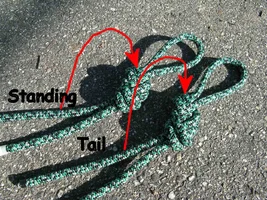
Unfortunately, usage has different knots going by the same name here. kN's post #191257, on page 4 of this thread, has an attachment with a photo showing the knot I tested. It's the upper of two, in gray. As you'll see the end passes out and back into a Ring Hitch or Cow Hitch structure, as opposed to a Clove Hitch.
Fair leads,
Brion Toss
 
[ QUOTE ]
That looks just like the Water Bowline only the clove hitch is separated. Is that not right?

[/ QUOTE ]

That is not right: it is a COW hitch, not a Clove hitch.
And the separation can be reduced. (Frankly, I think that if there
was historically some "water bowline", the hitches might've been
more separated than has come to be shown -- but it's hard to
tell what was actually done historically. Indeed, as you can /should
see HERE, we cannot agree on what Brion did.)

And my continuance from that stage -- Cow (or Clove, also) with
end tucked through two vs. one nipping turn/loop -- is to make
another "around the tree" (different tree: eye leg) turn and send
the end back parallel to its prior two tucks through the loops,
giving a third diameter and of course a further securing of the
end. This knot was created with rockclimbing dynamic rope in
mind, where the combination of firmness & smoothness can
lead to a bowline coming untied. The given Mirrored Bowline
can be relatively loose but secure.

*kN*
 
[ QUOTE ]
Hi Mark,
Unfortunately, usage has different knots going by the same name here. kN's post #191257, on page 4 of this thread, has an attachment with a photo showing the knot I tested. It's the upper of two, in gray. As you'll see the end passes out and back into a Ring Hitch or Cow Hitch structure, as opposed to a Clove Hitch.
Fair leads,
Brion Toss

[/ QUOTE ]
The "Mountaineer's Bowline" is a name that's been given to a Dbl. Bowline
(where there is a double turn, or two turns for the "rabbit hole", instead
of one), and where the tail gets a "Yosemite finish" (taken back out through
the collar).

And this is what Brion shows --despite his assertions contrary-- in the
first video. You can see the two turns rotating in synch, AND THAT THE
MAIN LOAD IS DELIVERED HIGH, into the upper turn, not into the lower
one, as it would be were it a Water Bowline, #1012, as Brion insists.
You can also see the angle & feed of the feeding-into-knot side of the
eye (the righthand, away side), coming to the lower part of these turns.
My eyes are better than that (and so, too, should others' be!). Would
that both videos had shown the knots clearly as tied instead of at some
later point of compaction. But, even so, there are things that simply
cannot occur from some starts.
In the 2nd video, the upper knot looks as though it might be some
botched effort at making the False Bowline Fig.8, given the way the
two parts turning around some horizontal impediment lie adjacent,
but other things aren't lining up so well to fit that knot's profile.
Maybe the Water Bowline w/Cow vice Clove (partially "Mirrored")
was at the bottom, busy receding; except that w/unstoppered end,
that seems unlikely to be its course.

I will surmise that part of the slickness of the 3/16" 12-strand arises
from its thinness; that thicker rope will be less liable to slip, from its
bulk alone -- that proportionally the surface is greater as diameter
reduces.

I've contacted the author of the 2004 thesis, but I'm not sure that he's
impressed with curiosities concerning knots (he's a geographer); there
is likely some bit of research & work to recall what he did, as it was a
sort of side show to the pursuit of stronger end termini. But he clearly
did go some ways in exploring knots, given his variety! I might again
try the professor who co-authored the paper. As for that "Cow hitch",
I can only imagine that it was stoppered, even though there's no hint
of it for that knot yet explicit mention for another; as said, the Cow
can be pulled out by hand in some cases (but my 5/16" Spectra rope
took a firm pull with the pulley (manual, IIRC) when tied around a
1cm 'biner, showing just some begrudging slippage).

*kN*
 
[ QUOTE ]
...I will surmise that part of the slickness of the 3/16" 12-strand arises
from its thinness; that thicker rope will be less liable to slip, from its
bulk alone -- that proportionally the surface is greater as diameter
reduces.

[/ QUOTE ]

This is an interesting idea. There is another attribute of the 3/16" that I suspect is more important--it is hollow. When I tested several attachment knots in 5/16" Tenex (also hollow), all of them, including a rethreaded figure 8, broke below 50% nominal rope strength. A spliced eye was more than twice as strong as any of them. The same rethreaded figure 8 in Yale Blaze broke at 78% nominal rope strength.

I would have guessed that any knot that did a lot of crawling under load would be a bad knot, and that knots in hollow braid would crawl far more than in ropes with a core. Now I'm not so sure. The double fisherman's knot I tested in Blaze crawled and squirmed to make one dizzy. Before it broke there were at least 6 or 8 loud bangs where it briefly held before resuming crawling. All of the crawling was in the knot itself; the tail did not get pulled into the knot. In spite of all this movement and the percussive adjustments, this was the best knot by a good margin, testing at 92% nominal rope strength. The much weaker rethreaded 8 was dramatically more stable against crawling, and exactly equal in strength to a rethreaded overhand and an ordinary bowline.
 
kN,
You appear to be saying that I did not know what I was tying. I find this most annoying. The knot in the first video was NOT, contrary to your assertion, the same as the knot in the second, which might account for what you saw. Please pay better attention, or, failing that, at least have the courtesy to ask for clarification, instead of assuming that I am in error. In that first video, the end was taken twice around the standing part, then back into the loop.
The knot in the second video was likewise not a "botched version" of anything; it was tied as described -- pictured actually -- in the upper half of the attachment to your post #191257. It might not have behaved as you expected it to, but I don't really think that it cared what you, I, or anybody else thought it should behave like. I did not test the re-entered variation, partly because I couldn't make reliable sense of your description, or of the photograph, and partly because the simpler version didn't slip.
As for the notion that the thinness of the sample I tested has some bearing on the inclination of knots to slip, there are two reasons that I believe you are in error. First, while there is more absolute surface area in larger rope, there is far less relative area; that's why, for instance, a 1/2" rope is more than twice as strong as a 1/4" rope. The other reason is that I have seen the same results in tests with larger rope.
I eagerly await clarification on the results of the Oregon tests. Meanwhile, have you considered my invitation to prepare and submit samples for testing? As this is the third time I've asked, I'll not bother you further if you are not interested. But I hope you are, as it might be a way to get us clear of speculation and mistaken perceptions.
Fair leads,
Brion Toss
 
[ QUOTE ]
When I tested several attachment knots in 5/16" Tenex (also hollow), all of them, including a rethreaded figure 8, broke below 50% nominal rope strength. A spliced eye was more than twice as strong as any of them.

[/ QUOTE ]
Hmm, more than twice "below 50%" presses close to 100%!
But a problem here is knot denotation:

[ QUOTE ]
The same rethreaded figure 8 in Yale Blaze broke at 78% nominal rope strength.

[/ QUOTE ]
How to define "same", and "Fig.8" ?!
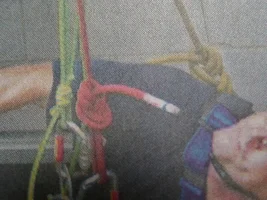
Attached is a photo of one SAR fireman with two "Fig.8" eyeknots attaching
ropes to him; they are DIFFERENT knots, but how many would recognize
this, and where it the examination of the practical significance of such
differences?

Moray, are you game for further testing? --seems there is some need.
(And I've given some ideas in photos etc. above.)

*kN*
 

Attachments

  • 193980-knot_Fig8_onSAR_p_M700.webp
    193980-knot_Fig8_onSAR_p_M700.webp
    71.9 KB · Views: 66
[ QUOTE ]
...Hmm, more than twice "below 50%" presses close to 100%!

[/ QUOTE ]

Correct. I seem to remember one of the manufacturers defines 100% as the break strength of a hollow-braid rope terminated by two spliced eyes. They probably do this because it is very easy to test the spliced rope and because any loss of strength from a properly made splice is extremely small. Whatever. My spliced eyes in 5/16-in Tenex Tec were more than twice as good as the best knot I tested.

[ QUOTE ]
But a problem here is knot denotation:...How to define "same", and "Fig.8" ?!...Attached is a photo of one SAR fireman with two "Fig.8" eyeknots attaching ropes to him; they are DIFFERENT knots...

[/ QUOTE ]

This is a good point. There is probably only a 50% chance the Fig. 8 eyeknots I tested in Tenex and Blaze were the same knot. The attached photo illustrates the difference I think you are alluding to. The uppermost nip around the eye comes from the standing part in the upper loop, but from the tail in the lower one; otherwise the knots are identical. I have no idea if they behave differently. I wonder if rock climbers, who seem to love this knot, are even aware that there are two different versions.
 

Attachments

  • 194178-Eights.webp
    194178-Eights.webp
    331.6 KB · Views: 63
According to "Life on a Line", the version with the standing part (as indicated in the pic) is the correct F8.

However, IIRC, and I don't have my "Life on a Line" book, I loaned it to Bruce Smith at On Rope, IIRC, there's only like a 5% difference between the two.

Also interesting, the author of LOAL, prefers the figure 9 purportedly because it is stronger. In the case of the F9, the version with the tail on the top (just the opposite of the F8) is stronger.

But my goodness, even if the knot reduces rope strength by 50%, which alone, it does not, that's still 3000 lbs for a 6000 lb rope. That's a 10:1 safety magin for a 300 lb load, how strong does it need to be?
 
[ QUOTE ]
Meanwhile, have you considered my invitation to prepare and submit samples for testing?

[/ QUOTE ]
Yes, I've considered it, but I (and others?!) need more information.
Perhaps some others here might care to try a trick or two, too.
What are the specimen requirements? As we're talking about
potentially pricey stuff (the 3/16" was a surprise, I was fearing
3/8" or bigger), do I want to send off some $80 length of line ... ?
-- no. But I now see a reasonable (actually, surprisingly so, to
the point of doubt!) source for 3/16" Amsteel BLUE (no grey that
size, and 1/4" a tad more), so I'll consider it.
What the video shows seems to be no all so long, though still
longer than necessary for that skinny cord; a connector to the
given long test-bed span seems a worthwhile cost limiter.

[ QUOTE ]
kN, You appear to be saying that I did not know what I was tying. I find this most annoying. The knot in the first video was NOT, contrary to your assertion, the same as the knot in the second, which might account for what you saw. ... In that ]b]first video,[/b] the end was taken twice around the standing part, then back into the loop.

[/ QUOTE ]
Unfortunately, this is inescapable: what we all can SEE courtesy of
your video is not (exactly?) this! (And we might remark at how odd
to have begun the videos only after such amazing transformations
occurred?) The first video is clear: there are TWO ADJACENT TURNS of
cord rotating upwards. The general axis of the knot is say 10:00-4:00
and these twin turns can readily be seen (the dark gaps in braid being
markers) rotating upwards, roughly towards 2:00, around the captured
bight of the end, stopper upper left, and collar around S.Part at bottom.

As the ring rises, it is pulling this end bight up through the line just
as a descender (e.g. figure-8 device) is pulled through rope on abseil;
the rope itself doesn't move, the <thing> moves through it.
One can mark a point in the S.Part-side eye leg (one on the right) and
see it hold steady against the brick wall background as the knot comes
up to absorb it.

So, you clearly have a DOUBLE BOWLINE here, no way around that.
(A Water Bwl. could account for the two turns, but would have to
(a) hide its crossing part (of Clove structure) and (b) load the lower
turn harder than upper, contrary the tension shown in video, and
(c) bring the end into the upper not lower turn, contrary images.)
There is no way a 2nd turn could be in the tail and rotating, also,
for there is no place to receive that rotated material -- the tail-side
eye leg isn't moving away from the knot (which would enlarge not
shrink the eye), and material isn't drawn out into the stopper
(which is relatively stable-tight throughout).

(I just realized the little rectangle icon of YouTube projects a
full-screen view; I have a 24" monitor, and --wow-- that's
writ large, even w/limited resolution. The twin parts moving in
synch is clear even small.)

And no way could somehow loading transform (before turning on
camera) the round turn of tail on S.Part into an extra turn of the S.Part
(in the way that one can e.g. tie a bowline by making a turn w/end
and then hauling hard to cast that deformation into the S.Part to
form its rabbit hole): for the S.Part bears 100% of tension, and at
most some 50% on another part is coming against it.

But, even those physics be damned, one cannot topologically
make the transformation to what is in the video!

So, how can we believe your assertion?
"I was there"
-- and with your own topology & physics?!!
.:. It just does not compute, sorry.

Now, maybe you doubled-up on both parts of the knot? --and in a
way "we're both right" ? I.e, a Dbl.Bwl "Enhanced" as per Asher with
the round turn of the tail?! I don't see that there are two wraps of
the end, for there just isn't the visible bulk for it. But I could be
missing this, given the compressibility of this material.

[ QUOTE ]
The knot in the second video was likewise not a "botched version" of anything; it was tied as described -- pictured actually -- in the upper half of the attachment to your post #191257. It might not have behaved as you expected it to, but I don't really think that it cared what you, I, or anybody else thought it should behave like. I did not test the re-entered variation, partly because I couldn't make reliable sense of your description, or of the photograph, and partly because the simpler version didn't slip.

[/ QUOTE ]
Again, the video belies this. At best, I'll allow that the Mirrored Bowline
was tied, but the specimen is upside-down to your report, and this
knot is unrecognizably visible only late as it (un)ravels at the bottom.

For the top knot in no way matches the Mirrored Bowline. In the first
few seconds --1st particular viewing angle-- , one sees the rotation
of a part anti-clockwise around one eye leg & the UNstoppered tail;
on the change of angle --camera moving lefwards-- one can just see
this rotating part feeding material down into the S.Part: this is NOT
how a Mirrored Bowline is structured; the M'dBwl has its additional
turn/half-hitch part nipping the tail and tail-side eye leg, and that
HH feeds into the S.Part's main turn towards the knot, and into the
S.Part-side eye leg in the other direction. But in the knot shown,
the ends are well removed with some bulk of wraps between them,
which is more nearly like the False Bowline Fig.8.

And "botched"? Yes, esp. if you find making the Mirrored Bowline
a challenge, this more novel knot would be much perplexing; I myself
botched it TWICE in forming it last night to play with transformations
that might match the video's image. (Botching one knot is a way of
*inventing* new ones, btw, though not favored by Marketing.)

Again, there are aspects of the shown knot that simply cannot come
from the supposed source knots. I cannot escape that.

[ QUOTE ]
As for the notion that the thinness of the sample I tested has some bearing on the inclination of knots to slip, there are two reasons that I believe you are in error. First, while there is more absolute surface area in larger rope, there is far less relative area; that's why, for instance, a 1/2" rope is more than twice as strong as a 1/4" rope.

[/ QUOTE ]
But this is just my point: as the surface is soooo slippery, its relative
abundance in small rope makes the surface aspect dominant; whereas
if there is much bulk, that might have some kind of effect like a
stopper knot and add more to bending resistance.

[ QUOTE ]
The other reason is that I have seen the same results in tests with larger rope.
I eagerly await clarification on the results of the Oregon tests.

[/ QUOTE ]
If the Oregoners saw this, they were remiss in not clarifying it, but that
could be the case. I think that I'll have to prod the authors a bit to learn
more, but your Video-1 should be a big help in explaining the question.

*kN*
 
Moray, how did you test the Grapevine bend (Dbl.Fish.)?
I.p., how did you anchor the ends of the test specimen?

[ QUOTE ]
According to "Life on a Line", the version with the standing part (as indicated in the pic) is the correct F8.

[/ QUOTE ]
Which version of <u>LoaL</u> ? This is not the recommended one in
the for-sale, 2nd edition: that one refers to this (w/o image, I think)
as being a version that is very hard to untie. What Merchant advocates
differs in having the S.Part start like this but drift to the outside
of the knot, and the tail-bight wrap to mimic this. It's tricky to form.

Btw, an assertion of a "10%" difference -- which I think was to be under-
stood as (if not explicitly stated) "10 percentage points"-- in a ca. 1980
Ontario Rock Climbers Assoc. Saftey(Reference?) Manual, authored
in part by Rob Chisnall. I paid attention to this (vs. some other sources'
assertions to "put loaded end on *outside*, marked 'X'") because their
images were unambiguous, which suggested that the knew what they
were talking about. (In contrast, Bruce Smith's "OnRope1" "MythBuster's"
image with the simplistic *flat* image of the Fig.8 shows otherwise;
that site has been denying the 10% claim. (And that site has a Knots
section that has been "coming soon" for 5 years or so! :o))
Lyon Equipment's 2001 HSE report also seemed to recognize this point,
and their tests were rather inconclusive (and dubiously structured),
though they concluded that the same sort of difference matters for
the Overhand eye knot and Fig.9 eye knot (though unfortunately the
report is quite ambiguous as to which orientation they intend--geesh).

To my surmise: the first / upper knot should be set by hauling hard
on the end vs. the eye, and even some loading of eye by pushing
against the knot body; what I believe should help is putting into that
knot as much gentle curvature into the S.Part as one can. In nylon,
one can expect considerable deformation of the knot given nylon's
elasticity; in other materials, ... YMMV!? -- my conjecture, untested.
(Lyon didn't show photos of in-tension knots to show ... .)

It seems that often the eye-bight's ends/roots come out of the
orientation as they bend to exit the knot into the eye; I think
that this is torsion-induced. (One can see this, e.g., alas, on the
cover of <u>Outdoor Knots</u> by Clyde Soles.) The differences
in the fireman photo I showed are as follows, as best I can disern:
the yellow rope is knotted with load on "tail" as Moray presents;
the red knot is like the S.Part-loaded one except that (1) the end
wasn't hauled when setting the knot and (2) the eye bight falls
out of this orientation (the leg seen in front/right down to 'biner
should be drawn over leftwards as it wraps around the S.Part,
which the draw of the S.Part will hold in position.
And, yes, it is a Good Thing that this knot seemingly exists with
such variance w/o issue, so far as we know. But it would be best
if we had knowledge about these differences (and accepted them
based on this knowledge, rather than in ignorance); some versions
might be much more vulnerable to flyping on ring-loading (loading
eye, knot qua rope-ends joiner), say.

[ QUOTE ]
I don't have my "Life on a Line" book, I loaned it to Bruce Smith
at On Rope, IIRC, there's only like a 5% difference between the two.

[/ QUOTE ]
Oh, well, that's a "5%" gain over the Mythbuster's stated difference (none).
Likely it's (a) much "YMMV" and (b) maybe not the aspect of the knot
that should determine which orientation you use (untying e.g, being
another), as any is strong enough.
BUT, if one's going to go about advocating the Fig.8 because of its
strength, these points need to be kept in mind. And there is much
of this in Net chatter, many times all echoes of some source that
might not even be well understood; and yet the quantity of such
echoes builds a Net-wise truism.

[ QUOTE ]
Also interesting, the author of LOAL, prefers the figure 9 purportedly because it is stronger. In the case of the F9, the version with the tail on the top (just the opposite of the F8) is stronger.

[/ QUOTE ]
Merchant has (in forums.caves.org forum?) reported that the Fig.9's
strength is more variable per loading: dynamic loading sees more
material movement, more heat, less strength than in slow loading.
A reason to prefer the Fig.9 is easier untying, but somehow the rumor
of (gratuitous) greater strength comes along for the ride.

Please note that the "Semi-Symmetric Fig.9" eye knot I showed above
is, well, a "Fig.9"; it is MUCH easier to untie than the others here, and
I'll guess does amply well re strength. Moreover, I think that the version
I show here can serve pretty well as a mid-line eye knot, and in loading
either end. --might lose that easy untying, but ... .

[ QUOTE ]
But my goodness, even if the knot reduces rope strength by 50%, which alone, it does not, that's still 3000 lbs for a 6000 lb rope. That's a 10:1 safety magin for a 300 lb load, how strong does it need to be?

[/ QUOTE ]
Bingo. And that is the intriguing aspect of the Oregon testing of HMPE
for forestry use, where some "Double Stevedore" knot is shown to be
at the 50% mark!? I can only imagine that this is the Fig.9 by our name;
I can't imagine which orientation it might be, or if that aspect was noted.

*kN*
 
Oops,
In my Techanderthal way, I posted a different video than the one I thought I had for "Spectra Bowline #1"; it had two turns on the end, not the standing part. Both versions were tested, however and both crawled out. Furthermore, neither of those knots appeared in the second video; there, the upper knot was the Ring Hitch variation, and the lower was from your post #191935. But don't take my word for it -- tie them, and any other knots you think might do well, and we'll get them broke. It seems that I have not been clear enough about my offer. But as I said in a previous post, "As for future tests, yes this stuff is expensive, so I hope to have the ropemaker contribute materials as well as tests." This offer still stands for you. Are you interested? I am confident that you will find that the knots that I said slipped, slipped, and that the one that I said didn't slip, didn't. I'm also confident that all of them will weaken the rope unacceptably, and that most or all of them will jam solid at low loads. I'm also confident that larger diameters will be at least as likely to crawl, partly because the relatively low surface area can't hold against the relatively higher loads, and partly because I've seen it happen. But I could be wrong, and here is your chance to prove it. Send a private message with your physical address. I'll have the rope and a set of requirements (basically loop size and sample length) sent to you.
 
Brion, thanks for your generous offer, I accept it.
PM'd.

Further, I have just sent e-mail again asking the Oregon
overseeing professor (of J. Hartter's thesis) about the knots
that they tested (CC to J.Hartter, who hasn't replied further
to my earlier query--other than to ask Who Am I?!--, and
also CC'd Dave Richards, who privately reported preliminary
testing of several hi-mods and seeing around 25% knot
efficiencies). Perhaps the news of Hartter's 50% will tickle
Richards's interest (and perhaps Dave has completed his
testing to the point of having some formal report -- as he
had then (2006) been hoping to present at the ITRS that
November).

And, Moray, are you still taking the measure of various
knots etc. in ropes?


*kN*
 

New threads New posts

Back
Top Bottom