- Location
- Port Townsend, Washington
[ QUOTE ]
Re weakness in compression for HMPE, don't the numbers really suggest
that it's about equally strong there, and just super strong in tension?
I.e., nylon or polyester will be (in force terms) no stronger; but they have
much lesser tensile strength, so percentage-wise they look better.
Which still leaves the point about sacrificing this strength via knots, for hi-mods.
[/ QUOTE ]
It seems that, if HM fibers were stronger in compression, relative to their tensile strength, they would not be weakened as much by knots. It is the relative efficiency of knots vs splices, in various materials, that concerns me.
[ QUOTE ]
FYI, HMPE "dental floss" slings for climbers have apparently been tested
in Clove hitches (no more than that!) on 'biners and shown good strength,
not slippage (!! -- my surprise), breaking the 'biner if tied in twin strand
(i.e., tying the sling vs. just one side of it ("sling" here = circle of material)).
[/ QUOTE ]
Source?
[ QUOTE ]
Okay, Yes, I tested the Bowlines you describe,
[/ QUOTE ]
!! Haven't seen hint of these from anywhere. I confess to some skepticism
given that you aren't seeing clear in at least the capsized bowlines case.
[/ QUOTE ]
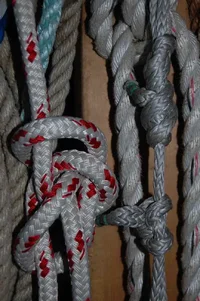
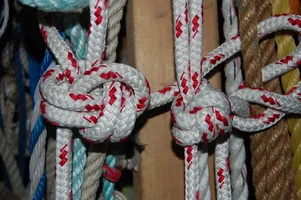
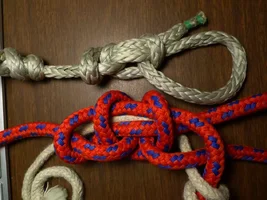
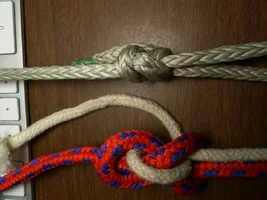
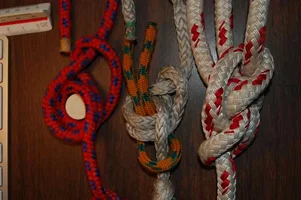
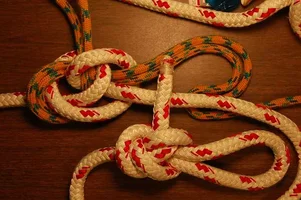
If I am not seeing clear, perhaps it is because I am misinterpreting the photographs; any chance that you might send clearer ones, to remove ambiguity? I've looked repeatedly at the attachments, and just don't see the capsize mechanism. I have, however, repeatedly seen people tie what I believe is the knot you picture, both in classes I have taught, and in the field. It is a simple matter of taking the end around the wrong part after passing it through the loop. The knot is know variously as an Eskimo Bowline and a Sideways Bowline. This is a far simpler, and therefore far more likely explanation for what you are seeing than some manner of capsize. But again, it is possible that I am misinterpreting the pictures.
You "confess to some skepticism" about my tests on the Bowline variations. Why?
[ QUOTE ]
I will post further shots. The point of which, btw, is that these commonly
known knots have shown transformations likely not expected, and one
can only wonder how loosely tied they were or if in fact it's a matter of
usage forces working this change. AND whether similar such changes
occurred in some of the testing referred to above, which might escape
notice.
[/ QUOTE ]
Seems farfetched, doesn't it, that widely separated lab workers would fail to notice, in repeated testing, that their Bowlines have somehow capsized into something else? I appreciate that this is a possibility, but it's hard to think of a more remote one. Tell you what, next week I'll be breaking some pieces of HM as part of a course we are teaching for Coast Guard inspectors. The idea is to demonstrate the danger that knots in HM can pose for charter vessels. I'll see if we can photograph the tests, and forward the results.
[ QUOTE ]
The "Figure 9" is, I believe, just a Stevedore's Knot, made as a loop.
[/ QUOTE ]
In some books, yes; but the Stevedore should have an extra half twist and
by this numerical naming be "Fig.10" (Lyon so tested it -- marginally better
than F.9).
[/ QUOTE ]
In what material(s)? To what results?
[ QUOTE ]
I have no doubt that people tie lousy knots at times, or loose ones, or sideways ones, but I fail to see why you are bringing those up in this discussion.
[/ QUOTE ]
Because those people can run tests, too. Because at the great loads put
by a break test, things happen that might be mostly unseen otherwise,
where what seemed a "good" knot was that -- good enough, then.
[/ QUOTE ]
If your argument has merit, I believe that it cannot be demonstrated simply by impugning the competence of others. Show us that what you say happens, happens. Please, show us, instead, that your postulates are valid.
[ QUOTE ]
As for the Sheet Bend, neither "half" of this "asymmetrical knot" will break; the break occurs outside the knot, as the internal deformations manifest in the apparently full-strength standing part.
[/ QUOTE ]
Firstly, I don't buy this breakage point. Yes, I HAVE some broken knots,
and one can find a point of hard compression/pressure near an entry point;
otherwise, you have quite a task to explain how weakness in compression
results in rupture where there is none.
E.g., consider the broken line in the video presented above: that pop of
material certainly manifest itself outside, but I think you can locate its
start right at the bend into the Clove, hard against the crossing part.
[/ QUOTE ]
I have no such task. The weakest point, by definition, is the one that gives way first, and in this case it happens to be just outside the knot. The rupture didn't "start" in the knot; it was related to forces occurring within the knot. This is not mere semantics. As opposed to mere knot semantics.
[ QUOTE ]
But in either case, the question remains: in which of the ropes joined in
a Sheet Bend --the bight-formed or hitching one-- does the break occur
(wherever posited)? This knot is recommended often for diff-sized ropes;
the data that's published is however for same-diameter ropes: if one joins
3/8" rope to a bight of 1/2" rope, will one get better than (say) 55%
of the 3/8" line (assuming that's the usual strength in like-dia ropes)?
(As there's some torsion in the hitching rope, I'm suspecting that it's the
one more weakened; but in thick-thin working, a thicker line on that half
just doesn't work well.)
[/ QUOTE ]
I'd love to know. Care to report on this?
Fair leads,
Brion Toss
Re weakness in compression for HMPE, don't the numbers really suggest
that it's about equally strong there, and just super strong in tension?
I.e., nylon or polyester will be (in force terms) no stronger; but they have
much lesser tensile strength, so percentage-wise they look better.
Which still leaves the point about sacrificing this strength via knots, for hi-mods.
[/ QUOTE ]
It seems that, if HM fibers were stronger in compression, relative to their tensile strength, they would not be weakened as much by knots. It is the relative efficiency of knots vs splices, in various materials, that concerns me.
[ QUOTE ]
FYI, HMPE "dental floss" slings for climbers have apparently been tested
in Clove hitches (no more than that!) on 'biners and shown good strength,
not slippage (!! -- my surprise), breaking the 'biner if tied in twin strand
(i.e., tying the sling vs. just one side of it ("sling" here = circle of material)).
[/ QUOTE ]
Source?
[ QUOTE ]
Okay, Yes, I tested the Bowlines you describe,
[/ QUOTE ]
!! Haven't seen hint of these from anywhere. I confess to some skepticism
given that you aren't seeing clear in at least the capsized bowlines case.
[/ QUOTE ]
If I am not seeing clear, perhaps it is because I am misinterpreting the photographs; any chance that you might send clearer ones, to remove ambiguity? I've looked repeatedly at the attachments, and just don't see the capsize mechanism. I have, however, repeatedly seen people tie what I believe is the knot you picture, both in classes I have taught, and in the field. It is a simple matter of taking the end around the wrong part after passing it through the loop. The knot is know variously as an Eskimo Bowline and a Sideways Bowline. This is a far simpler, and therefore far more likely explanation for what you are seeing than some manner of capsize. But again, it is possible that I am misinterpreting the pictures.
You "confess to some skepticism" about my tests on the Bowline variations. Why?
[ QUOTE ]
I will post further shots. The point of which, btw, is that these commonly
known knots have shown transformations likely not expected, and one
can only wonder how loosely tied they were or if in fact it's a matter of
usage forces working this change. AND whether similar such changes
occurred in some of the testing referred to above, which might escape
notice.
[/ QUOTE ]
Seems farfetched, doesn't it, that widely separated lab workers would fail to notice, in repeated testing, that their Bowlines have somehow capsized into something else? I appreciate that this is a possibility, but it's hard to think of a more remote one. Tell you what, next week I'll be breaking some pieces of HM as part of a course we are teaching for Coast Guard inspectors. The idea is to demonstrate the danger that knots in HM can pose for charter vessels. I'll see if we can photograph the tests, and forward the results.
[ QUOTE ]
The "Figure 9" is, I believe, just a Stevedore's Knot, made as a loop.
[/ QUOTE ]
In some books, yes; but the Stevedore should have an extra half twist and
by this numerical naming be "Fig.10" (Lyon so tested it -- marginally better
than F.9).
[/ QUOTE ]
In what material(s)? To what results?
[ QUOTE ]
I have no doubt that people tie lousy knots at times, or loose ones, or sideways ones, but I fail to see why you are bringing those up in this discussion.
[/ QUOTE ]
Because those people can run tests, too. Because at the great loads put
by a break test, things happen that might be mostly unseen otherwise,
where what seemed a "good" knot was that -- good enough, then.
[/ QUOTE ]
If your argument has merit, I believe that it cannot be demonstrated simply by impugning the competence of others. Show us that what you say happens, happens. Please, show us, instead, that your postulates are valid.
[ QUOTE ]
As for the Sheet Bend, neither "half" of this "asymmetrical knot" will break; the break occurs outside the knot, as the internal deformations manifest in the apparently full-strength standing part.
[/ QUOTE ]
Firstly, I don't buy this breakage point. Yes, I HAVE some broken knots,
and one can find a point of hard compression/pressure near an entry point;
otherwise, you have quite a task to explain how weakness in compression
results in rupture where there is none.
E.g., consider the broken line in the video presented above: that pop of
material certainly manifest itself outside, but I think you can locate its
start right at the bend into the Clove, hard against the crossing part.
[/ QUOTE ]
I have no such task. The weakest point, by definition, is the one that gives way first, and in this case it happens to be just outside the knot. The rupture didn't "start" in the knot; it was related to forces occurring within the knot. This is not mere semantics. As opposed to mere knot semantics.
[ QUOTE ]
But in either case, the question remains: in which of the ropes joined in
a Sheet Bend --the bight-formed or hitching one-- does the break occur
(wherever posited)? This knot is recommended often for diff-sized ropes;
the data that's published is however for same-diameter ropes: if one joins
3/8" rope to a bight of 1/2" rope, will one get better than (say) 55%
of the 3/8" line (assuming that's the usual strength in like-dia ropes)?
(As there's some torsion in the hitching rope, I'm suspecting that it's the
one more weakened; but in thick-thin working, a thicker line on that half
just doesn't work well.)
[/ QUOTE ]
I'd love to know. Care to report on this?
Fair leads,
Brion Toss