Break Testing

[ QUOTE ]
Ashamed to say I never thought of that. Cool stuff Mahk.

[/ QUOTE ]

It is one of those nice tricks we all scratch our heads and ask, "Now why didn't I think of that?" (At least, I'm scratching my head...)
smirk.gif


Mahk: I'm talking about leaders which could be 3'-4' diameter. They seem to be the pain. But, for everything else, I'll use your technique.
 
I just realized something. Brion, do you think I'm tying off loads with just a bowline around the limb? I'm using a running bowline. Do you think that changes things (in favor for using Amsteel still)?
 
[ QUOTE ]
... do you think I'm tying off loads with just a bowline around the limb? I'm using a running bowline. Do you think that changes things (in favor for using Amsteel still)?

[/ QUOTE ]

I was going to mention this, but it seemed too complicated. The reason it is complicated is you don't know how the system will settle out. Certainly as the load is applied to the line, the bowline will see less load than the main line. But with the load fully suspended with an opportunity to swing and shift, everything could equalize.

In any event, the half wrap around the wood is not going to change the knot loading very much. Add another full wrap before applying the bowline and you'll make a big difference, and the knot should see much less than the full load.
 
[ QUOTE ]
I just realized something. Brion, do you think I'm tying off loads with just a bowline around the limb? I'm using a running bowline. Do you think that changes things (in favor for using Amsteel still)?

[/ QUOTE ]

Hi again,
First, thank you for your graciousness in acceding to the idea that what you have been doing might not have been as safe as you thought it was. Next, to go to some earlier points, I have not only seen trees dismantled by crane, but have participated . Also square-riggers and daysailers. Next,my concern with HM rope slipping is that it will keep slipping, and crawl right out. I've seen this happen even with covered rope, the core leaving the cover like a snake shedding its skin. Of course, there's also the hazard of a shock-load-inducing partial slip, and a full or partial slip can happen even in very fuzzy rope. And finally, to get to your question about Running Bowlines, there should be less load on the knot, but as was pointed out above, not necessarily, depending how the load moves. The suggestion of a Round Turn might help here, though perhaps a Capstan Hitch variation would be better. Even if that were true, though, any of those solutions would be even better using a material better suited to the job than Amsteel with knots in it.
Fair leads,
Brion Toss
 
[ QUOTE ]
...In any event, the half wrap around the wood is not going to change the knot loading very much. Add another full wrap before applying the bowline and you'll make a big difference, and the knot should see much less than the full load.

[/ QUOTE ]

This is silly. I was thinking of a fixed anchor and the so-called tensionless hitch that rock climbers like to use. The whole point of this setup, as in your case, is to make friction take up the load so the knot has little or nothing to do. In this case, and many similar ones in rigging scenarios, you can have unequal loads in different parts of the line because of friction against the wood and because the wood supplies torque to resist the friction. Obviously (duh!) a hanging load can't supply torque like a limb still attached to a tree.

It does supply some torque when an imbalanced load tries to rotate in the sling, but who is going try and figure this into a crane rigging scenario?
 
About that "25%" : yes, the YouTube shows "25% capacity", mistakenly.
It happens, though, that the recommended WLLimit of 8,400# amounts
to 25% of the break, whereas it had been 20% of new tensile.
(42,000 => 33,000). With a little *spin*, this can be a correct video!
blush.gif


The break was shown nicely, IMO -- a burst of some fibres right at the
entry into the Clove Hitch, where the compression on them was great
(well, it isn't so easy to trace the fibre clump back into position at the
crossing part, but that's my surmise from doing so with other breaks).
I'm guessing that had that been a Prusik hitch (say; or a Rolling Hitch
backwards -- i.e., double turn first, HHitch finish (w/back-up)), I think
that there'd be less force transmitted to this crossing part, and so the
strength would be greater, a little. (Along the lines of what Norm was
thinking in suggesting the extra wrap, though --as he caught-- that
wasn't right for the particular situation he advanced it.)

[ QUOTE ]
We've done hundreds of break tests in wire, Nylon, Dacron, and assorted high-modulus fibers. And the techies at all the major rope companies have done thousands more. I have yet to see any type of knot -- hitch, loop, bend, anything -- that will reach much over 30% in HM rope, and they almost invariably will slip at as low as 10% unless stoppered or otherwise backed up.

[/ QUOTE ]
... hundreds of break tests / thousands more ...
Where can well-documented reports of all this testing be found,
for review & understanding of methods & results?
Frankly, I've not seen much imagination when it comes to tested knots.
E.g., there are two published sets of data in which the Fig.8 eyeknot
was tested both tied "re-woven" and "in the bight" -- who would've
thought that the knot cared; or if there was to be some difference,
where was the explanation of that? (The results were as expected:
essentially equal. [CMC Rope Rescue Manual; Dave Richards] )
It's really hard to establish a scientific program of understanding
knots when the data --and the methods of its determination--
are kept behind closed doors. (I have heard that Samson i.p. is
notorious re this.)

There are some reasonable ways to try to bolster the Bowline's shown
weaknesses in strength & slippage -- that of an additional tuck of the
end forming a 2nd collar and putting at least one more diameter
of material in the centrally nipped area; one simple repetition of this
structure gets you 4 diameters.

Beyond this are other knots, such as so-called Fig.9 eyeknot, in both
its common asymmetric form, and in an unknown(?) symmetric one.

Before giving up on knots, one needs to better consider them.
I've seen no evidence that those making the ropes do a good job of
this -- rather, often the opposite.

*kN*
 
[ QUOTE ]
[ QUOTE ]
...Let's just ignore for the moment the many incidences of slippage well below this load, and not just in textbooks...

[/ QUOTE ]
... I guarantee I leave enough tail on the bowline that it won't slip.

[/ QUOTE ]
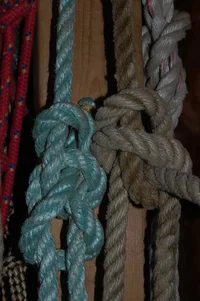
Rather than merely leave tail, do something with it -- tuck it back
through the central, nipping loop. (photo of two secured bowlines)

*kN*
 

Attachments

  • 189526-knots_BowlineSecured_LL.webp
    189526-knots_BowlineSecured_LL.webp
    112.1 KB · Views: 99
[ QUOTE ]

... hundreds of break tests / thousands more ...
Where can well-documented reports of all this testing be found,
for review & understanding of methods & results?
Frankly, I've not seen much imagination when it comes to tested knots...
It's really hard to establish a scientific program of understanding
knots when the data --and the methods of its determination--
are kept behind closed doors. (I have heard that Samson i.p. is
notorious re this.)

There are some reasonable ways to try to bolster the Bowline's shown
weaknesses in strength & slippage -- that of an additional tuck of the
end forming a 2nd collar and putting at least one more diameter
of material in the centrally nipped area; one simple repetition of this
structure gets you 4 diameters.

Beyond this are other knots, such as so-called Fig.9 eyeknot, in both
its common asymmetric form, and in an unknown(?) symmetric one.

Before giving up on knots, one needs to better consider them.
I've seen no evidence that those making the ropes do a good job of
this -- rather, often the opposite.

*kN*

[/ QUOTE ]

Wow. Not sure how to respond here. The rope tests I have done have primarily been with New England, Yale, and Cortland Cable; have you tried talking with their technical departments? My copies of test results are in a file folder many miles away right now (I'm in Hawaii. Yay), but could see about making copies when I get home. Still, I can assure you right now that we tested numerous versions of the Bowline, as well as a wide variety of hitches, loops, and bends, and that none of them did much better than 30%, assuming that they did not slip out far sooner. We conducted these tests precisely because we were in search of a knot or knots that would be good to use with HM fibers. We did not find any.
Rope makers have a very powerful vested interest in knowing how their products behave, and they have acted accordingly. People in the field have, in my experience,avoided more frequent disasters because of the extremely high strength of these materials -- low relative loads. But, let's see, just yesterday I was aboard a boat that broke an HM halyard with a Bowline in its end. Ran over its spinnaker. And last month I heard from the operator of a utilities truck that pulled a fat Spectra line right out of a Bowline, using the winch. But if you don't trust the veracity of thousands of factory tests, and you haven't personally seen or heard of in-the-field failures, does that mean that you will just assume the best? We are still learning to work with these fibers, after several generations of adjusting to more conventional synthetics. It would seem to make sense to benefit, to whatever extent possible, from the experiences of others.
Fair leads,
Brion Toss
 
[ QUOTE ]

[ QUOTE ]
... hundreds of break tests / thousands more ...

[/ QUOTE ]
Where can well-documented reports of all this testing be found,
for review & understanding of methods & results?
*kN*

[/ QUOTE ]
... Still, I can assure you right now that we tested numerous versions of the Bowline, as well as a wide variety of hitches, loops, and bends, and that none of them did much better than 30%, assuming that they did not slip out far sooner.

[/ QUOTE ]
Okay, did you test either of the ones I just posted, which (1) nip the end
a second time and (2) thus fatten the material around which the mainline
bends with its high load? (no)

Did you test the Fig.8 and Fig.9 eye knots, which are known in SAR/climbing
fields to be quite strong (though they're not exactly specified re geometry)?

Or the simple Timber hitch variation referred to by Norm & Spydey above
-- Ashley's #1669 ? (And one good turn might merit another, here, for
HMPE stuff.) That puts more material wrapping the mainline at the critical
point, so might help re strength, as well as security (and keeping it snug,
as Norm suggests).

[ QUOTE ]
And last month I heard from the operator of a utilities truck that pulled a fat Spectra line right out of a Bowline, using the winch.

[/ QUOTE ]
And I have a bit of broken Bowline in 5/8" (?) polypropylene off of some
truck, likely, which I doubt anyone would be able to identify -- i.e., it
was a case of geometry distortion, not really slippage per say. So some
of the reports of slippage I have some doubt about, having seen how
loosely bowlines appear in photos (and on-site inspection) of yachting
lines, and elsewhere. What is a "bowline" to that truck operator might
come as a surprise to you, or as an "Eskimo Bowline", say.

So, you see, it's not all so much just about the numbers (data);
it has much to do about exactly what (geometry) is meeting the
test device.
E.g., I'm sure that there have been many tests of the Sheet bend;
but I have never seen anyone state in which rope/half of this asymmetric
knot the break occurs -- good chance that one geometry is weaker than
the other (which points to an obvious question: if joining thinner rope
to thicker, vis-a-vis thinner rope's tensile, will the knot be stronger?).
Think we can get past another century without this information known?
-- and while knots books still present the Sheepshank and Thief Knot ... !

[ QUOTE ]
But if you don't trust the veracity of thousands of factory tests, and you haven't personally seen or heard of in-the-field failures, does that mean that you will just assume the best? We are still learning to work with these fibers, after several generations of adjusting to more conventional synthetics. It would seem to make sense to benefit, to whatever extent possible, from the experiences of others.

[/ QUOTE ]
Again, where is all this thousands-of-tests evidence, in what sort of form
that can enlighten? I recall your very article in Sail magazine to raise a big
warning flag about weakness of hi-mod cordage: why was this article such
a big deal, if those vested-interest rope vendors had done thousands of
tests and would've had that as old news to anyone in the market? And I
recall also the Practical Sailor magazine article supposedly double-checking
your claims, and making a mockery of testing and reporting (e.g., in one
bowline test with a Yale PP-sheathed Spectra line, their EYE SPLICES slipped
out; but they recorded that data in the report table for the bowline, and only
made a footnote about the actuality!! A grade schooler would get a bad grade
for such nonsense!).

And I recall some other commercial products that someone thought were
fit for use but found reality different.
So, please, don't ask for trust of the unknown.
Yeah, notes of caution are out. But it's hard to build an understanding on
suspicion and rumor and hype.

*kN*

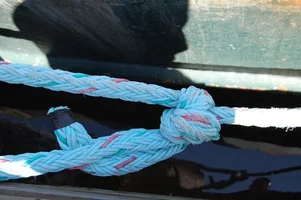
attch'd : common Bowline in 12-twin-strand CoExOlefin mooring line

TBC -- mirror of above capsized
 

Attachments

  • 189741-Bwl_D40_0059_8x2tuck_MM.webp
    189741-Bwl_D40_0059_8x2tuck_MM.webp
    37.2 KB · Views: 102
Here's roughly the same "bowline" but in a capsized form
(making it what might be called a Pile Hitch noose); I really
don't think that such structures are tied as found, but have
in fact deformed in use. It is not an uncommon finding,
to my eye.

*kN*
 

Attachments

  • 189742-Bwl_D40_0161_capszd_MM.webp
    189742-Bwl_D40_0161_capszd_MM.webp
    33.4 KB · Views: 95
Okay,
Yes, I tested the Bowlines you describe, and others, including French, Portuguese, etc. The "Figure 9" is, I believe, just a Stevedore's Knot, made as a loop. It breaks. I also tested many hitches, though I don't recall if 1669 was one of them. I will be happy to send you the results of those tests, complete with graphs showing slippage at given loads, when I return home.
I have no doubt that people tie lousy knots at times, or loose ones, or sideways ones, but I fail to see why you are bringing those up in this discussion. I am telling you that none of the many knots, and knot variations that I have personally arranged to test are safe to use in HM line. I am not claiming that Practical Sailor is infallible, or that people on yachts always tie things correctly. I suggested that you contact ropemakers' tech staff, as I did. Have you done so? Have you conducted any tests, to your standards, or anyone else's? Enough for a valid statistical sample? I know that you are active in the IGKT, so perhaps there are some connections you could exploit. I am not asking you to build confidence on suspicion, rumor, and hype; it is precisely those things which lead to bad rope practices. No engineering is possible without establishing standards, the idea being that these tend to dispel suspicion, rumor, and hype.
And that story in Sail. The techies I worked with all said something like, "But Brion, we KNOW that knots shouldn't be tied in this stuff." But they weren't testing them for sailing magazines. That was my job.
The "Bowline" in your attachment was, I believe, simply tied sideways, so that the load came on the wrong parts.It almost certainly did not capsize. It's an old, old mistake, all too frequently seen, afloat and ashore. But it, and just about any other loop that doesn't have stoppered ends will crawl right out of HM, or break at a very low load.
And your questions about asymmetry in knots are likewise old, old questions. Surely you have a copy of Day's Knotting and Splicing; before you continue trying to reinvent that particular wheel you might want to review what he has to say on the matter.
As for the Sheet Bend, neither "half" of this "asymmetrical knot" will break; the break occurs outside the knot, as the internal deformations manifest in the apparently full-strength standing part.
Fair leads,
Brion Toss
 
PS,
Those of you who are interested in learning more about knots than you ever thought possible might consider visiting the International Guild of Knot Tyers site: http://igkt.net/index.php
This is an organization of people who take their knots very seriously indeed. Lots of interesting forum threads, including stupefyingly detailed discussions on the effects of geometry on knot strengths, and how to establish testing that makes sense.
 
Love the conversation over here.

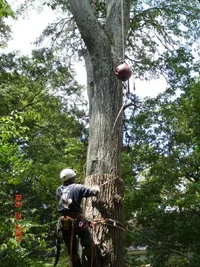
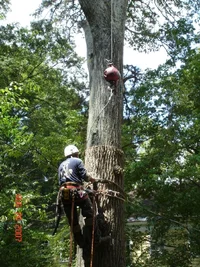
What I'd like to see is this: Different species of tree being tied off with a running bowline, clove hitch, timber hitch, or what ever...

And with different diameters of wood to tie them off on. Ranging from 9" diameter to 40" diameter.

And then, have some one do tests to see how the ropes stand up.

Would the breaking strength results be different if they were actually tested the way we arborists use them?
 
[ QUOTE ]
Love the conversation over here.

What I'd like to see is this: Different species of tree being tied off with a running bowline, clove hitch, timber hitch, or what ever...

And with different diameters of wood to tie them off on. Ranging from 9" diameter to 40" diameter.

And then, have some one do tests to see how the ropes stand up.

Would the breaking strength results be different if they were actually tested the way we arborists use them?

[/ QUOTE ]
Hi,
Nifty idea. Hard to duplicate in the lab, or to bring the lab to the trees. But you could set up a scaled-down test, using 1/8" Spectra or the like. Using a big come-along or truck winch you could first do a series of tests with eyesplices, to establish a baseline, then set up your series of knots, using rope from the same spool. This would require some form of shockproof tensiometer in the run. I'd also recommend a stout redirect, so the break doesn't launch things at you.
Just speculating here, but if I were to bet, I'd say that "the way we arborists" use knots isn't significant; it's more about the nature of the fibers, which are very strong in tension, not so much in compression.
Fair leads,
Brion Toss
Fair leads,
Brion Toss
 
Firstly, let me make clear that I take the warnings re knots in hi-mod
(any of HMPE, Kevlar, Technora, Vectran) to be valid until better information
is known. I'm just resisting the assertions that good evaluation has been
done, and pointing out that of what reaches general public consumption
for making any evaluation is sorely lacking -- both in quantity (what things
that do get out) and in quality (what details are (not) conveyed).
Re weakness in compression for HMPE, don't the numbers really suggest
that it's about equally strong there, and just super strong in tension?
I.e., nylon or polyester will be (in force terms) no stronger; but they have
much lesser tensile strength, so percentage-wise they look better.
Which still leaves the point about sacrificing this strength via knots, for hi-mods.

FYI, HMPE "dental floss" slings for climbers have apparently been tested
in Clove hitches (no more than that!) on 'biners and shown good strength,
not slippage (!! -- my surprise), breaking the 'biner if tied in twin strand
(i.e., tying the sling vs. just one side of it ("sling" here = circle of material)).

[ QUOTE ]
Okay, Yes, I tested the Bowlines you describe,


[/ QUOTE ]
!! Haven't seen hint of these from anywhere. I confess to some skepticism
given that you aren't seeing clear in at least the capsized bowlines case.
I will post further shots. The point of which, btw, is that these commonly
known knots have shown transformations likely not expected, and one
can only wonder how loosely tied they were or if in fact it's a matter of
usage forces working this change. AND whether similar such changes
occurred in some of the testing referred to above, which might escape
notice.

[ QUOTE ]
The "Figure 9" is, I believe, just a Stevedore's Knot, made as a loop.


[/ QUOTE ]
In some books, yes; but the Stevedore should have an extra half twist and
by this numerical naming be "Fig.10" (Lyon so tested it -- marginally better
than F.9).

[ QUOTE ]
I have no doubt that people tie lousy knots at times, or loose ones, or sideways ones, but I fail to see why you are bringing those up in this discussion.

[/ QUOTE ]
Because those people can run tests, too. Because at the great loads put
by a break test, things happen that might be mostly unseen otherwise,
where what seemed a "good" knot was that -- good enough, then.

[ QUOTE ]
The "Bowline" in your attachment was, I believe, simply tied sideways, so that the load came on the wrong parts.It almost certainly did not capsize.

[/ QUOTE ]
This concerns me, as it was as stated: a capsized (form as though...) Bowline.
Which now is a Pile Hitch noose. If not actually got via capsizing, then
someone would've had to tie and just set so ..., the Pile Hitch --that, I don't
believe.
The "sideways" one, yes, is seen and chosen and someone named "Eskimo";
I'll attach a capsized one of those! -- also in that 12-strand CEO line.
To this msg., first, though, I'll put another (night) pic of two bowlines
en route to Pile Hitches -- about half & two-thirds of the way to it, resp..

[ QUOTE ]
As for the Sheet Bend, neither "half" of this "asymmetrical knot" will break; the break occurs outside the knot, as the internal deformations manifest in the apparently full-strength standing part.

[/ QUOTE ]
Firstly, I don't buy this breakage point. Yes, I HAVE some broken knots,
and one can find a point of hard compression/pressure near an entry point;
otherwise, you have quite a task to explain how weakness in compression
results in rupture where there is none.
E.g., consider the broken line in the video presented above: that pop of
material certainly manifest itself outside, but I think you can locate its
start right at the bend into the Clove, hard against the crossing part.

But in either case, the question remains: in which of the ropes joined in
a Sheet Bend --the bight-formed or hitching one-- does the break occur
(wherever posited)? This knot is recommended often for diff-sized ropes;
the data that's published is however for same-diameter ropes: if one joins
3/8" rope to a bight of 1/2" rope, will one get better than (say) 55%
of the 3/8" line (assuming that's the usual strength in like-dia ropes)?
(As there's some torsion in the hitching rope, I'm suspecting that it's the
one more weakened; but in thick-thin working, a thicker line on that half
just doesn't work well.)
 

Attachments

  • 189806-Bwl_D40_0336_Cpzd2_LL.webp
    189806-Bwl_D40_0336_Cpzd2_LL.webp
    136.8 KB · Views: 60
And here is an "Eskimo Bowline", also capsized in CEOlefin mooring line.

The once-a-loop-becoming-a-spiral "rabbit hole" part is seen clearly
on this side, with one green marker strand which points down-right at
a red strand in either the end or the end-side eye leg; the collar,
which is "wrong"ly put around the main-line-side eye leg instead of
around the mainline (the rabbit path around the tree) is seen back
above/behind this point. (The long eye has formed a Girth hitch to the
pile, through which the legs & tail are passing.)

*kN*
 

Attachments

  • 189809-Bwl_D40_0457_EskCpszd_LL.webp
    189809-Bwl_D40_0457_EskCpszd_LL.webp
    78.3 KB · Views: 68

New threads New posts

Back
Top Bottom