

Navigation
Install the app
How to install the app on iOS
Follow along with the video below to see how to install our site as a web app on your home screen.
Note: This feature may not be available in some browsers.
More options
You are using an out of date browser. It may not display this or other websites correctly.
You should upgrade or use an alternative browser.
You should upgrade or use an alternative browser.
big rigging gone wrong vid
- Thread starter TC
- Start date

bonner1040
Branched out member
- Location
- Boston
Is it a big surprise? They broke a 1.5" 3 strand rope negative blocking a 10k lb piece of wood.

flyingsquirrel25
Carpal tunnel level member
- Location
- South East, PA
I didnt look like the piece got any more rope than what would have stretched out of the system. To me looks like too many wraps. Giving new meaning to "Let it run". No really let it run


- Location
- Phoenix Arizona
Hope those 1st trees they tied off too were not alive. How deep did the 1st 2 wraps bury themselves into the tree if they were alive? That was cool. Not sure what the point was. Need one of those thingamabobs that can measure the load. Wonder how high that got? One zillion pounds or so Ill bet

Using a shackle rather than a pulley block was an extremely stupid move.
The rope failed at that shackle with good reason!
jomoco
The rope failed at that shackle with good reason!
jomoco
bonner1040
Branched out member
- Location
- Boston
Who cares if they were alive? I for one am not crying about making a bit more deadwood in New Zealand!

Norm_Hall
New member
- Location
- Wauconda, (Chicago),IL,USA
A 25,000 lb. ABS rope catching a 10,000 lb. log negative rigging, using branch unions? No rigging blocks, no rope friction devices.
That's a 2.5 to 1 ratio on the rope. No way is that gonna hold, even using a 2 to 1 set up on the mass faling. It appears as though the rope broke at the shackle, like Jo said. Very small bend radius, on the shackle, for that rope, too. Way to many rope wraps on the 2 trees
The heaviest mass I'd take using a 25,000 lb ABS rope, negative rigging, using rigging blocks and rope friction devices would be 2,500 lbs.
What's the point of rigging a 10,000 lb log?
Did they know the tree was capable of supporting the forces generated?
They got lucky no one was hurt or worse.
That's a 2.5 to 1 ratio on the rope. No way is that gonna hold, even using a 2 to 1 set up on the mass faling. It appears as though the rope broke at the shackle, like Jo said. Very small bend radius, on the shackle, for that rope, too. Way to many rope wraps on the 2 trees
The heaviest mass I'd take using a 25,000 lb ABS rope, negative rigging, using rigging blocks and rope friction devices would be 2,500 lbs.
What's the point of rigging a 10,000 lb log?
Did they know the tree was capable of supporting the forces generated?
They got lucky no one was hurt or worse.
bonner1040
Branched out member
- Location
- Boston
It was a commercial for their supply house.

Daniel
Carpal tunnel level member
- Location
- Suburban Philadelphia (Wayne)
[ QUOTE ]
Using a shackle rather than a pulley block was an extremely stupid move.
The rope failed at that shackle with good reason!
[/ QUOTE ]
no question...
Shackle NO GOOD for heavy loads...
maybe the reason the root plate was going to lift was because they side loaded the thing... THAT IS AN ABSOLUTE SIN when rigging big... Guess they didn't read the fishing pole thread huh?
Which was more stupid, side loading or using the shackle???
Using a shackle rather than a pulley block was an extremely stupid move.
The rope failed at that shackle with good reason!
[/ QUOTE ]
no question...
Shackle NO GOOD for heavy loads...
maybe the reason the root plate was going to lift was because they side loaded the thing... THAT IS AN ABSOLUTE SIN when rigging big... Guess they didn't read the fishing pole thread huh?
Which was more stupid, side loading or using the shackle???

- Location
- rhode island
I think they realized it would break.

Treezybreez
Been here much more than a while
- Location
- Lancaster, SC
I think it was a combination of the shackle (Not the greatest bend radius) and all the wraps (too much friction).
I don't understand the purpose of the demo. It is not a realistic rigging scenario. It was fun to watch.
I don't understand the purpose of the demo. It is not a realistic rigging scenario. It was fun to watch.
Daniel
Carpal tunnel level member
- Location
- Suburban Philadelphia (Wayne)
"we were hoping that the extension in the rope would compensate for not be able to let it run"....
Guess not...
Guess not...

Bucknut
Carpal tunnel level member
No big whoop. I've broken ropes with MUCH smaller logs. Now THAT takes some skill.
TC
Participating member
I think the guys carrying out this experiment knew it was a high risk strategy, they tried to accomplish something very difficult with the minimum of equipment, albeit very highly rated gear (the rope and shackle). They knew everyday arborist ropes and blocks were not suited to the exercise.
Did everyone understand how the rigging was set up? see pics below.
It was an interesting approach despite it's failure and granted it was not without it's flaws which most people here have mentioned.
As a talking point, how would you guys have tried to make it work if money and equipment was of no concern?
Just off the top of my head I was thinking 3 of the large dmm impact blocks beneath the notch with a combined total rating of 900kn breaking strength (not WLL, lets disregard that as we're dealing with experimental and exceptional circumstances) eye spliced Yale slings holding them in place (cow hitch) not great I know, bad bend radius already) but go with it for now.
The main rigging rope x 3 - Yale double esterlon 1" diam, rated at 44000 lbs breaking strength. Total breaking strength of 132000 lbs convert to KNs = 587 KNs.
The 3 ropes will be wrapped around/run through 3 Hobbs at the base of the tree, with the ropes locked off on each device. Pull the top out and make sure everyone is about half a mile away from the tree

Lets accept the tree could take the load, would it work?
Basically like Reg's dual block rigging but with 3 blocks instead of 2, and 3 hobbs as lowering devices

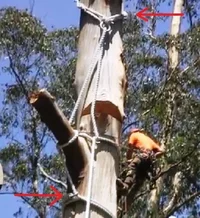
Here are some stills from the big rigging gone wrong vid that help you see the rigging set up more clearly, it's essentially a cradle rig that (in theory) doubles the breaking strength of the rope -


Did everyone understand how the rigging was set up? see pics below.
It was an interesting approach despite it's failure and granted it was not without it's flaws which most people here have mentioned.
As a talking point, how would you guys have tried to make it work if money and equipment was of no concern?
Just off the top of my head I was thinking 3 of the large dmm impact blocks beneath the notch with a combined total rating of 900kn breaking strength (not WLL, lets disregard that as we're dealing with experimental and exceptional circumstances) eye spliced Yale slings holding them in place (cow hitch) not great I know, bad bend radius already) but go with it for now.
The main rigging rope x 3 - Yale double esterlon 1" diam, rated at 44000 lbs breaking strength. Total breaking strength of 132000 lbs convert to KNs = 587 KNs.
The 3 ropes will be wrapped around/run through 3 Hobbs at the base of the tree, with the ropes locked off on each device. Pull the top out and make sure everyone is about half a mile away from the tree
Lets accept the tree could take the load, would it work?
Basically like Reg's dual block rigging but with 3 blocks instead of 2, and 3 hobbs as lowering devices
Here are some stills from the big rigging gone wrong vid that help you see the rigging set up more clearly, it's essentially a cradle rig that (in theory) doubles the breaking strength of the rope -
Attachments
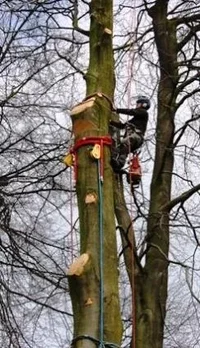
Just an 8 ton block in place of that shackle would have probably held well enough to uproot something!
jomoco
jomoco
TC
Participating member
[ QUOTE ]
Just an 8 ton block in place of that shackle
[/ QUOTE ]
the way they rigged it in that cradle configuration with the doubled rope idea, the rope would've possibly lasted a little bit longer in your 8 ton block than that shackle.
Exchange a big block for the top shackle in this pic, the lower shackle is just there to help keep the static end of the rope in place and also as a backup if the side limb had failed, but then the rope would've failed at that shackle for sure in that scenario, it the rope hadn't snapped and the timber was held up in the tree, would've been interesting to see how they lowered the hanging timber out of there, if the rope had dug into the wood etc -

Just an 8 ton block in place of that shackle
[/ QUOTE ]
the way they rigged it in that cradle configuration with the doubled rope idea, the rope would've possibly lasted a little bit longer in your 8 ton block than that shackle.
Exchange a big block for the top shackle in this pic, the lower shackle is just there to help keep the static end of the rope in place and also as a backup if the side limb had failed, but then the rope would've failed at that shackle for sure in that scenario, it the rope hadn't snapped and the timber was held up in the tree, would've been interesting to see how they lowered the hanging timber out of there, if the rope had dug into the wood etc -
Attachments

TreeCo
Carpal tunnel level member
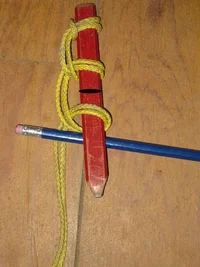
This probably would have worked better. On the ground three wraps around one tree then about six feet of slack so it could run some and then three wraps around another tree to bring it to a dead stop. The friction trees should be on the opposite side of the tree from where the load slams.

Attachments
TC
Participating member
I like that idea Treeco, doubles the breaking strength of their 25 ton 3 strand to 50 ton. They tried to do that a different way with their cradle idea.
BUT what about the inital rope on rope bite (just above the side limb) as that colossal piece of timber hits the rigging? probably a massive amount of damage to that section of the rope.
.
BUT what about the inital rope on rope bite (just above the side limb) as that colossal piece of timber hits the rigging? probably a massive amount of damage to that section of the rope.
.
I read that pic as no rope on rope after the piece falls, just rope on wood.
The rope may have failed through a pulley block, but nowhere near as quickly, and possibly not before tearing out that anchor tree.
It was an unusual setup, and would have been far stronger using a rated pulley block.
Rigging it like that at a seminar was not a good move at all IMO.
Rigging anything that heavy is crazy, but I love watching the result nonetheless
Thanks for posting it up Grover.
jomoco
The rope may have failed through a pulley block, but nowhere near as quickly, and possibly not before tearing out that anchor tree.
It was an unusual setup, and would have been far stronger using a rated pulley block.
Rigging it like that at a seminar was not a good move at all IMO.
Rigging anything that heavy is crazy, but I love watching the result nonetheless
Thanks for posting it up Grover.
jomoco
Reg
Branched out member
- Location
- Victoria, BC
[ QUOTE ]
A 25,000 lb. ABS rope catchhing a 10,000 lb. log negative rigging, using branch unions? No rigging blocks, no rope friction devices.
That's a 2.5 to 1 ratio on the rope. No way is that gonna hold, even using a 2 to 1 set up on the mass faling. It appears as though the rope broke at the shackle, like Jo said. Very small bend radius, on the shackle, for that rope, too. Way to many rope wraps on the 2 trees
The heaviest mass I'd take using a 25,000 lb ABS rope, negative rigging, using rigging blocks and rope friction devices would be 2,500 lbs.
What's the point of rigging a 10,000 lb log?
Did they know the tree was capable of supporting the forces generated?
They got lucky no one was hurt or worse.
[/ QUOTE ]
I thought the whole exercise was junk Norm, a couple of days ago. But since reading a little more into it, I dont believe the true objective was to successfully catch the log, more just to see what would happen, and if failure occurred, where and why.
So it failed at the shackle, predictably if at all. With a shackle, or block +5 of the rope then obviously you gain the strength increase of the 2:1 via compression where the line runs over the block/shackle. But such a block (pricey) probably would have got wasted, and to use a shackle +5 of a 40mm diam line would be extremely difficult to haul up there and set without a separate rigging system.
It does seem like a lot of time and drama for the sake of a post analysis at the workshop. But I suppose they just did it because they could....and had it in fact held, there would have been a lot less to discus. You probably had to be there.
A 25,000 lb. ABS rope catchhing a 10,000 lb. log negative rigging, using branch unions? No rigging blocks, no rope friction devices.
That's a 2.5 to 1 ratio on the rope. No way is that gonna hold, even using a 2 to 1 set up on the mass faling. It appears as though the rope broke at the shackle, like Jo said. Very small bend radius, on the shackle, for that rope, too. Way to many rope wraps on the 2 trees
The heaviest mass I'd take using a 25,000 lb ABS rope, negative rigging, using rigging blocks and rope friction devices would be 2,500 lbs.
What's the point of rigging a 10,000 lb log?
Did they know the tree was capable of supporting the forces generated?
They got lucky no one was hurt or worse.
[/ QUOTE ]
I thought the whole exercise was junk Norm, a couple of days ago. But since reading a little more into it, I dont believe the true objective was to successfully catch the log, more just to see what would happen, and if failure occurred, where and why.
So it failed at the shackle, predictably if at all. With a shackle, or block +5 of the rope then obviously you gain the strength increase of the 2:1 via compression where the line runs over the block/shackle. But such a block (pricey) probably would have got wasted, and to use a shackle +5 of a 40mm diam line would be extremely difficult to haul up there and set without a separate rigging system.
It does seem like a lot of time and drama for the sake of a post analysis at the workshop. But I suppose they just did it because they could....and had it in fact held, there would have been a lot less to discus. You probably had to be there.
New threads New posts
-
test
-
-

-

-
What's on your mind? TCI Magazine wants to know
- Started by Tree Care Industry Assoc.
- Replies: 23
-
 Apr 09 (Free CEUs) & May 07 - 'Urban Forestry Today' Webcasts @ Noon (Eastern)
- Started by UFT
- Replies: 0
-


