big rigging gone wrong vid

[ QUOTE ]


BUT what about the inital rope on rope bite (just above the side limb) as that colossal piece of timber hits the rigging? probably a massive amount of damage to that section of the rope.


.

[/ QUOTE ]

Yep, that is a problem but least both ropes are moving.
 
[ QUOTE ]


I thought the whole exercise was junk Norm, a couple of days ago. But since reading a little more into it, I dont believe the true objective was to successfully catch the log, more just to see what would happen, and if failure occurred, where and why.

[/ QUOTE ]

Ok,
Given that's true, why did they side load the tree? Couldn't they have taken a wrap or 1/2 wrap at the base of the tree?
They were all having a good laugh, but why break such a cardinal rule, then out it on youtube? MANY MEN have DIED becasue of side loading.. Its a bad example PERIOD!
 
[ QUOTE ]
[ QUOTE ]


I thought the whole exercise was junk Norm, a couple of days ago. But since reading a little more into it, I dont believe the true objective was to successfully catch the log, more just to see what would happen, and if failure occurred, where and why.

[/ QUOTE ]

Ok,
Given that's true, why did they side load the tree? Couldn't they have taken a wrap or 1/2 wrap at the base of the tree?
They were all having a good laugh, but why break such a cardinal rule, then out it on youtube? MANY MEN have DIED becasue of side loading.. Its a bad example PERIOD!

[/ QUOTE ]

I think the answer is in the paragraph you already quoted me on Dan....the last part especially, although I cant speak for the persons involved.

I do believe the whole thing was undertaken in a controlled environment, no persons on or within falling distance of the spar. If side loading and not the shackle had played the part in the faliure, then that would've presumably been the main talking point thereafter. It is not a how-to video.

A strategy/technique is a choice, as is climbing a tree in the first place....therefore only as dangerous as the people orchestrating the task of the particular situation. Doesn't matter who you are, its all about choices. If you make a bad choice, you own it.

 
Well said Reg. Some people can climb and rig wood out in a very safe manner such as yourself and others not so much. Choices is the key. It is critical that we all make the right choices while doing tree work, be it climbing or rigging...
 
[ QUOTE ]
As a talking point, how would you guys have tried to make it work if money and equipment was of no concern?

Just off the top of my head I was thinking 3 of the large dmm impact blocks beneath the notch with a combined total rating of 900kn breaking strength (not WLL, lets disregard that as we're dealing with experimental and exceptional circumstances) eye spliced Yale slings holding them in place (cow hitch) not great I know, bad bend radius already) but go with it for now.

The main rigging rope x 3 - Yale double esterlon 1" diam, rated at 44000 lbs breaking strength. Total breaking strength of 132000 lbs convert to KNs = 587 KNs.

The 3 ropes will be wrapped around/run through 3 Hobbs at the base of the tree, with the ropes locked off on each device. Pull the top out and make sure everyone is about half a mile away from the tree
smirk.gif


Basically like Reg's dual block rigging but with 3 blocks instead of 2, and 3 hobbs as lowering devices.

[/ QUOTE ]

The only way I would remove a 10,000 lb log is with a crane.

If 3 ropes were used, all 3 would have to have the same amount of tension, even amount of rope payed out from the 3 lowering persons. Too much guess work. Be safe. Take smaller pieces or use a crane.
 
[ QUOTE ]
If 3 ropes were used, all 3 would have to have the same amount of tension, even amount of rope payed out from the 3 lowering persons. Too much guess work. Be safe. Take smaller pieces or use a crane.

[/ QUOTE ]

I didn't plan to carry out the '3 rope' idea out.

The best way to make it work is to use loads of bull ropes tied round the timber using the natural crotch technique similar to Treeco's pic but more basic old school rigging for vert sections of timber.

I'm talking about using about 20 3/4" rigging lines, no metalware, take the wraps at the base of the tree, about 10 wraps per rope.

Pull the top out and watch what happens (preferably from a distance with binoculars), set up loads of video cameras.

Once the timber is hanging there, shoot the ropes with a shotgun until the whole piece collapses onto the ground.

If anyone has any alternatives to the shotgun (no, I dont mean an AK47) like a throwing axe or similar let me know.
 
I butt tied a fat 15-20K trunk to its stump using two5/8ths steel chokers and three 3/4 shackles, on a steep hillside, at night during a heavy storm.

It didn't even slow that log down a little bit. Just a loud crack and flames coming from where the steel cables parted. Much like a 12 gage blast in the dark.

The log went down the hillside, off a cliff, falling a few hundred feet before splashing into a river.

I knew it would fail, but not that easily with no perceptible slowing of the log at all.

Musta been the grease in the wire rope hitting the flashpoint temp real quick.

jomoco
 
They clearly laid out their reason for doing the experiment in the first 30sec of the video: "to promote ourselves" I take this as an entertainment vid and it actually was pretty entertaining!

jp
grin.gif
 
I would have liked to get everyones opinions prior to the log being toppled, it is very easy to watch the outcome and assume you would have predicted it.
On the day of the workshop the majority of those present felt we had a good chance of success, I was not so confident. As I had been swinging around the beast the day before I knew just how big it was. From a distance the scale of the rope to the log looked pretty good.
Our mission was simple, get some chunky gear and snatch a massive log. We were lucky to have a site with a dead 55m Mountain ash for us to play with.We deal with some pretty big trees from time to time so it was a great opportunity to try somthing different in a controlled environment.
As conventional rigging gear it not rated to handle the forces we intended to generate we had to improvise a bit. We opted to cradle rig the peice so we have a doubled rope catching the log and did not double the load on the anchor as is conventional rigging scenarios.As for a fifty tonne block that could accommodate the 2 eye splices, yeah it would have been great and if somone posts me one we will repeat it. Of course we knew what the consequence of the bend ratio was but thanks to all of those people who stated the obvious. I picked up the shackle a couple of days prior for $30, bargain.
So as to have plenty of rope between the friction at ground level and the rigging point we redirected the rope through a shackle attached to an adjacent tree, we did not have a sling long enough to go doubled around the tree being rigged. This introduced a bit of sidways action but not enough to worry about.
We would have loved to let her run but nobody put up there hand to estimate the friction required, dig their heels in and hang on, any volunteers? We relied on the stretch in the rope to decelerate the log.
In the end the rope snapped at a likley point but this was certainly not the only possibility of failure.
Just for the record it was not luck that stopped any persons being hurt or killed, we have been in the game a long time.
I will be happy to answer any questions.
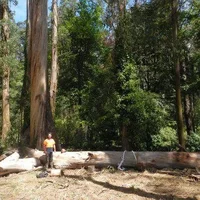
Here is a better shot of the size of the log.
 

Attachments

  • 352926-thelog.webp
    352926-thelog.webp
    70.7 KB · Views: 89
Do you know how to estimate the friction required? Ive read papers on coefficiency and bollard rope relationships but only relay on what seems right at the time and I wondered if anybody has a working rule of thumb. With the range of wrap size choice of bollard, tree, aluminium, steel and rope type it seems hard to quantify.
 
I understand ya but this guy in Japan has built a computer controlled friction device and he needs harder data than burnt thumbs, he's not sure how to differentiate between rope diameters, neither am I, gathered knowledge is hard to quantify. Thanks for the advice though....ill pass it on.
 
So that's the famous E. regnans!

What a monster!

Wonder why they're not happy in SoCal?

Took some serious huevos to rig that up!

jomoco
 
It would have been far more dynamic using a simple 8 ton block.

It was heat that parted that rope so easily.

Pulley blocks are as old school as the sea mate!

I love watching extreme catching dynamics play out below me while safely tied into a crane above.

Do it again with a block and record it from a safe distance, with a telephoto lens, in a bunker, through a slot.

jomoco
grin.gif
 
It was not parted so easily, the redirect sling at the base of the adjacent tree was melted together. It was a 25mm double braid tied with a cow hitch. I will post a pic of the break point of the rope, there is no sign of melting.
 
Yea, that anchor tree was rockin on its root plate big time!

But it sure looked to me as if the rope parted at the shackle, which I'm guessing got real hot, real quick.

jomoco
 
I got this. High blocks in surrounding trees, the more the merrier. No dynamic load. Pre tension them and the 10,000 piece will levitate. Set er in the back of a truck like a baby in a crib. When's spring coming?

Another thought I had was that fiddling music goes good with tree work videos.

edit--Then again I've never worked with a crane so I don't really know what 10,000lbs is. It may be bigger than I think.
 

New threads New posts

Back
Top Bottom