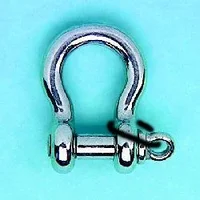
BF II shackle...

I still trust the shackle design. I did two things wrong that allowed that bolt to back out. I wore out the interference fit which is critical for that particular type of shackle and I failed to threadlock it.

What happened was MY fault, not a BF II design flaw.

With that said, I was pretty amazed at how little time it took for the bolt to come out. Something is going on there similar to what TreeCo has mentioned in the past that causes the bolt to rotate.
 
bigeyes.gif
Thanks for posting that Chip!
 
[ QUOTE ]
I wore out the interference fit which is critical for that particular type of shackle

[/ QUOTE ]

What is an intereference fit?

Too bad on the broken hand!! Hopefully he'll be good to go later this season. We met Mike Pressler this wknd at Bryant University. He's quite a guy and is intent on building the school into a D1 force.
 
An interference fit is the opposite of a clearance fit... the simple version is, the bolt is actually slightly larger than the hole so when you tighten it, the metal is more than tight, it interferes and will not vibrate loose.

Does that make sense? My machine shop terminology is from waay back in the past and kinda foggy. There is another type of fit and I can't remember it... tapered fit I think, which is what I think the shackle actually has.
 
[ QUOTE ]
Bryant University in Smithfield, RI?

[/ QUOTE ]

Yes, he's the coach there now after leaving Duke.
 
Shackles are no more or less useful or dangerous than biners. They all need constant inspection. How complex is your car? When was the last time anyone checked their lug nuts?
 
Sorry Tom but they now make double locking biners for a reason. I agree shackles are probably as safe as a regular biner but I don't think you would climb without a double locking biner. Would you?
 
I'm not making my point clear enough.

I've climbed on double lockers for decades, wouldn't have it any other way. After having a Stubai screwgate open up twice in about 3 weeks I bought Black Diamond SuperLocks. As soon as autolocking doublelockers came on the market I shifted again.

Back away and look a bit more globally. Everything has a failure mode. Knowing that and accounting for it in your work plan is critical. When are backups still backups? When are backups two components that work together?

Another way to look at this concept is to see if something is in series or parallel? What I mean is, do the components, when used together act as two seperate items, parallel or do they act in conjunction with each other, series. Not unlike batteries.

Parallel is 1+1=2
Series is 1+1=1

A shackle, when used correctly is as safe, maybe safer, than a biner. When used incorrectly by not tightening properly, checking or using threadlocker or a jam nut is not an indictment of the gear. This is the responsibility of the climber.

After doing gear inspections at comps and in the workplace I've found gear that was worn or didn't function correctly. Dangerous!

As I've said before, the procedure that I have followed with all shackles is to tighten them and then recheck every 7 or so days of climbing. I have NEVER found one loose. I realize that it's bad science to extrapolate one test too far.

Your mileage may vary :)
 
They make double locking biners because biners are made to constantly be opened and shut. Shackles are not made for the intent of being opened on a regular basis. I just bought some shackles to incorporate a butterfly bridge with my master saddle.

When buying them i was told to use a small zip tie to make certain that the pin doesn't back out. If you run the zip tie from the eye of the pin back to the shackle, after you have tightened with a pliers, it prevents the pin from backing out and doesn't allow it to twist at all. Its very simple and the zip tie can be cut and added very easily and inexpensively to make the shackle safe, time after time.
 

Attachments

  • 116629-116-fs.webp
    116629-116-fs.webp
    11.5 KB · Views: 60
I gotta chime back in so it's clear where I stand on this.

I love my BF II saddle, I have no interest in even trying out other saddles because I'm so happy with it. I'll buy a second one for my son... in fact, if anybody has a used small BF II for sale, let me know.

Nothing about my experience indicts the BF II bridge design or shackles in general.

I SCREWED UP. It's that simple. The manufacturer is clear that threadlocker should be used with the shackles. I was MODIFYING my bridge without any sanction from Komet Miller. I removed the shackles a number of times and re-tightened them... which wore out the threads. I should have replaced the shackles when I noticed they weren't as hard to tighten all the way down. I failed to use threadlocking compound after re-tightening.

The BF II shackles are the 'No snag bow' type. They don't have an ear you can wire or zip tie down. For $13.50 plus shipping you can replace the pair of them with regular bow shackles that have ears if you want.

I posted this because I know for a fact several people are using modified bridges and I want them to know the risk of cycling the shackle several times as well as failing to use a threadlocker.

Shackles that rely on interference fits work... it's an old, old principle with tons of data to support it. The problem with interference fits is that every time you turn the threads you're lapping the mating surfaces which makes them smoother and looser.

Without shackles, what should be used to attach a replaceable bridge that would be any safer? Carabiners aren't appropriate because they can side load and gate load easily in that configuration because they're too big. The Petzl Sequoia has a nifty ring that opens but it's still a metal and threads design.
 
I use no snag shackles for several applications.

http://www.bosunsupplies.com/products2.cfm?product=S0116-NS

Not having the eye on the pin makes for a more fair setup.

I would not accept the use of a nylon wire tie to secure the pin on a climbing harness. Many wire ties have broken in less 'active' surrounds than a harness. If, during a climb, the wire tie broke there could be the possibility of the pin unscrewing.

My allen wrench is on a leash in my harness all of the time.
 
I agree that a thread-locker should be used in conjunction with the shackle regardless the use of a zip tie or not. When i bought my shackles i was told that there should be some sort of visual prevention of the pin from backing out. Although the use of a thread-locker is appropriate it can not be seen and thus can't be proven to hold up in a visual inspection (if say ever ocia came on site).

I'm not saying that thread-locker isn't enough or sufficient, but it can't be visually inspected and if for any known reason the thread-locker either looses its adhesiveness or breaks loose and the pin starts backing out, it is going to be hard to notice until the pin fully falls out.

[ QUOTE ]
I would not accept the use of a nylon wire tie to secure the pin on a climbing harness. Many wire ties have broken in less 'active' surrounds than a harness. If, during a climb, the wire tie broke there could be the possibility of the pin unscrewing.

[/ QUOTE ] Although i have no proof or argument against that a zip tie wouldn't be sufficient i wouldn't know why it would not pass an inspection without conjunction of a thread-locker. Their obviously are guys that climb without thread-locker but would you ever doubt their bridge or set-up? If tightened properly wouldn't a zip tie really just be a back up, and how is that any less sufficient than any other type of back up?

I'm just asking questions, not challenging you. I know very little on this topic. Only saying what i've been told myself.
 
I just think shackles should be backed up with a wire tie similaer to countryboy's nylon zip tie. I have seen shackles come undone and wouldn't use one for personal safety without a back up. Ya I agree if used properly there shouldn't be a problem. Once I tie them shut I know there won't be a problem. Anyway I use buckingham saddles so I don't have to worry about this.
 
When you guys buy shackles, do you trust any stainless shackle you can purchase online that gives a minimum breaking strength of 5000lb? Is their any regulation as to their quality? Like CE?
When checking the shackles you are climbing on do you just check that the pins are tight without moving the pin? I have a friend that always checks his lug nuts when he gets gas. Tweaking them tighter and tighter each time. Because of this he strips lots of lug nuts which fuels his paranoia...another story.
 
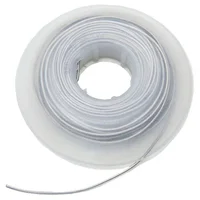
I'm going to try soft stainless wire used in aircraft and marine securing applications on my shackles. It's commonly used to secure shackle pins, bolts, nuts or hardware subject to vibrations. I think it would be tougher than tie wraps although not totally indestructible.

Found this interesting reference on the use of locking wire...

http://www.byrongliding.com/lockwire.htm
 

Attachments

  • 116682-sswire.webp
    116682-sswire.webp
    13.8 KB · Views: 39
I don't think those shackles were meant to be taken on and off repeatedly. After I theaded mine on with loctite I didn't remove them until they came off permanently.
 
Thread locking compounds are used in industrial and mechanical situations that would astound you. I am familiar with LockTite and trust the company's products. Whenever I LT something I clean both components and also use LT primer.

Years ago I had a drum chipper and the bearing that supports the drum on the opposite side from the belts slipped on the shaft. It galled/chewed away a layer of shaft. I thought that I was going to have to have the drum pulled, material welded on, machined true and rebuilt. But!!! there was about 3/32" of the shaft that the bearing would sit on that wasn't galled. A millwright friend of mine told me which LT product to get. I prepped everything and reassembled the works. The bearing was about 2-2.25" thick and8-10" diameter, the shaft was about 3" diameter or so. After letting the LT cure for a day the chipper went back into service. I hammered wood through that machine for another year and never heard any rumblings from that bearing. Find out from a millwright how trustworthy LT is. Amazing stuff!

There are plenty of stories about gear failures. I have to wonder if these 'failures' were caused by operator malfunction. Where the shackles in this case tightened to the proper torque? How often are they inspected by a qualified inspector? What does a person inspect for?

Shackles are common pieces in sailing where the shock loads would far exceed what they would experience on an arbo's harness. If they are installed and inspected according to accepted guidelines they can be depended on. I do.
 
My prediction is as the use of these shackles becomes more widespread in arbor gear the accident and fatalities associated with their use is going to result in them not being allowed for critical life support attachments.
 

New threads New posts

Back
Top Bottom