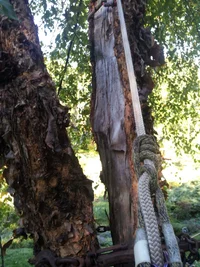
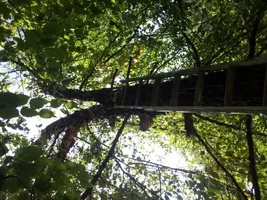
Betula nigra clump

Location
Orange, MA
Ok, I had several semi oddball questions I had bouncing around in my head awhile, but go figure, I didnt write them down so seem to have forgotten them for time being. I can even recall telling myself on friday to send myself a text as a reminder as to what the questions were, oh well.

Only one I can remember is being curious as to how they propogate/produce river birch clumps? I was told by an uncertain individual that he believed they literally just rubberbanded sprouts together as the seeds germinated, and thats how it works out. Depending on how far down the stem you cut, would you ever end up with a single bole, or would you always have 3 or 4 or whatever the flavor number of boles in the trunk? Do the root systems ever coalesce to the point of being a single functioning system, or could you damage all the roots to one stem and leave the other stems unaffected?

Theres more, wish I could remember, guess I'll add them on later when/if I think of them.......
 
I believe they cut to the ground in the nusery and the root sends up several 'stump sprouts' and that is your clump birch.
 
I worked in a nursery for a while, we put 3 individuals together to make a clump. You could try the stump sprout method though, it seems that would work.
 
Ok, now say you have codoms in a small tree you are training/pruning for structure. If you subordinate one, to the point it loses a majority of it's foliage and/or length, will it taper up at a slower rate or will the stem continue to taper/diameter up at the same rate as the unsubordinated stem?
 
Slower. By a lot. I prefer the banding three together technique, think of the ugly crotches you get from stump sprouts.

Tim
 
What's the strength of this codominant structure in river birches? It's so very common. When targets are present, should they be braced/cabled as they grow larger?
 
I cant help you much on the clumping thing. However I would assume that they would root graft at the very least. Yes the diameter growth would be drastically reduced with heavy pruning.

Around here it's not too uncommon to find douglas fir stumps callusing over. I have one in my sample pile, which I ripped. You can see the felling cuts and hinge, and it's fully occluded. This is due to root grafts, where the remaining tree will compartmentalize the wound. Some of these can be as far as 30' from the nearest tree. I assume that many other species can do this as well to some degree, so much we don't know about underground!

This is a river birch, which had a co dom top. It was splayed out and for about 20' on either side. It was very hard to believe that it could support this leverage. Counting the rings on the rams horns, it was like this for about 3-5 years...

2015-09-08 15.09.34.jpg2015-09-12 10.13.02.webp
 

Attachments

  • 2015-09-08 15.09.34.webp
    2015-09-08 15.09.34.webp
    784.4 KB · Views: 3
This spring we planted many three stem river birches grown in 20-25 gallon pots. Since we only get one chance to plant a tree I would do the prep work on the roots. Knocking the clumps out of the pots usually showed a thick mat of circled roots. A few whacks with an old polesaw blade loosened the ball. Then I shaved and poked on the top til I found the first order roots. Once the 'pot roots' were shaved off the top I was done

So...as usual a long story...what I found was that there were always three stems clumped together. I had to be careful not to loosen the intertwined roots and de-clump them. On some it would have been easy. The stems were about 1.5"

In the past when I've removed wind blown clumps I found that the larger stumps were sort of grafted or spliced together. The roots were certainly intertwined by the time the clumps got to be about 4" dia
 
I'm using "codominant" broadly--I mean it to include multiple trees pressed/grafted together at their bases. River birches are intentionally planted near buildings and parking areas to exhibit what in other trees is this failure-prone structure. Is a mature, codominant Betula nigra not a problem?
 
I think about this every year these clusters show up at the local nursery. My question is, should they not be better off to put a considerable amount of space between all the stems? Or could those installing the plants spec 3+/- independant plants in close enough proximity for the desired effect without the inclusions?
 

New threads New posts

Back
Top Bottom