
My question here is for competition climbing but this area gets more attention. Alright so if you're going up single line and put a VT about your ascender to back it up off of a carabiner and you're running double rope off a pulley you have attached to the bottom of the ascender do you still have to tie a marlin spike or other stopper knot with a carabiner in order to back it up again even though you've got your ascender already backed up? Or is it if you tie your stopper below that you get more points for working safer?

Navigation
Install the app
How to install the app on iOS
Follow along with the video below to see how to install our site as a web app on your home screen.
Note: This feature may not be available in some browsers.
More options
You are using an out of date browser. It may not display this or other websites correctly.
You should upgrade or use an alternative browser.
You should upgrade or use an alternative browser.
Backing up petzl ascender
- Thread starter PUClimber
- Start date

- Location
- Canon City ,CO
If I understood your scenario correctly I would consider it all a "no-go " in competion. If your are working DdRT from a pulley hanging off a Petzl ascender it should be called unacceptable because the Petzl isn't rated high enough in breaking strength. Toothed ascenders in general are (IMO) pretty iffy for hanging a work systen off of. This doesn't mean that they are unsafe- I use them for ascent but do not feel sanguine about working of one when possible slack and additional dynamic loading are added into the scenario.
Now that I've spouted off some of the guys with a lot more competion experience than I can set us both straight.
By the way-if you hung your pulley off of the V.T. on the SRT access line and backed the V.T. up(Instead of using the V.T. to back up a weak framed ascender) I would consider that perfectly acceptable.
Now that I've spouted off some of the guys with a lot more competion experience than I can set us both straight.
By the way-if you hung your pulley off of the V.T. on the SRT access line and backed the V.T. up(Instead of using the V.T. to back up a weak framed ascender) I would consider that perfectly acceptable.
The top holes of the ascension are designed to take a factor one fall, as petzl show it being OK to use it for self lining an 11mm rope in this fashion. Used this way, the rope cannot slip due to it pulling out of the shell.
http://en.petzl.com/ProduitsServices/B17%20ASCENSION%20B17502-F1.pdf
Further, the cam is rated to shred the sheath of a true kernmantle rope at 6kN on 11mm. The body of the top holes are rated for 17kN.
Therefore we can conclude, that the ascension is strong enough to be used in this way. The remaining risk of the cams shredding the sheath (which carries little strength - and certainly won't dump you on the floor), can be removed by tying a knot in the line immediately below. The shell of the ascender will remain on the rope, only to slip as far as the knot. I'd use a butterfly for work, because I can then reascend the fixed line. You won't shred the rope if you don't climb with slack.
So, to answer the question, I don't know about comps, but if you were to work with me, that is what I would approve. A knot should always go below in this situation (that won't pull out with the weight of the rope below).
A short energy absorber can be clipped from the ascension top holes to the pulley karabiner of the DdRT set up, to be super safe, although the entire access rope going up and down to you will do a good job of absorbing any factor 1 fall from work positioning (providing it passes EN 1891 type A).
Or better still, clip your DdRT set up into the alpine butterfly below the ascender. Take your ascender with you, and reascend the fixed line afterward (with the croll you have attached to the harness). You still have your work line in the knot to protect you when you pass the knot. Which is why these type of ascenders are favoured in other access work - quick and easy to take on and off.
This is an occasional set up - I think it best to self belay as in DdRT, or dead end the access line in the tree when work positioning - chainsaws and 'forgetting' the rope holding your life is the other side of the trunk, can lead to disaster. Not to mention trigger happy groundies cutting the rope from below - oops! Sorry Boss! /forum/images/graemlins/crazy.gif I'm currently working on a fail safe for this.
http://en.petzl.com/ProduitsServices/B17%20ASCENSION%20B17502-F1.pdf
Further, the cam is rated to shred the sheath of a true kernmantle rope at 6kN on 11mm. The body of the top holes are rated for 17kN.
Therefore we can conclude, that the ascension is strong enough to be used in this way. The remaining risk of the cams shredding the sheath (which carries little strength - and certainly won't dump you on the floor), can be removed by tying a knot in the line immediately below. The shell of the ascender will remain on the rope, only to slip as far as the knot. I'd use a butterfly for work, because I can then reascend the fixed line. You won't shred the rope if you don't climb with slack.
So, to answer the question, I don't know about comps, but if you were to work with me, that is what I would approve. A knot should always go below in this situation (that won't pull out with the weight of the rope below).
A short energy absorber can be clipped from the ascension top holes to the pulley karabiner of the DdRT set up, to be super safe, although the entire access rope going up and down to you will do a good job of absorbing any factor 1 fall from work positioning (providing it passes EN 1891 type A).
Or better still, clip your DdRT set up into the alpine butterfly below the ascender. Take your ascender with you, and reascend the fixed line afterward (with the croll you have attached to the harness). You still have your work line in the knot to protect you when you pass the knot. Which is why these type of ascenders are favoured in other access work - quick and easy to take on and off.
This is an occasional set up - I think it best to self belay as in DdRT, or dead end the access line in the tree when work positioning - chainsaws and 'forgetting' the rope holding your life is the other side of the trunk, can lead to disaster. Not to mention trigger happy groundies cutting the rope from below - oops! Sorry Boss! /forum/images/graemlins/crazy.gif I'm currently working on a fail safe for this.

- Location
- SE UK
Funnily enough i did just what you suggest today. My ART rope guide got stuck at the end of the day (don't they always). I'd installed an access line dead ended on the ground through a cambium saver in the tree ready to access the tree again tomorrow. I re-accessed the tree using a pantin and an ascender then set up a work postion line to move across to just below my sturck ART. I flicked it out easily then exited the tree using an 8.

- Location
- Seattle WA
i actually used a similar scenario in the aerial rescue event in MN and came w/in a hair of being DQed. i wanted to ascend with a blue handled ascender, backed up above w/a triple prusik, with my regular ddrt system running off a biner through the top hole of the ascender. at the inspection on fri i ran this by 3 judges/techs and was told i had to run my ddrt off the bottom hole of the ascender due to an issue of potential rope angles - which i thought was weird but i'm just a competitor, right? my understanding was that, as stated above, clipping a biner through the top hole (with or w/o a system running off it) is the only secure way to use this ascender as the rope physically can't seperate from the device even if the cam fails. turns out the judge in the tree disagreed with what the others had said, but it was allowed because i'd been told to do it the first way. i did have a knot (butterfly) below the ascender.
so the real answer, i think, about what comps will allow is that it's all still in the process of being determined, and communicated on down the line to judges/techs/competitors/working arborists. definitely did not serve me that time to get creative with my gear. i didn't dq but i got a pretty dang low score..
k.
so the real answer, i think, about what comps will allow is that it's all still in the process of being determined, and communicated on down the line to judges/techs/competitors/working arborists. definitely did not serve me that time to get creative with my gear. i didn't dq but i got a pretty dang low score..
k.

- Location
- Bloomington, Indiana
[ QUOTE ]
Funnily enough i did just what you suggest today. ....I'd installed an access line dead ended on the ground through a cambium saver in the tree
[/ QUOTE ]
But that sounds different from what Lazurus desribed:
[ QUOTE ]
or dead end the access line in the tree when work positioning -
[/ QUOTE ]
The system that he described is dead-ended (choked) <u>in</u> the tree. Your system (if I understand it correctly) was dead-ended <u>on the ground</u>.
Funnily enough i did just what you suggest today. ....I'd installed an access line dead ended on the ground through a cambium saver in the tree
[/ QUOTE ]
But that sounds different from what Lazurus desribed:
[ QUOTE ]
or dead end the access line in the tree when work positioning -
[/ QUOTE ]
The system that he described is dead-ended (choked) <u>in</u> the tree. Your system (if I understand it correctly) was dead-ended <u>on the ground</u>.
Kathy
I wonder if you'd have been rewarded for the extra 3 seconds it'd take to clip the alpine butterfly and avoid the whole ascender issue?
The technical standards issue of comps certainly needs resolving.
Maybe try it next time and win the whole event (It was always footlock and rescue that got me in the masters at the nationals - ha! footlock! fancy that! ).
Mahk, thanks for the succinct explanation! /forum/images/graemlins/grin.gif
I wonder if you'd have been rewarded for the extra 3 seconds it'd take to clip the alpine butterfly and avoid the whole ascender issue?
The technical standards issue of comps certainly needs resolving.
Maybe try it next time and win the whole event (It was always footlock and rescue that got me in the masters at the nationals - ha! footlock! fancy that! ).
Mahk, thanks for the succinct explanation! /forum/images/graemlins/grin.gif
Well I use the blue right handed ascender and the termination end of the single rope is at the base of the tree through a grigri. So the consensus I am hearing is that the material itself the ascender is constructed out of is not rated to work off as far as the holes in the base and the top. I will try to get some pictures of the system and get them posted.
- Location
- SE UK
Mahk, your right, bad day this end lol 

NickfromWI
Participating member
- Location
- Los Angeles, CA
PUClimber, that photo didn't work for me...
- Location
- Bloomington, Indiana
[ QUOTE ]
My question here is for competition climbing but this area gets more attention. Alright so if you're going up single line and put a VT about your ascender to back it up off of a carabiner and you're running double rope off a pulley you have attached to the bottom of the ascender do you still have to tie a marlin spike or other stopper knot with a carabiner in order to back it up again even though you've got your ascender already backed up? Or is it if you tie your stopper below that you get more points for working safer?
[/ QUOTE ]
Good question. These are the relevant sections from the 2006 ITCC rules:
2.2.26 Contestants who utilize a mechanical ascender, as a part of a static climbing system, must also include a system of backup to protect against an ascender malfunction. Mechanical ascenders, on a static line, can be backed up with another ascender on the same line or a pliable Prusik cord that is placed above the mechanical ascender and on the same line as the ascender. If a double-line static climbing system is used, both sides of the static line must be backed up independently. Prusik cordage must meet the requirements of 2.2.21 and must be able to immediately grip and hold the line and support the contestant’s weight should an ascender fail. All mechanical ascender-climbing systems are subject to the Special Advisor’s prior approval. (2006)
2.2.27 Contestants may work from a static ascending line provided that a separate, approved overhead climbing system is anchored to the static ascending line. Fall-protection anchoring systems must include a stopper knot or hitch on the static line below the anchoring system. Techniques for working from a static line with an anchoring system attached to the static line must be demonstrated prior to use and during gear inspection, and must have prior approval of the Special Advisor. (2006)
2.2.28 Contestants will not be permitted to place their hands on or near the cams of spring-loaded cam-
I think that, once you stop to work, you do need a stopper knot.
My question here is for competition climbing but this area gets more attention. Alright so if you're going up single line and put a VT about your ascender to back it up off of a carabiner and you're running double rope off a pulley you have attached to the bottom of the ascender do you still have to tie a marlin spike or other stopper knot with a carabiner in order to back it up again even though you've got your ascender already backed up? Or is it if you tie your stopper below that you get more points for working safer?
[/ QUOTE ]
Good question. These are the relevant sections from the 2006 ITCC rules:
2.2.26 Contestants who utilize a mechanical ascender, as a part of a static climbing system, must also include a system of backup to protect against an ascender malfunction. Mechanical ascenders, on a static line, can be backed up with another ascender on the same line or a pliable Prusik cord that is placed above the mechanical ascender and on the same line as the ascender. If a double-line static climbing system is used, both sides of the static line must be backed up independently. Prusik cordage must meet the requirements of 2.2.21 and must be able to immediately grip and hold the line and support the contestant’s weight should an ascender fail. All mechanical ascender-climbing systems are subject to the Special Advisor’s prior approval. (2006)
2.2.27 Contestants may work from a static ascending line provided that a separate, approved overhead climbing system is anchored to the static ascending line. Fall-protection anchoring systems must include a stopper knot or hitch on the static line below the anchoring system. Techniques for working from a static line with an anchoring system attached to the static line must be demonstrated prior to use and during gear inspection, and must have prior approval of the Special Advisor. (2006)
2.2.28 Contestants will not be permitted to place their hands on or near the cams of spring-loaded cam-
I think that, once you stop to work, you do need a stopper knot.
- Location
- Bloomington, Indiana
[ QUOTE ]
i actually used a similar scenario in the aerial rescue event in MN and came w/in a hair of being DQed. i wanted to ascend with a blue handled ascender, backed up above w/a triple prusik, with my regular ddrt system running off a biner through the top hole of the ascender. at the inspection on fri i ran this by 3 judges/techs and was told i had to run my ddrt off the bottom hole of the ascender due to an issue of potential rope angles - which i thought was weird but i'm just a competitor, right? my understanding was that, as stated above, clipping a biner through the top hole (with or w/o a system running off it) is the only secure way to use this ascender as the rope physically can't seperate from the device even if the cam fails. turns out the judge in the tree disagreed with what the others had said, but it was allowed because i'd been told to do it the first way. i did have a knot (butterfly) below the ascender.
so the real answer, i think, about what comps will allow is that it's all still in the process of being determined, and communicated on down the line to judges/techs/competitors/working arborists. definitely did not serve me that time to get creative with my gear. i didn't dq but i got a pretty dang low score..
k.
[/ QUOTE ]
I was the official that Kathy referred to who was in the tree in the aerial rescue event at the ITCC. But, I was a technician, not a judge and did not have the authority to disqualify anyone from the competition. A technician can, however, require someone to change something that they think is unsafe, and, in that sense the technician might cause the competitor a delay, and therefore a lower score, or the delay could cause the competitor to time out of the event. And I sometimes sent questionable climbing systems down to the scoring judges after a competitor had completed an event in order to make the judges aware of what the competitor had done and to let the scoring judges decide how to assess points.
Although I think that it is usually best for officials to stay out of discussions about specific performances, I am responding here because I think the discussion is really about safe work practices and not about subjective opinions of a particular performance.
The next few posts detail the setup that Kathy used in that aerial rescue and explain when and why it was an unsafe setup. The photos are mine and simply try to replicate what Kathy did. The only reason I’m doing this is to show how easy it can be to go from a safe system with adequate backup, to an unsafe system with a high potential for an accident.
Kathy said that she had initially wanted to use the upper hole of the ascender for her system and was told by “…3 judges/techs…” that she had to use the bottom hole. I think those officials were wrong. Kathy also said:
[ QUOTE ]
so the real answer, i think, about what comps will allow is that it's all still in the process of being determined, and communicated on down the line to judges/techs/competitors/working arborists.
[/ QUOTE ]
That’s true and I hope threads like this help to disseminate safe, workable systems to all climbing arborists.
i actually used a similar scenario in the aerial rescue event in MN and came w/in a hair of being DQed. i wanted to ascend with a blue handled ascender, backed up above w/a triple prusik, with my regular ddrt system running off a biner through the top hole of the ascender. at the inspection on fri i ran this by 3 judges/techs and was told i had to run my ddrt off the bottom hole of the ascender due to an issue of potential rope angles - which i thought was weird but i'm just a competitor, right? my understanding was that, as stated above, clipping a biner through the top hole (with or w/o a system running off it) is the only secure way to use this ascender as the rope physically can't seperate from the device even if the cam fails. turns out the judge in the tree disagreed with what the others had said, but it was allowed because i'd been told to do it the first way. i did have a knot (butterfly) below the ascender.
so the real answer, i think, about what comps will allow is that it's all still in the process of being determined, and communicated on down the line to judges/techs/competitors/working arborists. definitely did not serve me that time to get creative with my gear. i didn't dq but i got a pretty dang low score..
k.
[/ QUOTE ]
I was the official that Kathy referred to who was in the tree in the aerial rescue event at the ITCC. But, I was a technician, not a judge and did not have the authority to disqualify anyone from the competition. A technician can, however, require someone to change something that they think is unsafe, and, in that sense the technician might cause the competitor a delay, and therefore a lower score, or the delay could cause the competitor to time out of the event. And I sometimes sent questionable climbing systems down to the scoring judges after a competitor had completed an event in order to make the judges aware of what the competitor had done and to let the scoring judges decide how to assess points.
Although I think that it is usually best for officials to stay out of discussions about specific performances, I am responding here because I think the discussion is really about safe work practices and not about subjective opinions of a particular performance.
The next few posts detail the setup that Kathy used in that aerial rescue and explain when and why it was an unsafe setup. The photos are mine and simply try to replicate what Kathy did. The only reason I’m doing this is to show how easy it can be to go from a safe system with adequate backup, to an unsafe system with a high potential for an accident.
Kathy said that she had initially wanted to use the upper hole of the ascender for her system and was told by “…3 judges/techs…” that she had to use the bottom hole. I think those officials were wrong. Kathy also said:
[ QUOTE ]
so the real answer, i think, about what comps will allow is that it's all still in the process of being determined, and communicated on down the line to judges/techs/competitors/working arborists.
[/ QUOTE ]
That’s true and I hope threads like this help to disseminate safe, workable systems to all climbing arborists.
- Location
- Bloomington, Indiana
When Kathy entered the tree she went up a single line that was anchored at the base of the tree through a GRi-Gri. Kathy had a Prusik cord/tether that was attached to the single line with a three wrap Prusik knot and the cord/tether was connected directly to her saddle with a carabiner. On the single line below the Prusik she had a Blue Petzl Ascension, which is a single handled, right-handed ascender. On the bottom hole of the ascender she had a pulley and through the pulley was a doubled climbing line that was attached to her saddle (see attachment). This is perfectly legitimate according to the rules quoted in the post above (see 2.2.26). She had a secure connection to the ascender and the Prusik served as an independent backup to the ascender.
Attachments
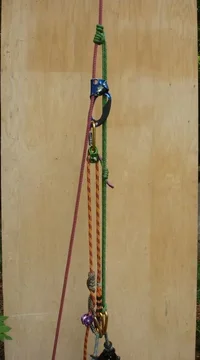
- Location
- Bloomington, Indiana
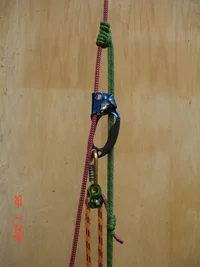
- Location
- Bloomington, Indiana
As Kathy was ascending, two of her carabiners became crossloaded. After she had stepped off onto a branch and as she was putting on her lanyard I called out 'Your ‘biners are side loaded’. She responded ‘I know’ and, after she had secured her lanyard, proceeded to fix the carabiners.
She then tied a butterfly knot in the single line below the ascender. She unclipped the carabiner that attached the prusik cord/tether to her saddle and clipped this carabiner in the loop of the butterfly knot (see attachment).
She then tied a butterfly knot in the single line below the ascender. She unclipped the carabiner that attached the prusik cord/tether to her saddle and clipped this carabiner in the loop of the butterfly knot (see attachment).
Attachments
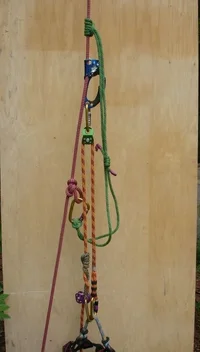
- Location
- Bloomington, Indiana
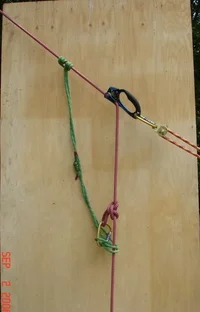
As soon as she did this she removed her lanyard and started moving out the limb towards the victim/dummy. As she did this the angle of her rope began to change (see attachment). The only thing that was holding her to the single ascent line was the blue ascender. The butterfly knot would stop the ascender if the ascender slipped down the ascent line, but there was nothing to back up the ascender if the ascender popped off of the ascent line. I looked at Kathy, then looked back at the ascender setup to see if I was missing something.
Attachments
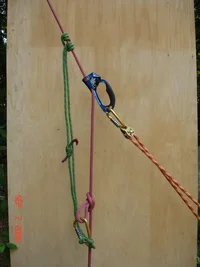
- Location
- Bloomington, Indiana
As Kathy moved in the tree the ascender reached a sharper angle (see attachment) and occasionally banged against an adjacent tree limb. I was about to tell Kathy to lanyard in so that she could reset her system when she swung back to the middle of the tree and descended to the ground. After she completed the event I asked one of the ground crew to take the ascent line out of the Gri-Gri and I sent the entire system down for the scoring judges to see.
Attachments
- Location
- Bloomington, Indiana
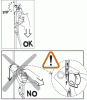
The last attachment shows a stationary mock-up of the ascender setup. In the actual competition the angle may have been more severe, the ascender was occasionally hitting a tree limb, there was frequent loading and unloading of the lines, and there was a lot more force involved. Petzl (the manufacturer of this ascender) gives specific warnings not to load the ascender in this manner--see this attachment, and image 7 at this link:
http://en.petzl.com/ProduitsServices/B17%20ASCENSION%20B17502-F1.pdf
http://en.petzl.com/ProduitsServices/B17%20ASCENSION%20B17502-F1.pdf
Attachments
- Location
- Bloomington, Indiana
In this and other threads people have raised questions about what type of gear is appropriate for ascending in tree care and what holes can be used in certain models of ascenders. This question of gear ratings really needs to be looked at more closely. In the June TCI magazine Daniel Murphy wrote a great article about footlocking which was discussed in this TreeBuzz thread:
http://www.treebuzz.com/forum/showflat.php?Cat=0&Number=50708&an=0&page=3#50708
(the thread also gives a link to an on-line copy of the article).
In the article it is stated:
“All ascenders carabiners, screw links, and shackles must be rated at a minimum of 5,000 pounds and meet other ANSI guidelines.”
Although there were some great points about technique, much of the gear that was shown does not meet the 5,000 pound rating that the author says it must. In Figure 2 the blue ascender on the right is a Petzl Ascension, rated at 18 kN for the top hole, and 20 and 15 kN for the bottom holes. See
http://en.petzl.com/ProduitsServices/B17%20ASCENSION%20B17502-F1.pdf
Below the Ascension is a Croll, which is rated at 12 kN for the bottom hole and 5 kN for the top hole (the top hole is really just a guide for the chest harness):
http://en.petzl.com/ProduitsServices/B16_%20CROLL_%20B16500-03.pdf
To the left of these is a Microcender. I haven’t been able to find a rating for this on the web or in any of the product literature
http://en.petzl.com/ProduitsServices/B54MicrocenderB54500%20040598_1.pdf
so (a couple of years ago) I wrote some emails to various sources and found that the shell of the Microcender is rated at about 3500 pounds.
On the rope with the Microcender is a Kong double handled ascender (called Twin Ascender by Kong). I haven’t been able to find any specs on this ascender in the literature or on the web, but I would guess that it is rated about the same as the ascenders made by the other manufacturers i.e. about 20 kN.
These ascenders are shown throughout the article, but none of them meet the ANSI Z 133.1 criteria for tree climbing (I am not familiar with standards outside of the US, so I don’t know if they are acceptable in other countries or not).
This is not meant to discredit Daniel Murphy, but only to point out how certain pieces of equipment have been quietly accepted into the tree industry without any discussion or research. Other ascenders which are widely used, but are also below the Z133 requirements are the CMI Expedition and the CMI Double-Handled Expedition ascenders, both rated at 4,000 pounds:
http://www.cmi-gear.com/catalog/ascenders/expasc.asp
and the CMI large Ultrascenders, rated at 4,600 pounds:
http://www.cmi-gear.com/catalog/ascenders/large.asp
http://www.treebuzz.com/forum/showflat.php?Cat=0&Number=50708&an=0&page=3#50708
(the thread also gives a link to an on-line copy of the article).
In the article it is stated:
“All ascenders carabiners, screw links, and shackles must be rated at a minimum of 5,000 pounds and meet other ANSI guidelines.”
Although there were some great points about technique, much of the gear that was shown does not meet the 5,000 pound rating that the author says it must. In Figure 2 the blue ascender on the right is a Petzl Ascension, rated at 18 kN for the top hole, and 20 and 15 kN for the bottom holes. See
http://en.petzl.com/ProduitsServices/B17%20ASCENSION%20B17502-F1.pdf
Below the Ascension is a Croll, which is rated at 12 kN for the bottom hole and 5 kN for the top hole (the top hole is really just a guide for the chest harness):
http://en.petzl.com/ProduitsServices/B16_%20CROLL_%20B16500-03.pdf
To the left of these is a Microcender. I haven’t been able to find a rating for this on the web or in any of the product literature
http://en.petzl.com/ProduitsServices/B54MicrocenderB54500%20040598_1.pdf
so (a couple of years ago) I wrote some emails to various sources and found that the shell of the Microcender is rated at about 3500 pounds.
On the rope with the Microcender is a Kong double handled ascender (called Twin Ascender by Kong). I haven’t been able to find any specs on this ascender in the literature or on the web, but I would guess that it is rated about the same as the ascenders made by the other manufacturers i.e. about 20 kN.
These ascenders are shown throughout the article, but none of them meet the ANSI Z 133.1 criteria for tree climbing (I am not familiar with standards outside of the US, so I don’t know if they are acceptable in other countries or not).
This is not meant to discredit Daniel Murphy, but only to point out how certain pieces of equipment have been quietly accepted into the tree industry without any discussion or research. Other ascenders which are widely used, but are also below the Z133 requirements are the CMI Expedition and the CMI Double-Handled Expedition ascenders, both rated at 4,000 pounds:
http://www.cmi-gear.com/catalog/ascenders/expasc.asp
and the CMI large Ultrascenders, rated at 4,600 pounds:
http://www.cmi-gear.com/catalog/ascenders/large.asp
New threads New posts
-
test
-

-
-
 Fruit tree holding on by a thread, client wants to get another year out of it. Thoughts?
- Started by climbingmonkey24
- Replies: 40
-
-

-


