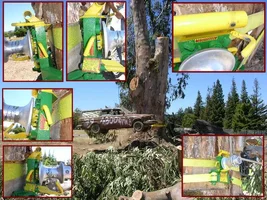
Are you considering a lowering and lifting device?

Re: Are you considering a lowering and lifting dev

I mean know disrespect to any of the folks who provide the GRCS lowering and lifting device for the general public to purchase and use in the field.

I will however provide the end users a small piece of advice so you don't, maybe, get killed on the job.

If you are using the attachment that is intended to lift objects with, be cautioned that it can and has exploded during the operations of lowering.

If you intend to lower extremely heavy objects, which the heads of the device to the fixed drum.(of course not during the lowering process)

I mention this concern to all users of the GRCS device so that at least you will be alert and can caution everybody you instruct.

The GRCS is a wonderful device when used and installed correctly and managed properly.

The attachment will show you what happens when you don't heed caution and excercise discretion when lowering heavy objects.

Again in closing, I did not mean any ill harm with this information, just a reminder to read the instruction manual and listen to the advise of exprienced users.
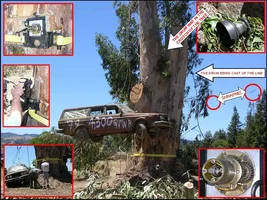
 

Attachments

  • 113170-VOLVODROPINPICTUREIT.webp
    113170-VOLVODROPINPICTUREIT.webp
    139.9 KB · Views: 160
Re: Are you considering a lowering and lifting dev

In response to over lapping with the HOBB's lowering device .
It depends on whether you have an old unit or a new unit? If you have an older unit the answer would be yes you could have problems overlapping.
If you have the new H-2 HOBB'S the answer would be NO the unit does not over lap during the lowering procedure.
 
Re: Are you considering a lowering and lifting dev

Anyone have SWL and MBS numbers on the Harken? (not looking for Greg Good's rule of thumb looking for Harken's......which may or may not be the same
grin.gif
)
 
Re: Are you considering a lowering and lifting dev

The load that popped the drum of the GRCS was much heavier than any sensible person would ever put on the device. The Hobbs failed at that point too.

I like the Hobbs and have used it on many occasions. I hope to try the GRCS someday too. Heck I'd own both if I could afford it.
 
Re: Are you considering a lowering and lifting dev

sohner,

thanks for the heads up...however, if youll notice the gvwr on the side of that car, you can see why it failed.

IMHO, if a guy is dumb enought to load that much onto his equip, he deserves to trash it.
 
Re: Are you considering a lowering and lifting dev

perhaps mean spirited and misleading statement Robert/Sohner.

Despite our personal preferences in which device we prefer, let us at least attempt the concept of impartiality & accuracy concerning the safety of these devices.

I am surprised you would write such a statement. You have always struck me as a person of honesty and integrity in regards to your professionalism with the tree industry.

I still believe that you are, but this particular discussion has gotten out of hand.


The Argument from Intimidation is a confession of intellectual impotence.
Ayn Rand (1905 - 1982)


After re-reading your 'warning' post Robert /Sohner, I have decided to recuse myself from any further hobbs/grcs discussions with you in public.

I have no wish to get into a personalized discussion/vendetta with you regarding these devices. I have my opinion, and you, have yours.

Respectfully,
Frans
 
Re: Are you considering a lowering and lifting dev

Yes the limits were excessive for any lowering device. But at what point was the threshold crossed?

If you review the attachment you'll see for yourself what happened to the Hobb's lowering device under the same scenario.

The infeed guide hook bend because the rope was not aligned properly.

The drum was slighly distorted but did not suffer catastrophic failure.

Bottom line the unit did not fail even under extreme loading conditions. In otherwords it held the car from hitting the ground. What more can you ask of any device?
 

Attachments

  • 113247-Hobbstestwithvolvo.webp
    113247-Hobbstestwithvolvo.webp
    150.9 KB · Views: 100
Re: Are you considering a lowering and lifting dev

Your welcome .

I couldn't agree more, that anyone dumb enough to load that much into their rigging system deserves to have their equipment trashed.

A person has to understand their limitations and all good things should be used in moderation.
 
Re: Are you considering a lowering and lifting dev

Think what you will and say what you want.

" Facts do not cease to exist because they are ignored." Anonymous-

My honesty and integrity are not in question. They are and will always be on the side of the practitioner. Safety first.

Yes I have my opinion and yes you have your's. The fact is we are not in disagreement about the usefulness of the two lowering device's mentioned in this post.

I may come across as someone who only use's a Hobb's device but truth be known I have used the GRCS in the field and have found it to be a tool of choice in some situations. I appreciate the effort to produce the GRCS device and some day when the time is right, I to, will own one. I like its features and convenience of operation.

I'll end by saying that this country is based on freedom of speech and I'm eternally
smile.gif
thankful for the treebuzz for allowing me to express my heartfelt feelings on the matter of safety in the field of arboriculture.
 
Re: Are you considering a lowering and lifting dev

The quote from Blair's book is a little out dated. The H-2 Hobb's device is capable of lifting continously and is not limited to 5-6 feet. Yes the older models were a bit limited in their lift capacity.
 
Re: Are you considering a lowering and lifting dev

I am seriously considering a new lowering device but need some convincing about the practicalities and cost effectiveness of the lifting part. Billson must be too busy to reply to my earlier query so perhaps someone else will cut-in and enlighten this dumbass Irish/Brit.

[ QUOTE ]
But we overcome that by using a big, reversible Milwaukee drill. Now we can use the GRCS in a more crane-like way. It saves a great amount of effort--less bending, less dragging, less lifting. We love it.

[/ QUOTE ]

99% of my loads are preferably headed down wards....or sideways if I either have to clear an obstacle or simply want to maneouvre a section from one part of the tree to another. I have on occasion had to raise the odd horizontal to avoid snagging etc, but a branch structure/rigging point that permits a load to be raised will normally also allow it to be sent sideways anyhow.

Also, unless the load is directly below the rigging point, I would only expect to achieve some lift before again goes sideways, unless you’re using an additional control line of some sort that is. So where's the advantage?

Billson said he could lift a load all the way up to the Rigging point with his GRCS if he so wanted, great for building a tree-house then! But why are you guys putting so much emphasis on raising these loads? Where are you taking them? Are you lifting them up to simply let them down again? Pre-tensioning a little, I’ll buy that one.

A winch is not a crane, not by a long shot. A crane will access then lift up and away, while a winch/rigging setup confines you strictly to the perimeter of a branch structure. Logging is different obviously.

Finally, safety concerns of having a guy winching at the bottom of the tree. Is it individual common sense and experience, or are there rules of thumb? Unless it were possible to mount the winch elsewhere I'd be very uncomfortable with that idea.

Frans, sohner, instead of arguing with each other about whose winch will lift the furthest, you can both kick my a$$ together if you so wish, as long as I get the message as to what I’m missing. Pictures/scenario’s would be great…anyone!

Maybe I’ve just spent my career doing easy jobs and never realized. Lowering device yes….lifting device??? No comparisons with other unrelated products either please. Thanks.
 
Re: Are you considering a lowering and lifting dev

[ QUOTE ]
Wow, that is a strong statement! Any statement like that should be backed up with some sort of information that backs it up. Otherwise it is just an unsubstantiated...
(unconfirmed, unsupported, uncorroborated, unverified, unattested, unproven; unfounded, groundless, baseless, without foundation, unjustified. opinion).


[/ QUOTE ]

I think we know what unsubstantiated means frans. But thanks for the thesaurus anyway.
smirk.gif
 
Re: Are you considering a lowering and lifting dev

Reg, I have seen a lot of your posts and feel you know what you are doing. I can only speak for the Hobbs as I have never operated the GRCS. It looks like a very well thought out piece of equipment.

However, I was with Hobbs while he was developing this device. If you are looking for a basic lowering device like you stated that will handle above and beyond what the porta-wrap will, that will also pretension the load and that, realistically, you will not be able to wear out in your lifetime (barring the occasional Volvo) the H-2 is a good unit. It is about 20 lbs heavier than the GRCS but at about $1800 (Sherrills price) vs $2500 plus $82 for the drill bit attachment, $100 for the removal plate and $460 for the truck mount there is a substantial price difference.

People look at the Hobbs and criticise its basic approach to strength but it is strong. And every part on it was well thought out with a specific purpose.

Both devices can be used with redirects to allow the ground person to get away from the base of the tree. But I think you will find, being able to pretension the load, there is a lot less crashing and banging about; thus reduced danger for your ground crew.

I have never run into a situation that if the lowering required was large enough to warrant the Hobbs that I didn't also need more than one ground person anyway. If it is a modest sized lowering job, the Porta-Wrap will handle it just fine.

D Mc
 
Re: Are you considering a lowering and lifting dev

I don't plan on shock loading a 4,300lb. log on my GRCS.

So, I don't see the concern because I don't think anyone in their right mind wouldn't do that either.

I have never "blocked down" a log/limb more than 600lbs. (Using the GRCS)

But, I know I have lifted stuff that was in the +1500lb. range, no problem.
 
Re: Are you considering a lowering and lifting dev

[ QUOTE ]
I don't plan on shock loading a 4,300lb. log on my GRCS.

So, I don't see the concern because I don't think anyone in their right mind wouldn't do that either.


[/ QUOTE ]

I agree!

What I don't get.....and I've followed Frans and his video for years now.......is how Frans keeps suggesting the GRCS was the superior unit....when it was the one that had the catastrophic failure while the Hobbs only suffered damage...but held! His conclusions have reeked of bias right form the start and I and other have called him on it in the past. It's about time someone else very close to the testing is speaking up.

BTW, I'm a happy GRCS owner and did own a Hobbs I purchased in 1989, but sold along with a business in which I was a partner.
 
Re: Are you considering a lowering and lifting dev

Reg

Two apologies: First, sorry for the tardiness of my response. (Which reminds me, is it too late to send out Christmas cards?) Second, I shouldn't have used the word "crane-like"; it's too suggestive and maybe a bit extravagant.

Sounds like your operation is different from mine, but I'll try to describe what we do in mine and how we use the GRCS. I work for a municipality ("city worker"--now there's a suggestive word). We remove street trees for several months every summer, mostly elm, ash and maple. We do it in two stages. The first crew takes out the tops and the second follows up later to remove the trunks and big wood. The topping crew has available an aerial lift and a separate chipper truck and chipper, but no equipment for moving brush and logs. The chipper is a pretty big one--fifteen inch capacity with remarkable crotch-breaking ability. It can handle big limbs if we can get them on the tray.

The bigger removals, typically, are of American elms with their characteristic multiple leaders and vase shape. Half the canopy extends over the road where the landing area is roomy. The other half is over the yard, which is often small and full of obstructions (fence, sidewalk, etc, and the house itself). What we like to do is tip-tie long limbs on the house side and pull them with the GRCS toward a rigging spar over the street. A control line is often, but not always, necessary to limit butt swing. Then we lower the limbs butt first directly onto the chipper tray. We might do this many times over the course of a removal, which is why we appreciate the fact that we can motorize the winch with our drill. We're fortunate that the lift is equipped with a power inverter.

In some cases, we might free-fall large leads onto the road. We can make just a few cuts, then use the motorized GRCS to drag large pieces under the rigging block and lift them onto a dump truck or onto the chipper. We wouldn't do that if we had to crank by hand.

In other cases, we might use the winch to pull and shorten up a transfer line if it appears that the limb being transferred will land short of where we want it.

The tool really does make life easier for all of us on the crew, but especially for the ground people. So yes, I am pleased with the tool. But it has become indispensable, and I hate to be needy.
 
Re: Are you considering a lowering and lifting dev

Thanks Billson, sounds like you've worked out a good labour-saving system.

My situation differs.
Being a freelance climber, I don’t get many street trees, they're normally squashed up round the back so implementing a chipper as you do is practically impossible. Great technique though, I get it. Slidelines?....I think I’ve set up only 2 in the last 5 years.

I suppose I'm trying to suggest that for most treework situations, gravity is your friend, you shouldn't fight it unless you really have to. So to argue about lift capacity/ convenience is fair enough but not to the extent that it overshadows the devices greatest and most significant attributes, their respective lowering capacities. At least that's how I see it.

One of a climber’s greatest assets can be his ability to know when and when <u>not</u> to implement the more technical strategies. Sometimes they create more problems than they actually solve.

Hey, great tools, both of them for sure, I'd be happy with either. Although, before choosing one over the other, I'd be prioritizing their practicalities slightly differently than what was earlier argued about in this particular thread.
 
Re: Are you considering a lowering and lifting dev

I tend to think of the lowering devices as small portable cranes. If you do a lot of trees in tight places, with poor access then having a GRCS or HOBBS sounds like it would benefit you. I also really like the ability of the devices to pre-tension the load, and lift limbs where there is no room for any 'drop' or settling such as over lines or very close to roofs. Much much more versatile than the porty.

We use a GRCS at the arboretum where I've been working and the only issue is that you have to hike the thing up steep slopes, which can get exhausting... But well worth the tool's advantages.

jp
grin.gif
 
Re: Are you considering a lowering and lifting dev

The weight of the object is only a portion of the equation. The distance of the fall and the amount of slack in the rope also contribute to the failure point in any system.
4,300 lbs may seem off the charts but consider the other factors and you had better start thinking about your cycle to failure factor and bend ratios.( everything that could have been exaggerated in the dropping of the Volvo , was , length of drop and slack in the line, just to exceed all limits) The intention was to break anything, everything or nothing. Knowbody had any idea what the outcome was going to be until the load hit the end of the drop.

If I do the math some what close a 600lbs log dropped four feet could potentially produce approximately 4,800lbs of force on the line.Ouch on the equipment. Yes many factors enter into the total equation but the statistics are something to contemplate.
This of course always reminds me of the retirement factor for any piece of equipment in the rigging used multiple times by many different operators.
Single operators are one thing, multiple users can change things entirely. Often it is the mentally that gets folks into trouble with taking to big a piece with to much drop and /or rope slack. Somethings are best learned with cutting things in managable sizes because you may be the one responsible for handling/manageing it. If you cut to big and things don't go the way you figured look out ! opps..
Some folks just like to test the limits of the design and others work within the safe working load limit.
It takes both kinds to make this world go round I quess, but beware of the different kinds of mentality and adjust accordingly to the situation at hand. All to often the ground folks will tell you to cut it bigger but as an exprienced climber you have to ask yourself what the heck does the ground person know their not in your position of observation. What looks like a small piece up in the tree often is much larger when it hits the ground.
 

New threads New posts

Back
Top Bottom