- Location
- Northern California
I personally have been using the Hobb's lowering device for over twenty five years. Its performance characteristic's to me are comparable to none. I've never had one explode on me or fail in any fashion. Sure their were time's when things didn't always go according to the plan but those times were a learning exprience for everybody. Sometimes the strap was to loose or the taper of the tree trunk was not taken in to consideration when mounting it on the tree. Simple and correctable matters.
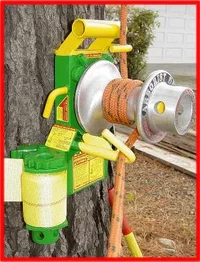
The new Hobb's H-2 is rated for use with arborist lowering lines from 1/2 to 3/4 inch in diameter. Offering solid mounting, smooth and precise rope control, increased lifting and pulling capacities, the H-2 is designed to perform on the job, on demand every day for years to come.
The reconfigured spool is cast from A-356 aluminum and T-6 hardened. With a 3/4 inch thick wall structure, the H-2 is designed for high impact loading, wear resistance and heat dissipation. Massive, maintenance-free, oil impregnated bushings support the front and rear of the spool, which rotates on a solid steel 1-1/2 inch shaft.
This device uses the winch strap bar to rotate the nose of the H-2 using the same priciples as a come-a long. Its designs are simple, reliabe and have impressive pulling and lifting power. With a 16:1 ratio the H-2 can develop over 3,000 lbs. of pulling force and is rated to lift up to 1,000 lbs. The H-2 increases it's versatility by being able to remove unwanted rope slack, lifting up limbs and perform other pulling and lifting tasks.
The unique, angled frame may be mounted in 3 separate configurations to suit the rigging task:
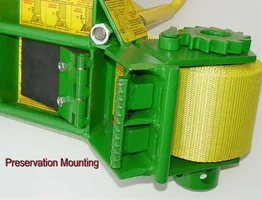
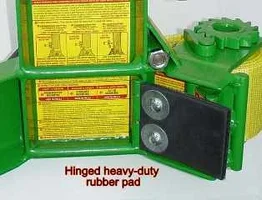
Preservation Mounting- For maintenance pruning when large limbs are removed and the tree is preserved. A hinged guard prevents spike insertion and a hinged heavy-duty rubber pad provides additional protection. 1,000 lbs. WLL (Working Load Limit)
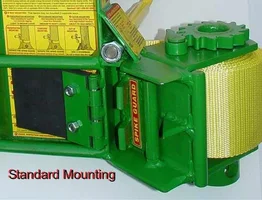
Standard Mounting- 3 side spikes aggressively cut into the tree when the strap is tightened for increased holding strength for most rigging needs. 2,000 lbs. WLL
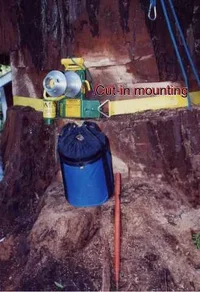
Cut-in mounting- A notch is cut into the tree and the top frame plate is placed beneath it for high impact loading (e.g.butt hitching trunk wood). 3,000 lbs. WLL
A "rope captured" fairlead permits the rope handler a wide range of movement. The entry hook guides the lowering line properly onto the spool. Side hooks let the operator safely tie-off the load line in certain situations. The H-2 comes complete with a 20 foot mounting strap, winch bar and detailed graphic labels explaining proper usage, ratings and warnings.
The H-2 weighs 54 lbs.
The new Hobb's H-2 is rated for use with arborist lowering lines from 1/2 to 3/4 inch in diameter. Offering solid mounting, smooth and precise rope control, increased lifting and pulling capacities, the H-2 is designed to perform on the job, on demand every day for years to come.
The reconfigured spool is cast from A-356 aluminum and T-6 hardened. With a 3/4 inch thick wall structure, the H-2 is designed for high impact loading, wear resistance and heat dissipation. Massive, maintenance-free, oil impregnated bushings support the front and rear of the spool, which rotates on a solid steel 1-1/2 inch shaft.
This device uses the winch strap bar to rotate the nose of the H-2 using the same priciples as a come-a long. Its designs are simple, reliabe and have impressive pulling and lifting power. With a 16:1 ratio the H-2 can develop over 3,000 lbs. of pulling force and is rated to lift up to 1,000 lbs. The H-2 increases it's versatility by being able to remove unwanted rope slack, lifting up limbs and perform other pulling and lifting tasks.
The unique, angled frame may be mounted in 3 separate configurations to suit the rigging task:
Preservation Mounting- For maintenance pruning when large limbs are removed and the tree is preserved. A hinged guard prevents spike insertion and a hinged heavy-duty rubber pad provides additional protection. 1,000 lbs. WLL (Working Load Limit)
Standard Mounting- 3 side spikes aggressively cut into the tree when the strap is tightened for increased holding strength for most rigging needs. 2,000 lbs. WLL
Cut-in mounting- A notch is cut into the tree and the top frame plate is placed beneath it for high impact loading (e.g.butt hitching trunk wood). 3,000 lbs. WLL
A "rope captured" fairlead permits the rope handler a wide range of movement. The entry hook guides the lowering line properly onto the spool. Side hooks let the operator safely tie-off the load line in certain situations. The H-2 comes complete with a 20 foot mounting strap, winch bar and detailed graphic labels explaining proper usage, ratings and warnings.
The H-2 weighs 54 lbs.