TheTreeSpyder
Branched out member
- Location
- Florida>>> USA
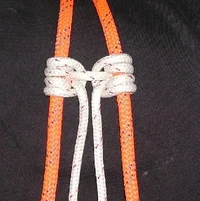
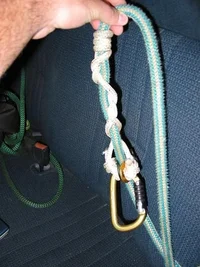
Glen i thought i took that picture out when you said that before, sorry. i'm pretty light, was shown it, and it werked for me. The differance is if you make the half-hitch/tending ring out of the strand coming from the top of the coil, or the bottom of the coil.
The consensus seems to be that for the Knut/TK we take the half hitch/marline hitch (respectively) to form single/lowest 'loading buffer' (to buffer load to real stopping power of coil on top)from the bottom of the coil. L or R as Mahk says wouldn't make any differance, except perhaps in twisted/3strand host, that had a specific R or L hand lay. As opposed to Distel/Schwab that we form the lowest/single 'loading buffer' turn; taking from the top of the coil.
Theorizing that 1 turn is almost enough, but not quite enough stopping power, a round (2) turn as pretty sure, a double round turn (3 turns) as very positive, and a coil (4 turns) (KnudeKnoggin?) as very positive stop with any preceding loading buffer. A real Frenchy coil as 7 turns as real downright positive with no need of help/buffer to stop. So we take the single turn in some shape or form, that almost is enough stop; and cap it always with coil (or some a double roundturn)to have tool that gives both stop and slide in right conditions. The single takes most of the loading, and the coil finishes the job. But (coil) stays in a courteous/non-siezing/powerband; with the loading buffer of preceding turn taking the brunt of abuse and loading. So we always have coil on top, and vary the single ring/turn/hitch/marl before the coil; to vary the charachteristic and name of that particular hitch.
Thanx,
-KC
The consensus seems to be that for the Knut/TK we take the half hitch/marline hitch (respectively) to form single/lowest 'loading buffer' (to buffer load to real stopping power of coil on top)from the bottom of the coil. L or R as Mahk says wouldn't make any differance, except perhaps in twisted/3strand host, that had a specific R or L hand lay. As opposed to Distel/Schwab that we form the lowest/single 'loading buffer' turn; taking from the top of the coil.
Theorizing that 1 turn is almost enough, but not quite enough stopping power, a round (2) turn as pretty sure, a double round turn (3 turns) as very positive, and a coil (4 turns) (KnudeKnoggin?) as very positive stop with any preceding loading buffer. A real Frenchy coil as 7 turns as real downright positive with no need of help/buffer to stop. So we take the single turn in some shape or form, that almost is enough stop; and cap it always with coil (or some a double roundturn)to have tool that gives both stop and slide in right conditions. The single takes most of the loading, and the coil finishes the job. But (coil) stays in a courteous/non-siezing/powerband; with the loading buffer of preceding turn taking the brunt of abuse and loading. So we always have coil on top, and vary the single ring/turn/hitch/marl before the coil; to vary the charachteristic and name of that particular hitch.
Thanx,
-KC

 ...
...