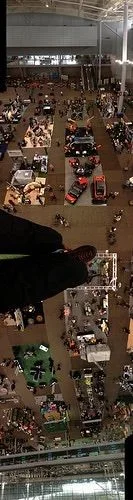
Anyone check out New England Grows this week?

Gorman

Branched out member
Location
Rhode Island
I made it out for the first day and saw some neat stuff. I liked how there were more tracked arial lifts there this year. Altec had one that was fully insulated.

 
I liked the bulldog bones you were climbing on oceans. I just wish they gave the speakers a longer time to do their thing. An hour to talk about crown reduction practices? No time for questions.
I liked that poison ivy cure they had too.
 
I liked the bulldog bones you were climbing on oceans. I just wish they gave the speakers a longer time to do their thing. An hour to talk about crown reduction practices? No time for questions.
I liked that poison ivy cure they had too.
I thought the insulated track lift was a good thing.

I thought Gillman was good. I didn't imagine that pollarding would be part of his presentation, though it was totally applicable for urban areas.

Unfortunate weather for the show in regard to the attendees, but the vendors did seem to be out in good force.

I heard from some of the equipment dealers saying the wrote a good amount of business, so hopefully it was good for most.

The 'poison ivy' guys pulled me over as I was finishing a roam around the floor just before the show closed. Seemed like some pretty cool stuff, but we both laughed as I told him I'm one of those freaks that doesn't react to those plant oils. Go figure.
 
George Hudler gave a good talk on Phytopthora canker on European beech in the northern US. Although it was sort of a throw-away at the end, he suggested that some lichens are parasitic, not just epiphytic. That is too radical for me, I'm staunchly in the non-harmful epiphytic traditional camp...but I've been wrong before!
Looked like good attendance at my presentation on tree injection and wounding, but the lights were so bright in my eyes, maybe the hall was empty!
 
George Hudler gave a good talk on Phytopthora canker on European beech in the northern US. Although it was sort of a throw-away at the end, he suggested that some lichens are parasitic, not just epiphytic. That is too radical for me, I'm staunchly in the non-harmful epiphytic traditional camp...but I've been wrong before!
Looked like good attendance at my presentation on tree injection and wounding, but the lights were so bright in my eyes, maybe the hall was empty!
Kevin, I am sad I missed out on your presentation. It's all too easy to get involved with demos on the show floor and wonder where the time went when I look up and check the clock. Next time, I promise. I did hear great things about you lecture from others.
 
Always enjoy hearing you Kevin Smith. I am not sold on it, but I thought what George hudler was saying about lichens was interesting. I've been wondering if high lichen populations can hinder a trees ability to put out epicormic growth or growth in general. Say, in response to winter moth damage?
 
Always enjoy hearing you Kevin Smith. I am not sold on it, but I thought what George hudler was saying about lichens was interesting. I've been wondering if high lichen populations can hinder a trees ability to put out epicormic growth or growth in general. Say, in response to winter moth damage?
Perhaps inhibited light reaching latent buds? I missed the lecture in discussion, but just looking for thoughts or input... Wouldn't lichens simply anchor to wood and not be able to draw nutrient or resources from anything but air?
 
Here on the lower Cape, some of the Lichen growth certainly seems detrimental. I have seen trees, mostly Oak, with such heavy lichen I am surprised they live. Others are certainly in decline.
 
Cre, I see similar things in my area. We aren't far from each other. What I understood was that the trees were in decline before the lichen took hold, and that the slower growing tissue lacked rapid enough expansion to keep the epiphytes from anchoring.
 
I definitely see a connection between winter moth damage and lichen infestation. They are opportunistic, and you will notice that they colonize thinner canopied trees because of the ability for light to get through. Winter moth damage mimics this, so you will see more lichen as the winter moth damage increases. Oceans, you are definitely on to something with the light reaching latent buds. I never thought of that!

Tom
 
I definitely see a connection between winter moth damage and lichen infestation. They are opportunistic, and you will notice that they colonize thinner canopied trees because of the ability for light to get through. Winter moth damage mimics this, so you will see more lichen as the winter moth damage increases. Oceans, you are definitely on to something with the light reaching latent buds. I never thought of that!

Tom
There's a small Hawthorn tree where I used to live. It looks stone dead from late August on through the Winter until late Spring. Looks like it would fall over if you sneezed near it. Loaded with lichen...can barely see any wood, but it pushes the same every year like clockwork. It's a very slow growing tree, and might make for a decent case study.
 
I can definitely understand that more slowly growing trees would support more dense lichen communities. George was noting new lichen growth at the base of killed branch tips...but he didn't show pictures or name the associated lichen. Hmmm, I'll have to keep my eyes open. Some of the ascomycetes that participate in lichens can be free-living as well.

I won't speculate further, but this is certainly a good PhD topic for someone with mycological interest and willingness to develop the chops for this sort of work. If a good case could actually be made beyond simple speculation, there is a good paper for Science or Nature or the Proceedings of the National Academy of Sciences. That's the really big leagues in my little world!
 
Kevin, a really good example is young trees at a nursery, in an area where lichen is prevalent. Trees struggling to grow have much more lichen than trees that are more vigorous. I have based a bit of my diagnosis of lichen on larger trees in these areas on this. This is different from what I posted above, but another issue in the lichen discussion. It appears to me that actively growing cork cambium doesn't allow the lichen to take hold as well as it does on more stunted stems.

Tom
 

New threads New posts

Back
Top Bottom