ANSI 6.3.6 (6.3.7 2012) about being secured twice

You are correct on 6.3.6. The floating bridge common on most modern saddles would count as one attachment point no matter how many ropes you have tied to it. The second attachment must connect elsewhere on the harness. If you incorporate two bridges then one rope on each bridge would make two separate attachments.

The standard is meant to protect against a fall if one attachment were accidentally cut.

What it doesn't address is the concept of egress, a climber should be anchored in such a way so as to easily facilitate a self rescue - a long enough rope to reach the ground, a self belay system (hitch, multiscender, etc.), and the tail running clean to the ground (not tangled or draped through canopy). It is my opinion that this should be required at all times because self rescue is the best kind of rescue.
 
I’ve never heard the fact that you should have your secondary system on a limb, trunk or other part of the tree suitable to act as a primary. I don’t know how many times I see a climber way out on a limb walk or other part of the tree only to laynard into a spindly little thing. Isn’t the main point of a positioning laynard not only to aid in position but to act as a backup to your main line? I oftentimes wonder what would happen if my main line was cut, would my new tip via laynard support my whole weight? Shock load from a small fall (assuming the act of cutting the main line also throws me off balance)?
 
I’ve never heard the fact that you should have your secondary system on a limb, trunk or other part of the tree suitable to act as a primary. I don’t know how many times I see a climber way out on a limb walk or other part of the tree only to laynard into a spindly little thing. Isn’t the main point of a positioning laynard not only to aid in position but to act as a backup to your main line? I oftentimes wonder what would happen if my main line was cut, would my new tip via laynard support my whole weight? Shock load from a small fall (assuming the act of cutting the main line also throws me off balance)?

I always lanyard into a proper anchor and not some spindly twig. It is my ass on the line.
 
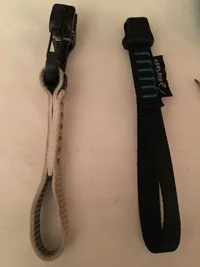
Adding a quickdraw dogbone, that has a larger loop at one end, to the grip, would make stick selection easier.
IMG_1685.webp
 
I’ve never heard the fact that you should have your secondary system on a limb, trunk or other part of the tree suitable to act as a primary. I don’t know how many times I see a climber way out on a limb walk or other part of the tree only to laynard into a spindly little thing. Isn’t the main point of a positioning laynard not only to aid in position but to act as a backup to your main line? I oftentimes wonder what would happen if my main line was cut, would my new tip via laynard support my whole weight? Shock load from a small fall (assuming the act of cutting the main line also throws me off balance)?
I think a lot of that, for me, depends on what will help my positioning and what my options are. I do a lot of scrambling out to tiny tips. We do a lot of minor reductions. I would dare say that half of the time I am working where nothing within reach is something that I would use as a primary point. I try to use points that would probably hold me, but a 2 inch oak stick 30+ feet straight out from the trunk just can't be assumed to be able to handle that much of a load...
I should do more DSRT. I wish that a second bridge was easier to use on the treemotion.
 
I’ve never heard the fact that you should have your secondary system on a limb, trunk or other part of the tree suitable to act as a primary. I don’t know how many times I see a climber way out on a limb walk or other part of the tree only to laynard into a spindly little thing. Isn’t the main point of a positioning laynard not only to aid in position but to act as a backup to your main line? I oftentimes wonder what would happen if my main line was cut, would my new tip via laynard support my whole weight? Shock load from a small fall (assuming the act of cutting the main line also throws me off balance)?
This is the reality that will continually challenge climbers to work in a safe mannor. Luckily the work in these situations is in the opposite direction of the main life line. The climber is most likely to be cutting away from his escape decsent. But the smart thing to do would be to use more attachments (when available) to spread your load across several limbs that in concert would support you. Usually to get out far enough to break the limb you are working on (without rope support elsewhere) you are already using ropes or your body to spread the load across multiple supports.
Thank you ANSI for giving us pause to ask: what happens if this goes wrong?
 
In regards to positioning vs. Security that is great conversation. I believe that dual ropework climbing solves lots of issues with feeling more secure.. we've got to use the knowledge of the trees strength as important part in choosing how to approach the work. I've been doing some amazing to me work positioning lately with dual stationary lines, in some far away trees on occasion with a lot of storm work lately... definitely love what can be done with just adding another line.. with time it becomes natural as anything.
 
Remember as well that the Z133 is not meant to be prescriptive. It is up to the climber to decide if the situation of a connecting both means of attachment to a single point (read) bridge is valid at the time. In many cases, as a climber I am entirely satisfied with this set up even though it does not follow a literal interpretation.

Let's be real. If as a climber, I put myself in danger of cutting my bridge, there are not to many pieces of PPE or rules on their use that are gunna help me.

This does not lesson the value of our safety standards. There may very well be a situation when the set up I described would be faulty with better alternatives clearly present .

In the end, make good choices, based on sound reasoning and the experience of the industry as a whole.

Tony
 
Last edited:
I absolutely hear what you are saying, appreciate the input, will keep that in my head and probably should have set it up a little different for a video. Couple of thoughts with this. I do have a procedure for ascending sketchy TIP, I'll post the video below, basically the long time used double lanyard wrap but with added use a A rope walker and attaching to suspension points on the harness. The initial TIP was cinched on 2 limbs and although it puts an added stress on the upper limb, there is a backup of the lower limb in the "bundle". What is really important to me when I set TIPs on a pine is that they are within an inch or two of the main stem. Seems very strong there otherwise the limbs have to be much larger.
Thanks again, Richard

Sketchy TIP
Richard, I had a thought about the issue of your fingers getting caught in the lanyard loop if the TIP fails. They could get caught pretty bad, with your whole weight on the loop suddenly, completely trapped in fact and perhaps injured rather badly. How about using a couple of very small tie-wraps to hold the loop around the tree open as you ascend, so that you only have to hold the two ends of the lanyard just outside of the loop instead of holding the loop around the tree open with your fingers? They would let go immediately under a real strain and allow the loop to close onto the tree, yet they would be strong enough to maintain the loop open on ascent as you flip the lanyard higher.
 
8.1.4 While working aloft, the climber shall have available a climbing line and at least one other means of being secured on his/her person at all times (e.g., an arborist climbing line and a work positioning lanyard). Two means of being secured shall be used when the climber determines that it is advantageous.

word for word Z133
 
I’ve never heard the fact that you should have your secondary system on a limb, trunk or other part of the tree suitable to act as a primary. I don’t know how many times I see a climber way out on a limb walk or other part of the tree only to laynard into a spindly little thing. Isn’t the main point of a positioning laynard not only to aid in position but to act as a backup to your main line? I oftentimes wonder what would happen if my main line was cut, would my new tip via laynard support my whole weight? Shock load from a small fall (assuming the act of cutting the main line also throws me off balance)?


You could likely break your lanyard attachment point on a limbwalk with a description such as spindly.

Two ropes, one slightly slack, one taut with independent positioners. SRT (naturally) on big conifer end-weight reduction or whatever. Lanyard if you want/ need it for positioning, mitigation of a slip to avoid a pendulum, or to pull yourself out to the limb tip with your lanyard advanced out the limb.
 
Agree...spindly is not a word that I ever want associated with life support

When I've judged comps I take this into account when scoring a work station.

There are times when a lanyard attachment point may consciously considered for balance...but not work positioning. What would the consequnce be if it broke?
 
Agree...spindly is not a word that I ever want associated with life support

When I've judged comps I take this into account when scoring a work station.

There are times when a lanyard attachment point may consciously considered for balance...but not work positioning. What would the consequnce be if it broke?
Generally speaking from a 320+ lb climber, this kind of situation never happens. If the branch is so spindly and long you're concerned about it breaking you have a second tie in because it's also so flexible and wobbly you don't have the stability to get out to the end of it.

As for branches breaking it from under you, it's either very sudden while you're getting into position, or slow and gentle with plenty of warning once you're in position and unless you're at the bottom row of branches, will generally catch on something and stay in place
 
I would just like to point out for beginning climbers, that the initial tie in point served primarily to access the second tree, and less so as a safety fro a fall from the first tree. The motion of swinging from one tree to another that is fairly far away almost always results in a mighty powerful collision. My advise to those that have not yet experienced the body slam of severe proportions is to recognize its true purpose. Other than that, this was pretty much a textbook example.
 
You are correct on 6.3.6. The floating bridge common on most modern saddles would count as one attachment point no matter how many ropes you have tied to it. The second attachment must connect elsewhere on the harness. If you incorporate two bridges then one rope on each bridge would make two separate attachments.

The standard is meant to protect against a fall if one attachment were accidentally cut.

What it doesn't address is the concept of egress, a climber should be anchored in such a way so as to easily facilitate a self rescue - a long enough rope to reach the ground, a self belay system (hitch, multiscender, etc.), and the tail running clean to the ground (not tangled or draped through canopy). It is my opinion that this should be required at all times because self rescue is the best kind of rescue.
Normally I would agree, but not in every case. If I am doing a tree with ground crew fully competent in climbing and rescue, and for whatever reason a rope dangling is more dangerous or that no rope would facilitate easier or safer movement through the work, then no I would climb with a bagged rope or no rope if the diameter and health of the spar meant I could safely rely on 2 point connections via flip lines or adjustable lanyards. I often use tubular daisy chains rather than twin flip lines. Just a thought. Sometimes people complicate setups and it begins to look like a spider set up shop in the tree!
 
I don’t know if any of you forgo taking a rope up a tree in favour of a lighter option? I often climb tall conifers with a throw line in a nose bag. I use it as the service line once I top out.
 
I don’t know if any of you forgo taking a rope up a tree in favour of a lighter option? I often climb tall conifers with a throw line in a nose bag. I use it as the service line once I top out.

I move faster, with less strain and wear & tear on my body when I know that I cover my butt. A climbing line is not that heavy, IMO. 120' of 11mm with a choking SRT set-up is reasonably light to carry in a bag. I don't go above 120' very often, if its much more, I use a longer rope, skinnier than my 1/2" daily driver.

I've seen flipline-only guys have to make every gaff-in count, because they life-support depends on every gaff, every time. Stomp it hit, yard it out.

Not all guys, and I'm sure that lots climb fast on one flip-line.
 
I move faster, with less strain and wear & tear on my body when I know that I cover my butt. A climbing line is not that heavy, IMO. 120' of 11mm with a choking SRT set-up is reasonably light to carry in a bag. I don't go above 120' very often, if its much more, I use a longer rope, skinnier than my 1/2" daily driver.

I've seen flipline-only guys have to make every gaff-in count, because they life-support depends on every gaff, every time. Stomp it hit, yard it out.

Not all guys, and I'm sure that lots climb fast on one flip-line.
Mostly 1 flip line for me. sharp irons but not pointy! rope in tow if I have a dude on the ground to un snag it with the odd errant branch.
 

New threads New posts

Back
Top Bottom