analyze this stump

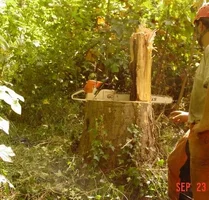
For the sake of easy reference I'll say that this pic looks north, east is to the right, and west is to the left.

The tree was faced to fall to the north (away from the camera), and the saw is sitting on what was the bottom of the notch.

Which way did the tree fall?
 

Attachments

  • 31306-DSC03066-Look_N_w_saw_and_Ph_cropped_resized.webp
    31306-DSC03066-Look_N_w_saw_and_Ph_cropped_resized.webp
    67.8 KB · Views: 292
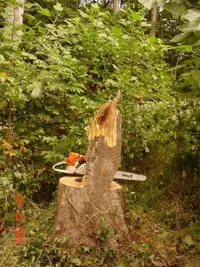
Looking west...

The saw and the camera have moved 90*. The camera is on the east side of the stump looking west. The handle of the saw is on the south side of the stump and the blade is pointing north, towards the intended direction of fall.
 

Attachments

  • 31307-DSC03068_look_W_fr_E_w_saw_resized.webp
    31307-DSC03068_look_W_fr_E_w_saw_resized.webp
    71.3 KB · Views: 207
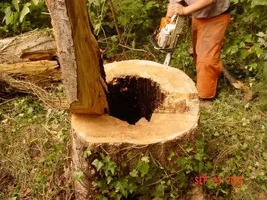
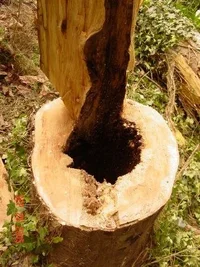
And looking down and east.

This was a dead beech, no leaves, but most of the twigs were still on it. The trunk was upright, the canopy size was light to light/moderate and all of the canopy was on the east side. It was not visually possible to tell that the tree was hollow until after the notch had been made. The tree was pulled to the north with a chipper winch.

Judging from the photos, what effect could/did the notch/hinge/backcut have on the fall of the tree? Would cutting it in a different manner have had any influence on how the tree fell?

Other comments???

Thanks!

Glens, please feel free to resize the photos if it would make it easier or faster for people to view them.
 

Attachments

  • 31309-DSC03073_look_down_fr_W_to_E_resized.webp
    31309-DSC03073_look_down_fr_W_to_E_resized.webp
    48.2 KB · Views: 155
Whoops!

He knew the tree was hollow before he started the back cut and that there would thus be less hinge material. By now he also knows beech doesn't "keep" well.

This is a prime example of the case where using bore cuts to form the hinge, then sawing out backwards to trip it all at once is the preferred method.

At least he got out safe, right?
 
It looks like a short little out of control barberchair to the east, nothing life threatening if the feller was quick on his feet. Hope nothin' got smashed. Looks like he tried to leave good holding wood on the west side but decay and overpulling by the winch got the best of him. A lesson to be learned.
 
I'd say it went East too but then I think I see the trunk laying there on the ground. The tree must have had a natural lean that way. The part of the hinge that broke off low was decayed and wasn't really a hinge at all unless you count wood that had the strength of the meringue on a lemon meringue pie. When the hinge on the west side went the east side couldn't take the strain and broke off high.

Of course this is just a guess.

So..........what did ya bust?

Dan
 
I'm with TreeCo on this one. I don't think it would matter which way it was cut the result would be the same with the wood as decayed as it was

If it could be done over, cutting a tapered hinge slowly might have steered it in the right direction by cutting the compression east side more and leaving the tension west side thicker with more hinge material than the compression side.

Unless the tree is topped out the decayed ones have a mind of their own and go the way of the natural lean, no matter what you do.

Larry
 
As told before, fallen east. I think that a more tapered backcut (east smaller hinge) would have helped. Also when most wood/crown is on one side (east here) i would set up the winch not due north but more north/west. if needed with redirect by a pulley. Or maybe just a holding line from the west that directs the fall.
 
What we really need to fell decayed trees with optimal control is multiple lines, at least three but four would be better, to stabilize the pole. We need to be able to measure the amount of pull on each of these lines in real time and the winches need to be computer coordinated and controlled.

Science fictionish for sure but the technology is here already, it's just not cost effective to apply it to tree work yet.

Dan
 
It's hard to say without seeing the tree before felling. From the description and the stump, it looks like it went to the East. Was there a lean? Was the hingewood sound? It appears the West side hingewood was decayed. (There doesn't appear to be alot of pulled fiber on the West side). There must have been alot of weight on the East side of the canopy? Was there an adjacent tree to the West prohibiting growth or is that the way it grew naturally? If there was more natural growth on the East side, that might indicate internal problems on the West side. Was the tree sounded before felling? That would at least tell us the tree is hollow. Was the pull directly to the North? Did the tree go over on it's own and was the cutter still cutting? Or did the cutter give the go ahead sign to start pulling? There is alot of hinge on the East side and pulled fibers.
 
It went East, too much holding wood on the East side, probably started going North and pulled quickly to the East because the hinge was punky on the West side and maybe not as thick as the East side, it broke early.
A higher hinge because the tree is known to be hollow, an even back cut that isn't sloped and an equal amount removed in the back cut at the hinge along with a slight pull with a rope in the top with a balanced tree.
Also depends on the wind, the lean and how the weight is distributed in the top.
 
It went east.

Canopy was greener and perhaps weighted to the east. Greener on the east side means preferable hinge on that side and west side possibly decayed.

The tree should have been side roped. If that were impossible due to obsticles and you were unable to fell going with the green weighted side then another option would have been to do a tapered bore cut up to the hinge leaving a strap at the back to be cut last. The thicker side of the taper obviously on the west. Prior to the strap being cut a nominal amount of pull force or pretension to set momentum in the desired direction upon the rear strap being cut.
 
i analyzed Glens comments and calculate it went in the down direction. i think balance to NorthEast with possible barberchair; but not full reverse on axis. An inspection of the Face before BackCutting should reassure me with more elastic looking wood on the counter/West side of the hinge device. i think the pull/tension/counter balance of lean side needs elastic/stretch fiber logically. The compression/push/lean side needs solid not elastic device. Whereby, the compression side can be drier/deader, as long as it doesn't give; it can perform push function; pull needs the more tenuous elasticity.


i think possible early closes in face aggravated situation. Longest holding east fiber has less levraged length and angle both, than SoutWest holing fiber that tore off early.

i think the rot in center face sould have given some early close, but think ther might have been early close/dutch on West forcing weaker wood to tearoff early, and then only pull fiber on East controlled, along with east lean, but looks like an early face close there too? To form stop/sieze up fiber column, not across fiber (that would leveraged/bend/flex) spar. So was bound between East Lean Pull + East Fiber Pull vs. Push from East close in face at finish and ruptured up the single colum holding everything on East in barber chair type situationm from the warring forces /matching forces of pushes and pulls.

If added push/pull to West to counter lean, could have made worse at early tearoff on West, by giving more pull power to East hinge in response.

 

New threads New posts

Back
Top Bottom