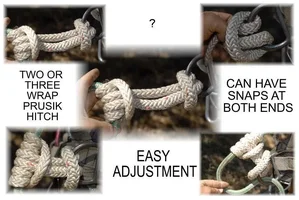
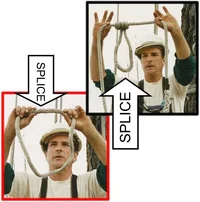
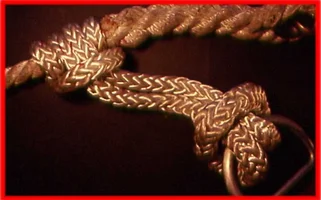
A hip line ajustment.

Sometimes the simplest methods are what is right for you. Many years back Eugene Hendrickson and myself were working on how to adjust hip lanyards and he showed me this idea which I later modified to come up with this technique.
 

Attachments

  • 118025-AHIPLANYARDADJUSTMENT.webp
    118025-AHIPLANYARDADJUSTMENT.webp
    58.2 KB · Views: 336
Where is the splice in all those turns??

i'd suggest one of the newer, smaller cords for same. Then lanyard reeved through the D as a mount and tender (like i believe you are showing). i've evolved this some time ago into a more compact hitch with a Sailor's Gripping finish(to make self tending; for when it doesn't hit the D as tender squarely; even with the ring maid by the cord on the D). At Tom's suggestion i've also arraigned the pulls more to mimic the loading the D was constructed for. These strategies are cheaper and lighter than cams; and can be extended under load(unlike cams). The short coming is a cam the hitch can hang in 'dirty conditions' like pine sap; where a cam works better.

My lanyard is about 20' long; from an idea i got from big JP. 1 very good trick with a very adjustable lanyard(i think hitch gives finer adjustmeant than cam) for me is if you are on loan branch standing, and need to cut: i'll bend knees with lanyard under branch i'm on; then tighten it down hard, then stand up hard against the tension and lock legs for more stability.

Chord%20Tending%20on%20Lanyard.jpg
 
Cool. I remember looking thru some of Dads old photos and seeing the flipline itself wrapped around your hip D-Ring. I guess this was the first thing they did for a self-adjusting lanyard back in the day. I'm sure Robert has a pic or remembers it. I'll try and scan a pic in later if anyone is interested.
 
Spyder,

About what length cord to make that VT, as pictured. What diameter?

I use a delta link to attach lanyard to D ring.

Just made a shorter rope and a lanyard out of my climbing line today by snagging the tail with the pole saw. :(
 
3/8". Tom et al have a deal of just using a dog snap for tender i believe. This isn't part of the connection; just a tender, so doesn't have to be up to the tensile standard of the support chain. i just kinda like my minimalist gear.

The 3/8 will be lower tensile than Sohner's; but it is in a dual legged position on a dual legged support to my massive 135# (dripping wet). But, also, in such tight bight's and round cords, the lower diameter will give less leveraged distance on the bent axis; so less tensile loss. Of curse; a flat (Tenex; the large white looks flat before splice?) would have even less loss; by being A) more flexible, so therefore less loss because the leverageing weakness against tensile / tensile loss comes from the resistance to bending X B) less 'height'/length on the bent axis of the bight; so less leveraged distance. (Read that as tensile strength loss = resistance to bend X Height(leveraged distance) at the bend)

Witch brings me to my main point(lessnessism); that one short coming of a splice; is the stiffness X 'height'(?) at bend that it would lend; so therefore any splice should be on straight/ non-bent portion of line (for purists)(?). i just like pushing the theory; to grasp it more; ain't trying to plough into anyone(especially when everyone is bigger'en me!).

But, anywho; i think a smaller diameter would be more 'discrete'/out of the way, serve as well, and could avoid the last shortcoming by allowing termination at both ends/ rather than splice...(don't mind me, i'z just a fool fer'dis chit!)
 
Is this what you were reffering to ?

This technique served many a years in its hayday. Still comes in quite useful even today. Yes, the times have passed it by for most folk but it still has a long proven track record in the industry.
 

Attachments

  • 118133-Lanyardadjustmentoldphoto.webp
    118133-Lanyardadjustmentoldphoto.webp
    34.9 KB · Views: 241
[ QUOTE ]
Cool. I remember looking thru some of Dads old photos and seeing the flipline itself wrapped around your hip D-Ring. I guess this was the first thing they did for a self-adjusting lanyard back in the day. I'm sure Robert has a pic or remembers it. I'll try and scan a pic in later if anyone is interested.

[/ QUOTE ]

I remember doing that...I cant beleive it was allowed.
When I bought my 1st saddle they set me up with a steel core. It simply when through the d ring and then back under itself. I hated it.
 
[ QUOTE ]
[ QUOTE ]
Cool. I remember looking thru some of Dads old photos and seeing the flipline itself wrapped around your hip D-Ring. I guess this was the first thing they did for a self-adjusting lanyard back in the day. I'm sure Robert has a pic or remembers it. I'll try and scan a pic in later if anyone is interested.

[/ QUOTE ]

I remember doing that...I cant beleive it was allowed.
When I bought my 1st saddle they set me up with a steel core. It simply when through the d ring and then back under itself. I hated it.

[/ QUOTE ]

Cats Paw I think is what it's called.
 
funny you guys bring this up, i just learned it today from one of my companies many veteraned/now retired climbers, looks absolutly crazy but he said when he was on the coast thats how they all did it, very simple, not much gear, and it gets the job done

and yes, it is the cats paw
 
i'm thinking the ol'timey adjustmeant was more properly called a Becket; and in thicker or even cabled line (both for stiffness/ not to 'buckle out' considerations like could happen with more typical modern gear); also should have thickened splice or some kind of stopper at end.

A Cat's Paw more properly would be like a Cow or Girth (depending on if open or closed lacing/ 1 or 2 legs of pull) with extra twists (rather than turns; which would be more prussic like; open prussik if 1 leg of pull, closed with 2) in each eye; then hook reeved thru; rather than the hitch laced on. but, that is not to say; that some didn't call the hitch to sideD a Cat's Paw informally
 
[ QUOTE ]
i'm thinking the ol'timey adjustmeant was more properly called a Becket; and in thicker or even cabled line (both for stiffness/ not to 'buckle out' considerations like could happen with more typical modern gear); also should have thickened splice or some kind of stopper at end.

A Cat's Paw more properly would be like a Cow or Girth (depending on if open or closed lacing/ 1 or 2 legs of pull) with extra twists (rather than turns; which would be more prussic like; open prussik if 1 leg of pull, closed with 2) in each eye; then hook reeved thru; rather than the hitch laced on. but, that is not to say; that some didn't call the hitch to sideD a Cat's Paw informally

[/ QUOTE ]


Ditto that about Becket and Cat's Paw--although I don't think I could write it like Spydey.
 
I used to use the Becket bend with a steel core flipine all the time for life support. Till I realised it would be extremely difficult to get me off a pole if anything went wrong - unless the cable croppers from the bracing kit happen to be in the truck that is
tongue.gif


After seeing what happens when you can't release a lanyard cam after its loaded, I always use prusiks or a releasable cam device (like a Grillon).

However, I have found the becket bend useful (as in quick and easy) to secure rigging lines to the harness whilst sorting out aloft; you can wrap a bull line one handed that way around the hip D behind the lanyard snap/krab - sort of a Becket bend upside down in reverse
wink.gif
As the bull line is tied and the lanyard clipped, you should have no way to confuse the two - I just find the rigidity and location of the hip D convenient for this type of thing.

Give it a try - should keep you all occupied for 30 minutes
grin.gif
 
When using the loop of rope to attach your steel core flip line the loop of rope acts like a fuse point in the connection. If you should be in a position where the core line is streched to the point where you can't move you can always if needed cut the loop of rope and not have to cut the steel core line. You can cut the loop with a pair of hand pruners.

Sure their are plenty of choices when deciding how to hook up not every thing is right for everybody. Start out simple and build up from their.
 

New threads New posts

Back
Top Bottom