Ebbs and flows bro, ebbs and flows!! This thing is going where it needs to go.As my man useless info would say....another felling thread gone wrong

Navigation
Install the app
How to install the app on iOS
Follow along with the video below to see how to install our site as a web app on your home screen.
Note: This feature may not be available in some browsers.
More options
You are using an out of date browser. It may not display this or other websites correctly.
You should upgrade or use an alternative browser.
You should upgrade or use an alternative browser.
A Discussion on The Fundamentals of Tree Felling
- Thread starter Tony
- Start date

RBJtree
Branched out member
- Location
- Pittsburgh
That is my experience too, however, in PA we haven't had any lack of rain in quite a few years. We have had a lot of dead ash which, like all trees, get more brittle the longer they have been dead. I have also noticed that the weight increase of very wet live wood, such as when sap is rising in the spring and it has been rainy, seems to cause horizontal limbs to break down sooner than if they were at a medium wetness, but thats not felling. I can't say i've noticed a difference durring felling with medium to very wet wood.In some cases it changes the wood character. Last year the wood moisture levels were the lowest ever record by the DNR, less hingy and more brittle.
RBJtree
Branched out member
- Location
- Pittsburgh
I've never been a timber faller. I do urban and suburban work. Mostly in tight places often over roofs and overhead utility lines. Sometimes I get the chance to drop a tree whole. I actually got to drop 11 trees whole in the last 2 days, but that is a rare number for me. In Pennsylvania there are no training requirements to do the work I do. Within a certain distance of power lines you are supposed to be certified, but that rule is usually ignored and never enforced. I think it is a good thing to require some training. I kind of hope our government starts requiring more training of us. It would certainly save lives and probably make our industry better over all.Hi again, very interesting thread this, and have read some things that chime with me. Tony mentioned felling smaller dia trees and complacency I think also from Rico. I admit I have fallen for this one. Say Ive been on a job falling douglas at 160 foot, been doing it for weeks. Then Im asked to nip down the landing and tip over some squirt of a tree, and thats when its so easy to fuck it up.
This is an American forum with most if not all contributions American, thats cool. Just hope its ok to chip in with a UK perspective. Over here every cutter has to be liscenced, no ticket no work, full stop. To get your ticket you start with training on trees no greater than guid bar, say 18 inches. Once you've done mantainance and risk assesment then you start felling. An uprite tree with simple sink and back cut. Moving on to leaning in direction of fell, and finaly felling away from the direction of fell. Theres also snedding or what you call bucking I think.
As a trainer I would typicaly take 6 may be 8 guys into the wood and work a buddy system. A spruce plantation , trees at two meter spacings and perhaps forty foot tall. The idea is to cut out every fith row, the go for miles. There is plenty to cut and they do so for 5 days solid. I move through the wood watching and talking stumps with the guys, as the days pass I'm not looking for perfection it seldom happens. I'm looking to see who has grasped the princibles, and importantly whos has,nt. Sooner or later some one get one hung up and we all gather for a laugh and then discus the safest way to get it to the floor.
The following week an indipendant examiner comes into the wood and puts ech candidate through his paces for a competant pass or not yet competent fail. Ive been trainer and examiner. Newbies are nervous, understandable. So theres conversation to help the candidate eaz in. Lets supose he/she gets it on the floor in roughly the right place, however the hinge is a bit squify and the back cut aint quite right. It not nesseseraly a fail, You could ask the candidate what he thought of the fell and what he has lernt from the stump. If he can identify the erorrs, he can correct them. So have another go. With luck its a pass and the candidate gets his ticket, limited to guid bar only. He returns to his employer and consolidates his learning for a year or two untill ready to return to training and move up the scale to bar and a half ext. This period of consolidation is important and the hope is the fundementle priciples stick. An important point. No money passes between the candidate his trainer or the assesor/examiner. Thats all handled by City and Guilds, only right and proper. It can atke a trainer a couple of years to qualify as too examiners, and are required to demonstrate skills to a higher authority on a regular basis. Sorry if this has been long winded way of driving home the need for understanding the basics of felling, and building on that.

Serf Life
Been here much more than a while
- Location
- Maine Island
More gov'mt ovah-sight! Christ bud haven't you read the news? We need less of that to make economy better and keep dumb people in their place.I've never been a timber faller. I do urban and suburban work. Mostly in tight places often over roofs and overhead utility lines. Sometimes I get the chance to drop a tree whole. I actually got to drop 11 trees whole in the last 2 days, but that is a rare number for me. In Pennsylvania there are no training requirements to do the work I do. Within a certain distance of power lines you are supposed to be certified, but that rule is usually ignored and never enforced. I think it is a good thing to require some training. I kind of hope our government starts requiring more training of us. It would certainly save lives and probably make our industry better over all.
RBJtree
Branched out member
- Location
- Pittsburgh
I'm iffy on it honestly. I am not a great lover of big government, but I think there are things the government should do. So long as the government is made up of the people and not the oligarch. Shit did I just write something political? I've been trying to quit.More gov'mt ovah-sight! Christ bud haven't you read the news? We need less of that to make economy better and keep dumb people in their place.

Tony
Carpal tunnel level member
- Location
- Lancaster, PA
As I evaluate a tree for lean I am looking for a few key things.
To judge lean I simply step back from the tree as far as is reasonable, form a diamond with the thumb and forefinger of each hand, center this over the biomass of the tree (all things tree) and envision a plumb line descending to the ground. The distance this imaginary line intersects the ground from the cut gives me a rough lean measurement. This system generally works and will not have you fee tricked by apparent lean caused by phototropism or other environmental factors.
If that lean measurement starts to exceed 3 to 5 feet in any direction, the bells start to chime. Not in danger, but in planning. Often offsetting the face, pull lines or other techniques can be used to compensate for lean. (that is for a future part of this discussion) Suffice to say in very general terms, when I estimate 3 to 5 feet of lean, the lean or how to compensate for it becomes a major contributing part of the plan. Lean of any amount, or conversely no lean at all, must always be considered, but I don't specifically plan for it save the parameters above. Again I make that last statement in VERY general terms.
First and foremost, I will always feel in the direction of lean if possible. I see no reason to struggle against gravity. The next easiest lean to deal with is back lean. Moving a tree straight forward and over center uses your hinge to it's fullest extent and wood fiber cooperates nicely all other things being in line. Side lean can get tricky, tree height, wood type, time of year are always factors, but play more into the equation with side lean because you are asking the hinge to do so much more.
I look forward to your thoughts and then we can move on to the next element I plan for Equipment and escape route.
Tony
To judge lean I simply step back from the tree as far as is reasonable, form a diamond with the thumb and forefinger of each hand, center this over the biomass of the tree (all things tree) and envision a plumb line descending to the ground. The distance this imaginary line intersects the ground from the cut gives me a rough lean measurement. This system generally works and will not have you fee tricked by apparent lean caused by phototropism or other environmental factors.
If that lean measurement starts to exceed 3 to 5 feet in any direction, the bells start to chime. Not in danger, but in planning. Often offsetting the face, pull lines or other techniques can be used to compensate for lean. (that is for a future part of this discussion) Suffice to say in very general terms, when I estimate 3 to 5 feet of lean, the lean or how to compensate for it becomes a major contributing part of the plan. Lean of any amount, or conversely no lean at all, must always be considered, but I don't specifically plan for it save the parameters above. Again I make that last statement in VERY general terms.
First and foremost, I will always feel in the direction of lean if possible. I see no reason to struggle against gravity. The next easiest lean to deal with is back lean. Moving a tree straight forward and over center uses your hinge to it's fullest extent and wood fiber cooperates nicely all other things being in line. Side lean can get tricky, tree height, wood type, time of year are always factors, but play more into the equation with side lean because you are asking the hinge to do so much more.
I look forward to your thoughts and then we can move on to the next element I plan for Equipment and escape route.
Tony

RopeShield
Carpal tunnel level member
- Location
- Ontario, Canada
Imho lean is one the easiest things to overcome. Lean/centre of mass is a constant and rarely does it change in felling operations. Be warned of long heavy over reaching nearing horizontal limbs, multi leader spreadingcrowns. One miscalculation of the ballast and a tree will tip away from the lay.
1. Model the tree. Balance on one foot and hold as much weight as you can imagine is proportional to the tree. Imagine what it takes to overcome the lean and weight. be sure to calculate the warning through the tipping process
2. Know the wood at the specific notch and backcut site for the intended lay. This needs carefull assessment before lean.
The wood on the other hand is rarely consistent and will have defecencies(torqued, fractures, internal seams etc also goes from tension, to compression to rotted, wet to dry, frozen or or vice versa. Be warned Trees in urban environments, fence lines and almost any where man has occupied can have metal. A pipe, t-bar, bolt, lag, screw etc can easily turn a tree..
Lean will be difucult to assess when visual observations from distances less than 1/2 the height and the centre of mass is unuasal or asymetric. Tree hugging and looking up the stem is flawed eye can be tricked to see or misssing the whole picture
3. Draw a Hard line to the sky, centre and front of view of the tree from as many profiles as possible and remark lil to left, lil to right an lil to back of the lay for example. Rake handle held at the top like pendulum or coworker holding poles under the tree will work
Every thing can be set to perfect, pull lines, wedges, jack etc but if the wood at the cut is miscalculated the results can be catastrophic. Evaluate the ood
When it is crucial trees should be dismantled to a safe felling height or more consistent centre of mass
1. Model the tree. Balance on one foot and hold as much weight as you can imagine is proportional to the tree. Imagine what it takes to overcome the lean and weight. be sure to calculate the warning through the tipping process
2. Know the wood at the specific notch and backcut site for the intended lay. This needs carefull assessment before lean.
The wood on the other hand is rarely consistent and will have defecencies(torqued, fractures, internal seams etc also goes from tension, to compression to rotted, wet to dry, frozen or or vice versa. Be warned Trees in urban environments, fence lines and almost any where man has occupied can have metal. A pipe, t-bar, bolt, lag, screw etc can easily turn a tree..
Lean will be difucult to assess when visual observations from distances less than 1/2 the height and the centre of mass is unuasal or asymetric. Tree hugging and looking up the stem is flawed eye can be tricked to see or misssing the whole picture
3. Draw a Hard line to the sky, centre and front of view of the tree from as many profiles as possible and remark lil to left, lil to right an lil to back of the lay for example. Rake handle held at the top like pendulum or coworker holding poles under the tree will work
Every thing can be set to perfect, pull lines, wedges, jack etc but if the wood at the cut is miscalculated the results can be catastrophic. Evaluate the ood
When it is crucial trees should be dismantled to a safe felling height or more consistent centre of mass
There is nothing better for assessing leans than a plumb bob/plumb line. Its never wrong and can be used to read even the subtlest of leans, used to read changing leans within a given tree, and used by your groundie to read leans when you are blownin tops or chunking wood. A dirt cheap indispensable tool, and a must have for any serious tree-man.
Last edited:
davidwyby
Branched out member
- Location
- PNW to SoCal
Is this thread still relevant or did it get replaced by something newer?

Evo
Been here much more than a while
- Location
- My Island, WA
Yeah, felling is so 2019... We use other methods now..
Still Legit, post up!
Still Legit, post up!

Daniel
Carpal tunnel level member
- Location
- Suburban Philadelphia (Wayne)
A lot depends on the type of trees and terrain you are working on... There's a lot of flat ground outside of NoCal. Small trees too.When it hits the ground well see if your fleet footed enough to haul ass side hill to keep yourself from getting fucking killed. Hows that for boring bro?
davidwyby
Branched out member
- Location
- PNW to SoCal
I mostly cut brittle or very brittle (dead) stuff. Occasionally I travel and get a treat of flexible conifer. I have made a study of trying to get brittle stuff to hinge.
Thick hinges seemed to work, those were pull trees. The spars with high back cuts just snap off. The shed was slated for demo anyway.
Unfortunately, this gent from Oz doesn’t seem to be around any more. I’m going to try
his method of centering the back cut vertically.

 www.arboristsite.com
Thick hinges seemed to work, those were pull trees. The spars with high back cuts just snap off. The shed was slated for demo anyway.
Unfortunately, this gent from Oz doesn’t seem to be around any more. I’m going to try
his method of centering the back cut vertically.
Does anyone else "Long Hinge" difficult trees ?
When the timber is old or brittle, or the tree has to fall against it's weight/wind/lean, and it has to fall with the hinge attached at least 1/3 it's fall arc = I use a "long hinge". 20 years in the industry without formal training. My work is in domestic situations where you are removing trees...
www.arboristsite.com
Daniel
Carpal tunnel level member
- Location
- Suburban Philadelphia (Wayne)
One of the most important fundamental principles in suburban tree falling is the proper use of pull lines. Loggers may frown on the idea, but they're playing a much different game.For clarity, this is a discussion about the FUNDAMENTALS and BASIC PRINCIPLES of tree felling.
Factors include:
amount of pulling force= always more than enough. This is best achieved by pulling with equipment. Rule of thumb is that equipment can pull with a force equal to it's weight with good traction. MA systems to increase pulling force and avoid over-tensioning lines require ground anchors. When pulling with equipment some care must be taken to prevent over-loading lines. Proper cuttign technique will allow the hinge to be the weak point and do it's job of getting the tree moving into the lay without the need to overload lines. I personally do not subscrie to the general rule of keeping trhe force on pulling lines to 20% SWL. I don't mind going far beyond that when needed, if it means the differnce between dropping a big tree from the ground or having to climb and rig. INcreased productivity more than offsets the need for regualr rope replacement. Knot strength becomes an important factor when ropes are intentionally loaded beyon SWL.
height of rope placement=higher than average is generally better. When pulling by hand height is crucial. Higher lines offer huge advantages in leverage and allow for bending of the wood which stores energy and shifts the balance of the tree. Movement of the canopy during pretensioning is more visible with higher pull lines, and allows for better visibilty and judging of the amount of force needed.
Pretesioning the lines to eyeball movement before cutting to determine if pull is adequate, prevent tree from sitting back during back cut, and providing info through movement as back cut is near complete.
number of pull lines/ground anchors= 2 or 3 may be needed on heavy back leaners. I have used 4 on occasion. if there is any question about not having enough pull to get the tree moving to the lay, just put another pull line in that tree.
direction of pull can be crucial: when fighting back leaners 180 degrees to the lean is crucial. When fighting side lean compensation pulls directed away from the intended lay to offset the side lean. Using mobil equipment provides best control of direction. Otherwise, when there is no tree in the desired direction to use as a ground anchor, direction can be maniplated with floating blocks, properly offset vectors, and portable ground anchors with pins hammered into the earth.
Proper use of equipment to do the pulling. use of equipment such as skid loader or truck is much better than hand pulling. Proper commnications between faller and operator is crucial to prevent early over loading of pull lines etc.
Proper pulling force allows for fatter hinges which hold much better than thin hinges, as long as you ...... (don't want to get into the super secret stuff here Tony)...
davidwyby
Branched out member
- Location
- PNW to SoCal
Ok, here’s one to kick around :
Spiral grain.
I’m always trying to do the impossible - get eucalyptus to hinge.
I tried this cut I learned from an Aussie on arbsite.
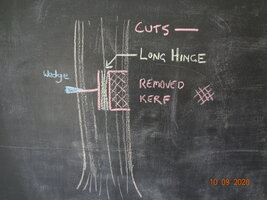
This was the result :
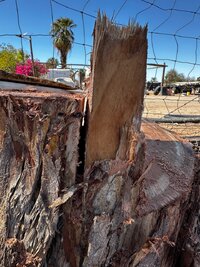
The off side (away from me, closest to wire fence, west) had slight tension and grain running rearward. Broke early.
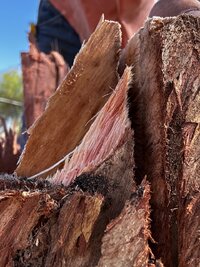
The close side had grain running forward and held on longer, functioning as a sizwheel.
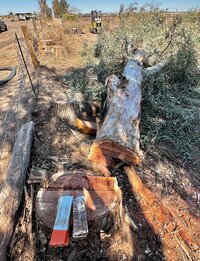
Pulled the tree right and clipped the pipe fence, which luckily shrugged it off.
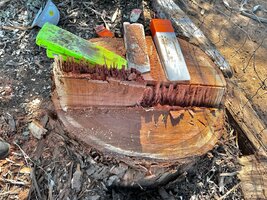
Spiral grain.
I’m always trying to do the impossible - get eucalyptus to hinge.
I tried this cut I learned from an Aussie on arbsite.
This was the result :
The off side (away from me, closest to wire fence, west) had slight tension and grain running rearward. Broke early.
The close side had grain running forward and held on longer, functioning as a sizwheel.
Pulled the tree right and clipped the pipe fence, which luckily shrugged it off.
davidwyby
Branched out member
- Location
- PNW to SoCal
Looks like I clipped the back of the hinge, probably didn’t help. That side had a little tension too, see limb on right side of tree once down.
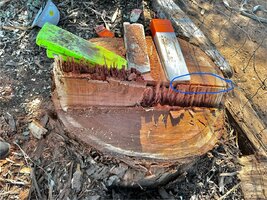
Evo
Been here much more than a while
- Location
- My Island, WA
Interesting, looks like a modified block face and a shark gill had a baby.Looks like I clipped the back of the hinge, probably didn’t help. That side had a little tension too, see limb on right side of tree once down.
View attachment 97808
Wonder if a snipe and having the back cut on the same plane as the top of the block face would help at all.
davidwyby
Branched out member
- Location
- PNW to SoCal
I have tried that quite a bit. Usually just snapped off top or bottom.Interesting, looks like a modified block face and a shark gill had a baby.
Wonder if a snipe and having the back cut on the same plane as the top of the block face would help at all.
I think putting the back cut elevation in the center encourages the hinge to flex. However, in this case, the close side did not hinge at all and the back side just broke off. Maybe it was too thick. There’s also the species consideration. Starting to seem like the smoother the bark, the more short grained and brittle it is.
Last edited:
davidwyby
Branched out member
- Location
- PNW to SoCal
I think I screwed it up.
Nicked the hinge in the circles, so it went with the weakest spots when forced by the wedges. I imagine the spiral grain was still a contributor.
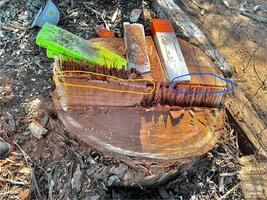
Nicked the hinge in the circles, so it went with the weakest spots when forced by the wedges. I imagine the spiral grain was still a contributor.
davidwyby
Branched out member
- Location
- PNW to SoCal
Where were we talking about how much hinge can be gutted?
Nature gutted this one and still got it 90 to the lean with all the tricks I know. Cut 1/3 of the compression side, wedge in the back of it. Dutchman in the face compression side, sizwheel, double hinge. 48” DBH.
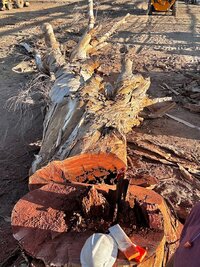
Nature gutted this one and still got it 90 to the lean with all the tricks I know. Cut 1/3 of the compression side, wedge in the back of it. Dutchman in the face compression side, sizwheel, double hinge. 48” DBH.

southsoundtree
Been here much more than a while
- Location
- Olympia, WA
Wedges near the hinge lift upward very hard on the hinge without the leverage to rotate the trunk as with wedges far from the hinge, at the rear of the tree.I think I screwed it up.
Nicked the hinge in the circles, so it went with the weakest spots when forced by the wedges. I imagine the spiral grain was still a contributor.
View attachment 97813
New threads New posts
-
test
-
 Alternatives to standard asphalt around roots
- Started by southsoundtree
- Replies: 2
-
-

-

-
 For Sale: 2018 Vermeer BC1000XL Chipper | 918 Run Hours | Deutz Diesel
- Started by Blue Ribbon Tree
- Replies: 2
-


