
Aerial Traveler
Participating member
- Location
- ...
...
Last edited:

Follow along with the video below to see how to install our site as a web app on your home screen.
Note: This feature may not be available in some browsers.

I disagree. Lanyards are primarily used for work positioning purposes with the secondary function being life support (and only in brief specific circumstances). In a rec climb these uses are rarely needed.The concept of minimalist climbing gear is an interesting campfire discussion. Not having a lanyard is taking it too far. Even in a purely rec climb.
The lanyard is part of PPE
Watched it all. Very safe climbing. First climbing vid I watched in a while. Nice.Having some fun clearing deadwood out of a young walnut at a private campsite on a nice November day in southeast Ohio. I decided to ditch my lanyard and use both ends of my rope to access the tree. Nothing too ground breaking in this video. just a nice little climb to make a favorite hammock spot a little safer.
The intro is a bit long on this video, if you get bored skip to 16:53 for the start of the climb.
Is there a pre-climb campfire and coffee break? Of course.
Do you get a look-see of my current saddle storage set-up? Yep.

If more people could adopt this attitude, the world would be a way more chill place.Taking notes...


When I was thinking about setting up a double ended lanyard, I realized that if the point was to facilitate more rapid advancement into a conifer that was not being removed, there were better ways to achieve that function. If you've advanced to your original TIP on your main climb line, and want to advance further, then you have your lanyard and your main line. Otherwise what? You wanna climb up from the ground with just a double ended lanyard? That's not smart at all. I just haven't seen a use case that didn't have a more elegant solution. I now have the gear and just shoot a line up to the highest safe limb and walk up the rope.First lanyard foisted on me was "double acting" and "double ended" by virtue of a classic prussic and it's usability sucked beyond words. Maybe if sized just right for advancing up conifers?
I agree with Moss that lanyards and climb lines are just a continuoum, really the same. Long lanyard, short climb line.
First lanyard foisted on me was "double acting" and "double ended" by virtue of a classic prussic and it's usability sucked beyond words. Maybe if sized just right for advancing up conifers?
I agree with Moss that lanyards and climb lines are just a continuum, really the same. Long lanyard, short climb line.


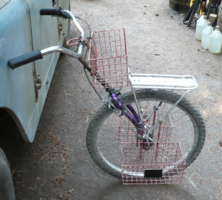
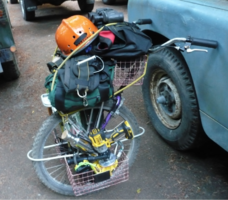
I often have to hike quite a ways to a tree, so cutting bulk with kit in the backpack has been an ongoing goal. I made up a very lightweight 8 ft lanyard of 9mm rock climbing stuff and a smaller DIY version of surveyor's BOLA, which has been great. The whole thing will almost wad up in a coat pocket, and while I often miss having my longer HELL lanyard on some climbs, it has been good to have this minimal option. But if there are trails and no extreme bushwacking involved, I also have my homebrew pack wheel which is good for a lot more weight than I can carry on my back. One of these is very quickly made from the front fork of a discarded mountain bike. It helps to have a brake that can be locked in park mode, like you see on strollers for infants. Then, you set the brake in park, and lean the handle bars against the tree when you get to it so it stays upright to load or unload. I have had as much as 100 pounds of kit on this rig and it makes for an easy hike (photo). It will navigate much narrower, twisty trails that a wagon or two wheel setup.Get a 10 foot 10mm lanyard if you're worried about bulk, or skip breakfast if it's a weight thing!
Great idea, Tom. There is bound to be a way to rig a kickstand. I also had the idea, for steep uphill parts of a hike, to sort out how to motorize it, using the same big DeWalt cordless drill I use on my power ascender. This is one of the best attributes of our RollGliss-based power ascenders a number of us have built, over a proprietary unit like a Wraptor or Ronin. With a quick twist of the keyless chuck, the drill comes right off and can be used for anything else. A bike rear wheel can be substituted in place of the normal front wheel, and this would give a chain sprocket stack that free-wheels when you shove the pack wheel manually, but kicks in immediately when power is applied. A good rainy-day project in the shop!@Burrapeg
Brilliant!
I can envision a swing out tripod kickstand that is toe operated to use as a stand. Along the lines of the legs on golf bags. Pivot the a-frame kickstand at the top of the frame.
Now I'm watching the alleys for a junked bike.

You could also buy an electric wheel to put on the front of that, they have become very popular in this area with the Amish. Many of the scooters on the road now have an electric front wheel, apparently they free wheel with little or no drag so you could simply pedal along when you want, kicking the power when you need it. They also have amazing power, these guys are running down the road at about 40 mph on a little aluminum scooter.Great idea, Tom. There is bound to be a way to rig a kickstand. I also had the idea, for steep uphill parts of a hike, to sort out how to motorize it, using the same big DeWalt cordless drill I use on my power ascender. This is one of the best attributes of our RollGliss-based power ascenders a number of us have built, over a proprietary unit like a Wraptor or Ronin. With a quick twist of the keyless chuck, the drill comes right off and can be used for anything else. A bike rear wheel can be substituted in place of the normal front wheel, and this would give a chain sprocket stack that free-wheels when you shove the pack wheel manually, but kicks in immediately when power is applied. A good rainy-day project in the shop!


