3:1 pretension on porta wrap (?s)

Chris Schultz

Carpal tunnel level member
Location
Minturn
Has any body set up 3:1 on porta wrap for pretensioning a load? How well did it work? What hardware did you use? Im rarely on the ground running ropes, my groundie is strong for his size, but sometimes I think he struggles to get real good pretension on a load. Is it worth setting up gear for the 3:1? I’d love to own a Hobbs, or GRCS, but they’re too spendy.....
 
When Portys came out i was first kid on block around here with one, lots of naysayers..
It was original Bent T style, hollow down center to a threaded base/amon nut that served to the eye on tail side.
Threaded thru with rod and closed eye, so eye presented out top also, secured at base.
.
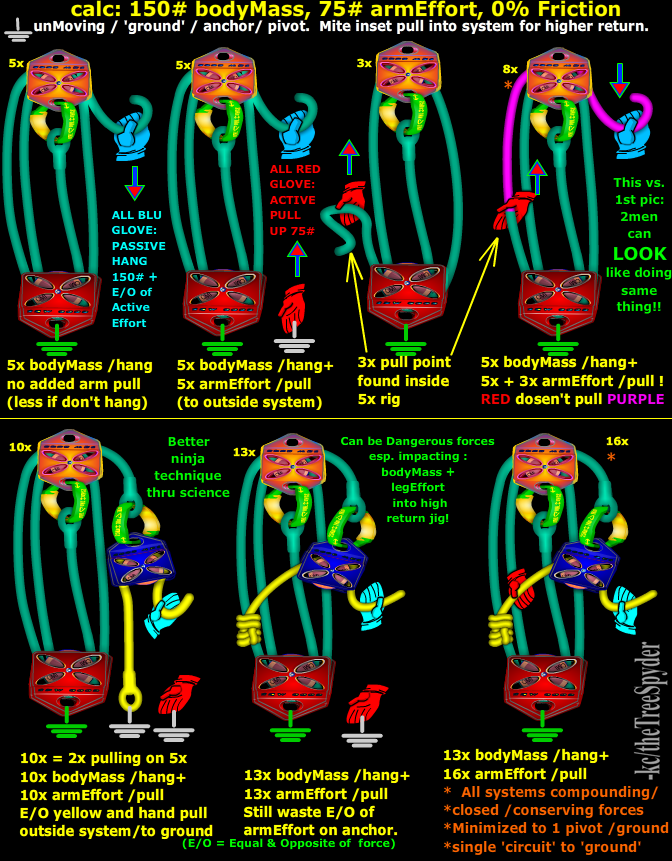
Had a 3/1 and sometimes 5/1 used as a compression jig like truckers use for tarp tie downs over load Truckers Hitch w/small pulleys. and Prusic grab for main line.
Take 'purchase' of line with jig, 'hold it fast' with frictions of Porty, and re-extend jig for another compression.
.
Next step found is hanging on end of jig, reaching inside jig,
>>place free hand on other side of pulley that input feeds
>>pull up on the new hand hold while still hanging on end of jig with 1 hand
Usually limited by applied bodyweight as input
>>now using all bodyweight + equal and opposite of effort at 3:1 position normal input
>>plus the effort input inset in system pulls another 1x on compression
>>net: 4xEffort + 3xFull bodyweight
>>rather than3xPartial bodyweight applied
.
Next time, impact into system, snatch purchase hard thru Porty
Then also can make loop as input on end,
>>fold back up against self and hold firm for leg input
>>now instead of flexing arm input and legs as static receiver
>>rigid arm and flex legs for 4xLeg effort +3xBodyweight, some impact
Build a 5x Piggyback jig tho throw into 3x place a/n
>>using method described can get potential of 8xEffort + 5xBodyweight
.
i found the methodology after rather unpopularily stating that standard DdRT gives climber 2/1 over self (less friction) on ISA BBS (Bulletin Board Services that evolved into being called forums)
>>a special place of special people: first communicating arbos powered by Win3.1 etc. some of us across dial-up on free 25hrs a month Walmart account. ISA closing BBS was part of the pre-dawn twilight of TB birthing i think; w/Tom & Mark leading the way.
>>and also found that hitch slid loaded on command, because load autonomously switched to 'static' leg
>>just as if 2 legs and one failing or stretching more, most rigid resistance carries most load w/o question
>>freeing up hitch to slide on 'dynamic' leg
>> yet same would lock on single line, proven again later w/SRT as no 'buddy' leg/line to hold load as freed up hitch to slide.
But anyway, find the 4x from 3x jig and 8x from 5x jig
>>as simple extension of counter-intuitive 2/1 pondered in hours of sitting/riding DdRT.
Been a long road, and this methodology is one of best things came back with, can be applied to rigid class_1 lever system also.
 
In the past I've used a handled ascender with either a carabiner or pulley below it. Luckily I never shredded a rope, same can be done with a prussik. Take a single wrap on the bollard then up to the prussik.

Ropejack works really well, as well.

Anymore if I need to pretension I use the bollard on my BMG (kind of like cheating) or I sweat the line going into the porta wrap. Does your ground man know how to sweat a line, or is he trying to pull straight down on the load?
 
When Portys came out i was first kid on block around here with one, lots of naysayers..
It was original Bent T style, hollow down center to a threaded base/amon nut that served to the eye on tail side.
Threaded thru with rod and closed eye, so eye presented out top also, secured at base.
.
Had a 3/1 and sometimes 5/1 used as a compression jig like truckers use for tarp tie downs over load Truckers Hitch w/small pulleys. and Prusic grab for main line.
Take 'purchase' of line with jig, 'hold it fast' with frictions of Porty, and re-extend jig for another compression.
.
Next step found is hanging on end of jig, reaching inside jig,
>>place free hand on other side of pulley that input feeds
>>pull up on the new hand hold while still hanging on end of jig with 1 hand
Usually limited by applied bodyweight as input
>>now using all bodyweight + equal and opposite of effort at 3:1 position normal input
>>plus the effort input inset in system pulls another 1x on compression
>>net: 4xEffort + 3xFull bodyweight
>>rather than3xPartial bodyweight applied
.
Next time, impact into system, snatch purchase hard thru Porty
Then also can make loop as input on end,
>>fold back up against self and hold firm for leg input
>>now instead of flexing arm input and legs as static receiver
>>rigid arm and flex legs for 4xLeg effort +3xBodyweight, some impact
Build a 5x Piggyback jig tho throw into 3x place a/n
>>using method described can get potential of 8xEffort + 5xBodyweight
.
i found the methodology after rather unpopularily stating that standard DdRT gives climber 2/1 over self (less friction) on ISA BBS (Bulletin Board Services that evolved into being called forums)
>>a special place of special people: first communicating arbos powered by Win3.1 etc. some of us across dial-up on free 25hrs a month Walmart account. ISA closing BBS was part of the pre-dawn twilight of TB birthing i think; w/Tom & Mark leading the way.
>>and also found that hitch slid loaded on command, because load autonomously switched to 'static' leg
>>just as if 2 legs and one failing or stretching more, most rigid resistance carries most load w/o question
>>freeing up hitch to slide on 'dynamic' leg
>> yet same would lock on single line, proven again later w/SRT as no 'buddy' leg/line to hold load as freed up hitch to slide.
But anyway, find the 4x from 3x jig and 8x from 5x jig
>>as simple extension of counter-intuitive 2/1 pondered in hours of sitting/riding DdRT.
Been a long road, and this methodology is one of best things came back with, can be applied to rigid class_1 lever system also.
Does your wife know you talk like this? I love this post! I'm gonna ponder this formula all day. THIS is the kinda think'n that clear a hangover and add a cool new toy to the collection. Thanks dude.
 
1f71badae352d04b47e0c05fa8ba5201.jpg

f984fad34e3fd525b9893bdd36e7f41f.jpg

31895e7be5fb7687cd1ef7ae4c1a77cb.jpg

7498bb0b252b125bbb1153845b50bbc0.jpg


I used this setup the other day. Working solo, pretensioned this pine before felling


Sent from my iPhone using Tapatalk
 
In the past I've used a handled ascender with either a carabiner or pulley below it. Luckily I never shredded a rope, same can be done with a prussik. Take a single wrap on the bollard then up to the prussik.

Ropejack works really well, as well.

Anymore if I need to pretension I use the bollard on my BMG (kind of like cheating) or I sweat the line going into the porta wrap. Does your ground man know how to sweat a line, or is he trying to pull straight down on the load?
He knows how to sweat the line, and when possible I help from my end also.
 
1f71badae352d04b47e0c05fa8ba5201.jpg

f984fad34e3fd525b9893bdd36e7f41f.jpg

31895e7be5fb7687cd1ef7ae4c1a77cb.jpg

7498bb0b252b125bbb1153845b50bbc0.jpg


I used this setup the other day. Working solo, pretensioned this pine before felling


Sent from my iPhone using Tapatalk
I’m more talking pretension in a top down rigging scenario. I’m liking the looks of the ropejack, was hoping someone out there had used the stein pretension pulley setup. I’m thinking prusik and swivabiner.
 
Last edited:
If more pull is often needed, a DWT can be setup as well, adding mechanical advantage in the canopy.
This can help, but raises the total strength of the support thus reciprocally dropping elastic dampening response. Support against load is all about rigidity statically, but dynamically rigid against can keep peak pulse forces, elasticity dampening can allow some steam to escape back down to nominal load forces.
.
A 10k rope is more rigid against a 500# impact than a 5k line of matching materials and design
>>a 5k line in 2/1 will be more rigid to the 500# impact , more like 10k than 5k dampening response
>>elastic response is going to increase over usable range as load encroaches more into headroom
>>after load parts of rope elasticity may replenish immediately, over hours or to next day or if real hard hit never : 'hysteresis'.
.
Not always a bad thing, especially w/o impact
>>but factor to be aware of as courses thru system loading against impact and side force expressed etc.
 
We do it regularly to lift limbs. Pulley up top, rope rigged through the portwrap like normal, and a 3 to 1 setup off the top of the portawrap. The 3 to 1 is normally used with a prusik or klemheist around the main line. We push it up with a pruner pole so we can get a good bit of travel. The main rig rope ends up being the main progress capture. A prusik or jumar can also be setup to hold the 3 to 1 tail so 1 guy can work it.
 
Does your wife know you talk like this?
Yes thanx, except for the 'purchase' and 'hold fast' parts, that is sailor speak in ABoK.
.
i do/did pre-tighten normally for speed, then drop to lower power granny gear, dual input strategy to finish/tweak out further 'purchase', to be later, slowly 'paid out'(mine) in lowering, ABoK defines 'Cast Off'/total free immediate, unrestricted release as opposite of 'Make Fast'. 'Hold Fast' and 'Make Fast' seem to be ABoK references best translate to me as 'immediately secure'.
.
The key in secondary force input, is to reflect promised equal and opposite force, not(wasted) outside the system like normal person, but recursive fold back inside system again against target.
.
This takes 1st class lever, who's unique defining property is the ONLY mechanical leverage class that input/output move in opposite directions, around center pivot, so effort direction can join it's equal and opposite/already in progress in concert against load at 1 or dual points of input. So to in 1 hand have force input to system, and at same time join in the equal/opposite in opposition direction against a load next in chain. Pulley, seesaw, 4way tire iron, rolling log, standing on wheel tread and pulling up on other side, large round steam valve etc. Rope arc is just flexible lever example. Visualization of rigid levers vs. flexible lever effects of rope and pulley
.
Full bodyweight hanging gives it as input, but also assures that equal and opposite is not against bodyweight as normal. i grew to picture if on scale and bodyweight on scale did not change that knew equal/opposite folded back into system , just not weight, cuz all must be accounted for, so doing all to stack chips on our side. Then kinda becomes like some martial art slide/drop a/n and rest of forces at leveraged extremes on target against own CoG as pivot(?).
Born while sitting in DdRT as part of these forces, and dependent on them as sorted.
>>also used to stomp down trash with lesser weight like this when kid, but did not know what was doing fully..
SaveForces_5.png

.
3:1 normal is 1-2-3 ends and arc positions.
>>1x is external hold vs. rest of support between pivot and load
>>2x position is usually anchor pivot/non moving part, less loaded than compression
>>hand hold makes this open system
'Close' the system , to self contained , locked against self/locked off
>>2x position loads to a/2 again as much, to be equal to, not lesser than 3xPosition
Same as when 'close' of system to self contained while inputting effort and getting 4x each end from 3x input
>>But, then seeing as bodyweight part of input has single input point
>>then adds to the the 2x,3x (LEG) positions 2x,3x as more normally expected.
But now have 2 inputs to orchestrate to hit with both, impact one and keep moving with other, hold with one and impact with other etc. To play game with more power x options of usage as intriguing game changer
>>treating every bit of effort, own bodyweight to directly hit or fold back to directly hit target w/1st class lever reverse allowing to reflect own equal and opposite effort back against target and employ bodyweight as well
>>usually if pulling down as input limit to bodyweight, pulling up effort as limit
>>here get both at once + secondary input of equal and opposite thru 1st class lever return.
Different_ways_of_handing_a_pulley_system_to_get_different_outputs.png


Rigid uses of same concept
 
I’m more talking pretension in a top down rigging scenario. I’m liking the looks of the ropejack, was hoping someone out there had used the stein pretension pulley setup. I’m thinking prusik and swivabiner.
I’ve used stein’s pulley eye to eye combo intended for this purpose. It works as intended and is easy to set up and break down quickly, with one hand, which is usually the requirement for a system like this that you’ll actually use day to day. It’s very simple and easy to instruct someone on.

having an open sheath allows you to pop the rig line in and out without undoing a carabiner. (I’ve not used a rope jack so I don’t know if that’s easier or not.)

It is annoyingly single purpose. But a lot cheaper than other options.

I use a swivabiner on my saddle- and I see the swivel actually making things harder for the operator in this situation. Kind of all flopping around when you trying to feed a rope into the sheath one handed.
 
Reg is the shit. Seeing as how he designed this, and displayed it in the video, one could assume it’s legitimacy.... but I wanted to hear other’s real world opinions on it.
 
Back
Top Bottom