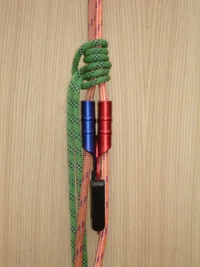
Does 'ascender' here mean the Kong double-handled ascender? I think that is what is meant and will respond to that.
[ QUOTE ]
I don't see any problem with the method, the fact that both legs of the line are locked in place by the upper ascender means that even if one side of the lower ascender were to fail the knot above the ascender (Prusik , Klemheist or other knot tied onto both legs of the rope) would provide back up.
[/ QUOTE ]
No--the upper set of Kongs would provide the backup, not the knot. The knot would just create more drag.
You are right that both legs of the climbing line are locked in place by the upper ascenders. But, if one side of the lower ascenders were to fail, the cam on that side of the upper ascenders would provide the backup by jamming the upper ascenders against the branch/friction saver. That is what holds the whole system in place and that is the point of the upper ascenders. If you pull down on either leg of the climbing line the other leg of the climbing line pulls the ascenders up into the branch/friction saver. Because this is done before the climber starts their ascent, the upper ascender is jammed against the branch/friction saver for the whole ascent. There is very little or no slack and the climber might not even notice if one of the cams on the lower ascender failed.
The prusik cord <u>might</u> provide a backup if <u>both</u> cams of the lower ascender were to fail. But, the Prusik cord has to be set very loosely on the climbing line because the Kongs create a gap in the legs of the climbing line (see attachment). Because of the looseness of the Prusik the climber might fall some distance before the Prusik tightened on the climbing line. The Prusik is not required, however, and seems superfluous. It creates added drag for every ascent and <u>might</u> work only in the very unlikely chance that both cams of the lower ascenders failed at the same time.