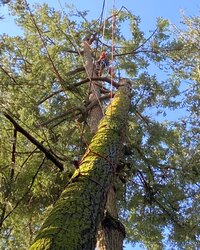
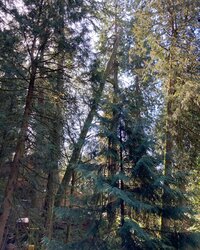
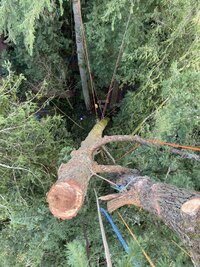
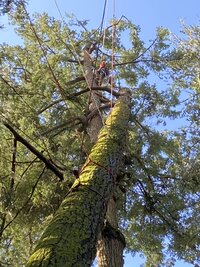
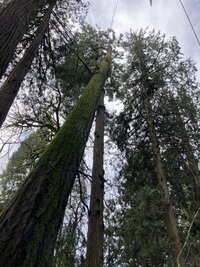
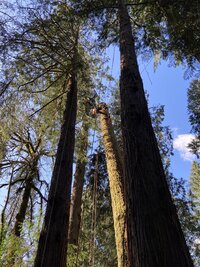
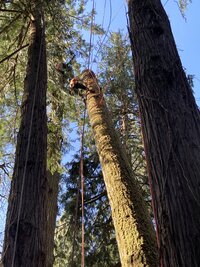
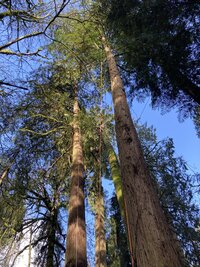
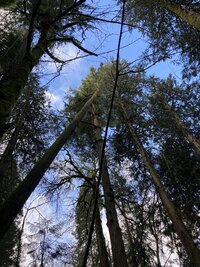
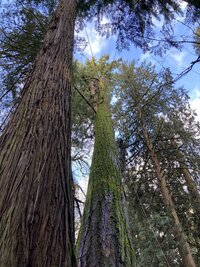
Large, uprooted doug-fir laying into another doug-fir... thoughts?

Just wondering if you could fall both trees and sell the logs? Might help these folks out and deal with the hazard if kids are around.
Probably still the question of "how?" as the behavior of that root plate isn't known (does it want to sit back up or finish falling?). Nor is it known how those 2 are hooked together. Even in an open field, I'd be hesitant to just notch and back cut (I'd plunge cut) the upright tree and expect it to fall it straight away from the leaner. If the branches are hooked and the roots holding on too much on the leaner, you've limited your options for next steps, right?
 
You said there is “crane access” sorta? You also mentioned a skidder winch could do it? Spitball here: what about a large wrecker winch? I don’t know if you got those kind of tow trucks in your region. But the big wreckers that recovery tractor trailers up in the mountains here is what I’m picturing. Those guys are usually always game for something crazy too…. It would be the quick and dirty way to do it, especially if it’s a lop & leave.
Is the leaner on the driveway side or back side of the upright tree? If its on the back side, you probably need more push than pull, right? If driveway side, that oughta work. Do those trucks have more pulling power than a skidder winch??? I'm guessing the wrecker operators are more experienced with creative angles...but any skidder operator has pulled out a leaning tree - but maybe not one with the root ball still attached. I'd be really hesitant to cut the leaner off of the root ball with a tree that big, but that may be an option. Then any experienced logger can get it down.
 
Probably still the question of "how?" as the behavior of that root plate isn't known (does it want to sit back up or finish falling?). Nor is it known how those 2 are hooked together. Even in an open field, I'd be hesitant to just notch and back cut (I'd plunge cut) the upright tree and expect it to fall it straight away from the leaner. If the branches are hooked and the roots holding on too much on the leaner, you've limited your options for next steps, right?
Rope up in the standing tree to a winch with MA system, set up your hinge on the standing tree and bore cut to a healthy sized strap (listen for any popping - the tree is kinda the same as a leaner with all the added stress on it), tension the MA up and cut strap lower than the back cut so you still retain possession of your saw . . .
If by chance this doesn't pull down the fallen tree, you can still most likely winch it down too but if it's really bent up now, bet it'll go too, esp if limb tied. My 2 cents . . stay safe out there.
 
  • Like
Reactions: ATH
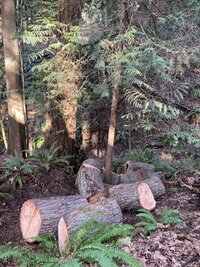
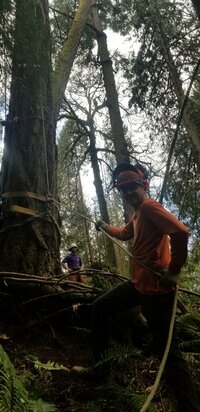
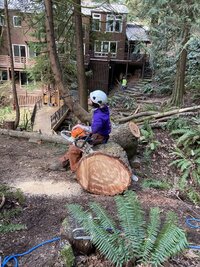
I did one a few years ago that was an absolute monster. We had 5 GRCS units to guy and rig down the tree. Tree was in yard A. Leaning towards garage/office in yard B. Brush left the property out yard C. I took two days to get it rigged and got it down to the contact point. Robert Bundy released the contact point and did the lower log in one day. Day 4 was derigging. Big conifers in a suburban setting can make for some exciting tree work.
 

Attachments

  • 75D2D921-2E85-48CA-837F-A28FFF9FABCE.jpeg
    75D2D921-2E85-48CA-837F-A28FFF9FABCE.jpeg
    517.9 KB · Views: 38
  • 3BA43EF3-E6C5-479E-BD90-1E0F65F46E48.jpeg
    3BA43EF3-E6C5-479E-BD90-1E0F65F46E48.jpeg
    864.5 KB · Views: 37
  • IMG_9867.jpeg
    IMG_9867.jpeg
    1 MB · Views: 35
  • IMG_9826.jpeg
    IMG_9826.jpeg
    685.3 KB · Views: 31
  • IMG_9863.jpeg
    IMG_9863.jpeg
    977.6 KB · Views: 36
I did one a few years ago that was an absolute monster. We had 5 GRCS units to guy and rig down the tree. Tree was in yard A. Leaning towards garage/office in yard B. Brush left the property out yard C. I took two days to get it rigged and got it down to the contact point. Robert Bundy released the contact point and did the lower log in one day. Day 4 was derigging. Big conifers in a suburban setting can make for some exciting tree work.
That's sick that you have the gear to do that. I, being notoriously cheap, will probably stop at 2 GRCS units, but I realize now that having more gear opens up not only the opportunity to make more money, but to get into more fun and interesting work..... You are certainly opening my eyes Sensei Ryan.
 
That's sick that you have the gear to do that. I, being notoriously cheap, will probably stop at 2 GRCS units, but I realize now that having more gear opens up not only the opportunity to make more money, but to get into more fun and interesting work..... You are certainly opening my eyes Sensei Ryan.
The company I contracted for on the project had 3 GRCS units, I had one, and we borrowed another from another contract climber. Currently I own 2 and can’t see buying more. Learning to use a GRCS to tension ropes and load them onto Portawraps is a very useful skill for projects like this when you don’t have multiple GRCS units.
 
The company I contracted for on the project had 3 GRCS units, I had one, and we borrowed another from another contract climber. Currently I own 2 and can’t see buying more. Learning to use a GRCS to tension ropes and load them onto Portawraps is a very useful skill for projects like this when you don’t have multiple GRCS units.
So you can use 1 GRCS to tighten up a rope, put it on a POW, then just move the GRCS to another tree and do it again ad infinitum?
Hadn’t thought of that.
 
Last edited:
I feel confident that I can piece it down, one way or the other.


A thought about it is that the bowed (failed) tree is jammed between the support tree (also deflected, storing energy) and root plate (potentially unbroken compression roots want to unbend), like a loaded spring with gravity loading it more.

I think I can face-cut with a wide bird beak directed at the support tree. Gut the hinge. and backcut ng to let the stump fall away from the support tree, pulling the trunk backwards as it falls (the root plate is tilted upward and therefore sideways a few feet from its natural position.)

If the root plate won't move on its own, I have a 13k truck and winch to help.

If it really wants to collapse toward the support tree, i can fence-post it down and fold the trunk to one side.


The big "x-factor" is if the limbs are locked.

 
I worked for the company Ryan was contractor for on that project. Was a new groundie at the time. Here’s some more photos/videos from the project of Ryan and Robert taking on that uprooted and pinned Doug-fir. Definitely the gnarliest rigging scenario I’ve ever been a part of. Can see our drag path across that small foot bridge in “yard C”
 

Attachments

  • IMG_5161.jpeg
    IMG_5161.jpeg
    1.2 MB · Views: 30
  • IMG_5163.jpeg
    IMG_5163.jpeg
    127.6 KB · Views: 30
  • IMG_5152.jpeg
    IMG_5152.jpeg
    1.2 MB · Views: 29
  • IMG_5157.jpeg
    IMG_5157.jpeg
    1.1 MB · Views: 27
  • IMG_5158.jpeg
    IMG_5158.jpeg
    871.6 KB · Views: 26
  • IMG_5150.mov
    IMG_5150.mov
    25.1 MB
  • IMG_5147.jpeg
    IMG_5147.jpeg
    1.2 MB · Views: 26
  • IMG_5148.mov
    IMG_5148.mov
    15.7 MB
  • IMG_5146.jpeg
    IMG_5146.jpeg
    1.1 MB · Views: 24
  • IMG_5145.jpeg
    IMG_5145.jpeg
    1.1 MB · Views: 30
Sounds like you have options.

You can cut the fallen tree and see what happens, if no good dump the support tree.

Do the same but clear the limb locked areas first, assess for a crane then as you mentioned it would need to be brushed out first anyway.

I’d start with a conversation with the client and some point of reference numbers for separate scenarios, let them decide to some degree.
Occasionally for situations like this I think of it as, the trees are going to go if nothing is done, and if they are free of targets just bite the bullet and put them both down. Unless the client has funds enough and will enough to save out the support tree.

Dealing with limb locked, cut up trees is no fun and neither is walking one down with weights and diameters like that.
 
An issue to consider is whether it was solely a gravity failure or was it wind driven. Gravity stays put if you unlock the limbs. Wind slapped the limb lock might be preventing re uprighting. However the bent trunk says it went far enough to now be a gravity situation. I wouldn't trust adjacent trees with crazy loading because their root systems are how much different than the failed tree - uncertainty. But if you can keep the rigging forces limited by strategy rigging could offer some control for triggering a final felling/release event. Armchair advice. I cede to the experts.
 
Where you say "tie it off to the standing tree", you mean essentially lash the 2 trees together to make sure the leaning tree won't either set up when the top is removed or fall down when the entangling branches are cut, right?

What size of rope would you use to do that on trees this big? I'm assuming the rope won't get a big dynamic load because the goal is to keep it right where it is, right? Just a bunch of wraps around the 2 trees with 5/8" rigging line as tight as possible? I can certainly see where a TIP from a crane would help facilitate that - depending on what the branches are like in there, it could be difficult to get a rope around easily.
There are several ways to accomplish this and depending on factors of the jobsite and what tools are available determine which is best for that job.

Multiple wraps as you mentioned does work well. And if you are deliberate about where to place the wraps to prevent crossing other wraps, you can release the load under tension if needed later. Such as if it tries to stand back up. You could then fell the trunk. It's often easier to use a shorter rope or to have it bagged to manage the rope length through the limbs.

Another way would be with a large block and rigging rope down to a friction device. This will Multiple forces on the standing tree though.


This is also assuming the trees are trunk-to-trunk, right? Or would you do the same if it is big branch-to-trunk or big branch-to-big branch?

So if that stabilization is done, and there are no targets below, why crane picks to get the top of the falling tree down instead of bombing out in several pieces? Would cutting those bombed pieces be advisable while tied into the crane or is it best to tie into upright tree?


Yes trunk to trunk would be ideal but use whatever you can. Even two points not touching each other would be fine if your certain it will stand up, or if they had bypassed you could do two points beyond that if you were certain it would not stand up.


You certainly could just bomb out sections of the top, whether tied into the tree or the crane. It's just situation dependent


One thing to be certain of is that the trunk won't fall or stand up while the crane is hooked to it. A crane supporting a leaning trunk, and then you take top weight off causing it to stand up, can drag the crane with it.
 
A rough calculation of an average doug-fir log weight for 32" diameter x 100' is 10k.

I'm guessing it's bigger, plus limbs.
Likely a dense doug-fir.

I could get a 22 ton in, maybe. Bigger cranes probably won't make the driveway.

I've had something similar, but the doug- for was straight, not loaded up like this one. I cut the butt right at ground level, then he lifted the top end out of the support tree. He was able to leave the butt on the ground and pivot it to the open lawn.

This looks bigger, with more problems.

I think a crane will not really be useful.
 
A rough calculation of an average doug-fir log weight for 32" diameter x 100' is 10k.

I'm guessing it's bigger, plus limbs.
Likely a dense doug-fir.

I could get a 22 ton in, maybe. Bigger cranes probably won't make the driveway.

I've had something similar, but the doug- for was straight, not loaded up like this one. I cut the butt right at ground level, then he lifted the top end out of the support tree. He was able to leave the butt on the ground and pivot it to the open lawn.

This looks bigger, with more problems.

I think a crane will not really be useful.
I've often wondered about such a maneuver. That sounds pretty epic. I wonder what percentage of crane operators would be willing to do that.
 
A rough calculation of an average doug-fir log weight for 32" diameter x 100' is 10k.

I'm guessing it's bigger, plus limbs.
Likely a dense doug-fir.

I could get a 22 ton in, maybe. Bigger cranes probably won't make the driveway.

I've had something similar, but the doug- for was straight, not loaded up like this one. I cut the butt right at ground level, then he lifted the top end out of the support tree. He was able to leave the butt on the ground and pivot it to the open lawn.

This looks bigger, with more problems.

I think a crane will not really be useful.
I don’t think it would be a good idea to try to take loaded dynamic picks with a crane. Who knows what the added forces would be.
Just for conversation sake I could potentially see a crane being utilized to pick some of the weight and support a tree while it’s being dismantled my more conventional means.

Those dead on hung up trees can be a real puzzle, more so when the limbs are locked like Velcro.

Any chance you have a actual photo?

I assisted with one not unlike this but it also had the neighbors house as a target. We used the ole Earsted yarder, to winch it up supporting the tree while it was limbed and a non loaded portion of the top was removed. We then picked it up more, put a big ole face cut and let the cable free spool out to get it to swing to the side.
 
Last edited:

New threads New posts

Kask Stihl NORTHEASTERN Arborists Wesspur TreeStuff.com Teufelberger Westminster X-Rigging Teufelberger
Back
Top Bottom