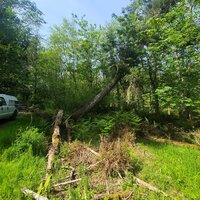
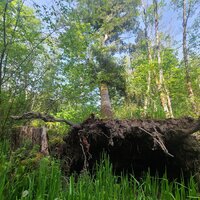
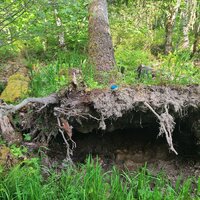
Large, uprooted doug-fir laying into another doug-fir... thoughts?

With this species when they are hung up where there is a target, my methodology is almost always to secure the tree with multiple lowerable rigging points, climb up and get rid of as much weight as possible, and then either bring it down in pieces or start taking weight off the butt. It certainly isn’t a situation I would want to feel rushed based on budget constraints.
 
I don’t think it would be a good idea to try to take loaded dynamic picks with a crane. Who knows what the added forces would be.
Just for conversation sake I could potentially see a crane being utilized to pick some of the weight and support a tree while it’s being dismantled my more conventional means.

Those dead on hung up trees can be a real puzzle, more so when the limbs are locked like Velcro.

Any chance you have a actual photo?

I assisted with one not unlike this but it also had the neighbors house as a target. We used the ole Earsted yarder, to winch it up supporting the tree while it was limbed and a non loaded portion of the top was removed. We then picked it up more, put a big ole face cut and let the cable free spool out to get it to swing to the side.
Absolutely no dynamic picks.


That estimated log weight feels too light in my head. Stump wood seems to me to be denser.


The 22102 Manitex, at that distance, couldn't handle anything close.


I think a crane would increase the risk.


Could be 15 minutes of cutting on the ground or hours on the ground or in the tree.


I may go today or tomorrow and climb it.
 
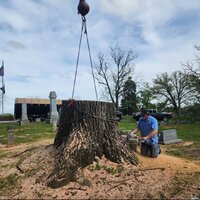
It's wild to me how much species can change the weight of trees. Granted the diameter is larger here, but this short chunk of Oak was 6000lbs. View attachment 98436
What do you think the volume is?


How does that stump wood volume multiply out for an average cubic foot's weight?

In my first real crane job (Was I in the deep end!!!) Has a stump pick a few feet tall and a few feet wide...3k for maple.

Beware average charts with stump wood and crotches.


I think I multiplied at 40 pounds per cubic foot for DF.

Charts may say an average of 44 pounds per cubic foot.

I'm guessing denser than average for this based on the growing area (old forest). It does have lots of water, though.
 
....

I'm guessing denser than average for this based on the growing area (old forest). It does have lots of water, though.
Probably the case with maple...but with ring porous trees (oak, for example) the opposite can be true... I'd have to dig, but there was a paper specifically looking at Red oak. Since faster growing trees put on more wood throughout the growing season, the have a higher portion of latewood which is more dense than the porous early wood. In slower growing trees that ratio is closer to 1:1. In really fast trees each ring may over be 75% latewood.
 
Doesn't big dynamic crane loading = youtube awakenings?

arccos(30 ft/ 100ft) = 72 degrees or 18 degrees off vertical

I think standing back up ought to only possibly occur well into spar shortening, by which time the spar may have slipped or been convinced to slip off the supporting tree. This possibly suggests a guy/pull rigging to restrain standup/ yank the spar past the support tree. A good long line will be immune to going tight during the fell. This might go with a standard debrushing detangling from the top down until the spar can go. It would sacrifice bark contact though. And you'd have to get right to the highest tangle - is there any possible tip that high? that wouldn't sketch you out . Keeping climb lines out of the equation - pick a tree the most away from the probable eventual fell (to the side kind of like location of felling escape route) and grapple over so if all hell breaks loose you bail out and swing into the 3rd tip tree. trunk smack better than ground smack. bag your line tail to keep it out of tangle zone. consider medium light breakaway local tip/lanyards. coffee brainwaves : )


edit - to connect to my first post: while the tangle is velcroed the support tree is largely in vertical axis compression loading, when the tangle is freed and the spars allowed to slip the leaner changes to mostly side loading the support spar and that could be a vulnerable moment for the support tree's root plate
 
Last edited:
Absolutely no dynamic picks.


That estimated log weight feels too light in my head. Stump wood seems to me to be denser.


The 22102 Manitex, at that distance, couldn't handle anything close.


I think a crane would increase the risk.


Could be 15 minutes of cutting on the ground or hours on the ground or in the tree.


I may go today or tomorrow and climb it.
Exploratory climb to develop a workplan? If you are just going for it, I wish you the best. I will be thinking about you and holding positive outcomes in my mind's eye.
 
I had to put together a bid for 35+ removals at that job (a lot of smaller alders, a few big alders and willows, plus 2 more blow- downs), so didn't give the fir as close of attention as needed at first look.

A dog-leg at 50' was something I missed, and from the angles I was looking at it, I misinterpreted that dog-leg as more bend that it was... still 45⁰ or less from horizontal at the butt to 90⁰ at the top.
 
  • Like
Reactions: evo
I've got a large doug-fir in a wet area leaning hard and bent into another large doug-fir. It fell a few weeks ago. I looked at it last week. It's away from obstacles, along the driveway. Crane access would be possible, not good. $1200-1500 minimun seems avoidable for a no-obstacle, no clean-up job. Not sure how a crane could/ would help until it's untangled.

They are both about 30" dbh.
The root plate is 35⁰-ish. The failed tree is strongly bent against the support tree. The root plate (roots broke next to the gravel driveway) is about 3-4' lifted in the high side. The failed tree is laid very squarely into the support tree. Big have large and strong branches, possibly laced together.

I can't see compression side roots to address if they are broken or springy.

There is a lot of bend in the failed tree in thick wood... easily 12" diameter, maybe a good bit more.

The limbs obscure the interaction between the trees.


I can climb up the support tree from the back side If I take time to get a good TIP that doesn't No evidence of domino-uprooting observed.

Its also possible to spur right up the failed tree.

Because of the sizes and amounts of branches, coupled with the lean, I don't expect the leaner to slide/ shear branches in a dependable way.


I can't tell if the failed tree is whittled off the support tree. If it will want to straighten and lift off the support tree, or continue to fall.

I was considering a sloping cut to the side to get it to slide off while the root- plate falls down and back.

Is there any goal of preserving the supportive tree?

Use a high reach aerial lift to buzz off all brush that is free then reassess the plan?

Set some back stays to hold the trunk until you free the crown and then release?

Use a lift to make a directional cut mid way up the failed tree that would force things in ideal directions without potential for harm to you or the lift?

Fell them both with a clear exit route strategy?

Dynamite???
 
Your clarifying pic negates my PNW conifer forest assumption. I think my support tree root plate comments still apply. I can't see any easy no-damage to the vertical trunk plan - that's a huge chunk of spar being restrained with a lot of tilt load. Maybe if you maintain the contact at the upper location till disengagement/fell you can avoid massive trunk diameters direct contact. Or restated crunch some upper structure during tearing the trees apart. Don't see any 3rd tree to tie into. But the only movement that seems reasonable to detangle/disengage is directly backing out, standing up the tree - not likely achievable. So what does that leave? Strip and slip - seems tough or walk it down from the root plate - wouldn't want to be there making those cuts. And it could still stay hung. Maybe strip a bunch of weight, separate off the root plate and drag the butt away to slide the top down with a mofo winch pull. Still fraught to quote Lion King. : ) Careful detangle prep maybe it could work.
 
When 'walking down trees', besides ' fence posting' with vertical cuts, i commonly make high hinges toward the center of the cross section of the bole.

I can set the hinge (possibly with a pretensioned rope), then back away and push or pull to trip the hinge, moving the butt to the side or even away from the support tree... if the hinge is at 6', it will shift 6 feet sideways. Backward, even more.


I need to be careful of buttress roots.

Stripped limbs will make a cushion.
 
Is there any goal of preserving the supportive tree?

Use a high reach aerial lift to buzz off all brush that is free then reassess the plan?
This is going to need a 100' lift or a decent climber.


Set some back stays to hold the trunk until you free the crown and then release?
I would need to pull it the failed tree up with a lot of force, I think. Holy Backleaner, Batman!! :)

There aren't good anchor points 'behind' it.


Use a lift to make a directional cut mid way up the failed tree that would force things in ideal directions without potential for harm to you or the lift?
Super-sketch. Lots could fly lots of directions.


Fell them both with a clear exit route strategy?

Dynamite???
The support tree is a significant tree. It definitely can be preserved.

The homeowners are pretty nature-y.
 

New threads New posts

Kask Stihl NORTHEASTERN Arborists Wesspur TreeStuff.com Teufelberger Westminster X-Rigging Teufelberger
Back
Top Bottom