
Large, uprooted doug-fir laying into another doug-fir... thoughts?

southsoundtree

Been here much more than a while
Location
Olympia, WA
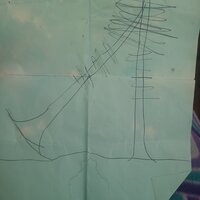
I've got a large doug-fir in a wet area leaning hard and bent into another large doug-fir. It fell a few weeks ago. I looked at it last week. It's away from obstacles, along the driveway. Crane access would be possible, not good. $1200-1500 minimun seems avoidable for a no-obstacle, no clean-up job. Not sure how a crane could/ would help until it's untangled.

They are both about 30" dbh.
The root plate is 35⁰-ish. The failed tree is strongly bent against the support tree. The root plate (roots broke next to the gravel driveway) is about 3-4' lifted in the high side. The failed tree is laid very squarely into the support tree. Big have large and strong branches, possibly laced together.

I can't see compression side roots to address if they are broken or springy.

There is a lot of bend in the failed tree in thick wood... easily 12" diameter, maybe a good bit more.

The limbs obscure the interaction between the trees.


I can climb up the support tree from the back side If I take time to get a good TIP that doesn't No evidence of domino-uprooting observed.

Its also possible to spur right up the failed tree.

Because of the sizes and amounts of branches, coupled with the lean, I don't expect the leaner to slide/ shear branches in a dependable way.


I can't tell if the failed tree is whittled off the support tree. If it will want to straighten and lift off the support tree, or continue to fall.

I was considering a sloping cut to the side to get it to slide off while the root- plate falls down and back.
 

Attachments

  • 17457646135794936842057905602418.jpg
    17457646135794936842057905602418.jpg
    455.5 KB · Views: 21
i would guy the fallen tree and than climb it, strip it out. at some point i would tie into the upright tree and trigger the fallen tree.
 
I know you said it is unlikely the leaner will come down climbing that...even without seeing that, I think "yeah, what's 200 extra pounds going to do to? That's less weight than water when it rains on the tree...less force than a gentle breeze blowing on it." But I'd still tie into the standing tree instead if that is at all possible.

From there, could enough branches be cut on both of the trees to untangle them enough to push the leaner - but leaving enough branches to hold it up? (I know...that's often a really tricky thing to guess which branches are holding how much weight!) In your picture can you push it (with excavator or dozer) straight away from where we are looking at it? (again...tricky to know how the roots want to hold on).
 
They are both big trees. Way too much to rope down.


A skidder winch would do the job. I'm short (1) skidder.


If it wants to continue to fall, My concern is protecting the support tree's trunk.

The uprooting tree is heading very straight into the trunk of the support tree.


If I start at the top, whittling it down And it keeps wanting to fall, I think I would keep cutting rounds (from a position just above the spar) through the tension wood until the tree, round by round, settles by way of small longitudinal splits/ slabbing out, more gently laying the spar top against the trunk of the keeper.

It might help if I bevel the spar top's supporting edge each time to be less than 90⁰.


Before cutting, I could hang 1/3 or 1/2 width strips of plywood on the support tree to end up between the trunks as the failed tree settles.
 
Crane access would be possible, not good. $1200-1500 minimun seems avoidable for a no-obstacle, no clean-up job. Not sure how a crane could/ would help until it's untangled.
Just to make a point. Don't sacrifice the safety of using a crane in this instance because of the cost. Just add it into the quote and continue on.

Typically we use the crane to do the untangling. Where your tree is making contact, tie it off to the standing tree then crane picks down to that point. From your diagram, I'd probably have the crane fly me up the leaning trunk first removing any unsupported limb weight, then tie it off and remove the top.

From there assess the best way to remove the rest which might involve bracing or guying the uprooted trunk back then taking a top log(s) until the rest can be felled away from the standing tree.
 
The failed tree is Strongly bent against the support tree. Both grew vertically. I don't think the top broke out, on impact. The top of the failed tree is likely along the trunk of the support tree. The tree is tipped about 65⁰-70⁰. They were growing with trunks 30-40' apart.
30"dbh-ish. 100' easy.


I could only get a small crane in the driveway. Not sure how it would help that much.


If the failed trunk was extending past the support trunk, it would be entirely different.
 
  • Like
Reactions: ATH
Can you set up a floating TIP on a line between the support tree and another tree down the driveway? Then I would feel a lot better about spurring up the failed tree and figuring it out as you reveal the unkowns. I don't know how I would bid something I can't really see. I would want to do it at an hourly rate, so if it takes longer than estimated to safely manage any previously unseen, that's not on me.
 
This is a teacher's house in the woods. The two trees can stand until it/ they fall in a storm. It will land in the woods. The homeowners have 2 very young kids.

Many other tree issues were postponed (ignored) until one fell in the driveway.

If I can reasonably manipulate it down from the ground, they'd be happy not to look at it leaning and keep the second tree.

They don't have large money for it.


I wish I got pictures. There was a lot to see on that property and I was mentally occupied.
 
This may sound like money grubbing talk I don’t mean to

It’s not our job to spend our clients money. It’s our job to do proper treework. First of all is risk management. Don’t cut corners. If a tree falls and there is damage, or worse, the courts won’t worry about how you will pay

You could soften the financial blow by financing the payment. Add in a fair interest rate and monthly payback. You become a credit card which could complicate your life if they stiff you though

Risk/hazard reduction first

Tom
 
do you have to keep the support tree? Can you just fell it with the leaner? Or cripple them both and hit with another tree?
 
  • Like
Reactions: ATH
If they don't have the budget to ensure that the support tree is kept, then they may just need to accept that it is what it is, and they can:
a) wait for it to fall, or
b) let you take the chiselbit approach
 
I feel confident that I can piece it down, one way or the other.


A thought about it is that the bowed (failed) tree is jammed between the support tree (also deflected, storing energy) and root plate (potentially unbroken compression roots want to unbend), like a loaded spring with gravity loading it more.

I think I can face-cut with a wide bird beak directed at the support tree. Gut the hinge. and backcut ng to let the stump fall away from the support tree, pulling the trunk backwards as it falls (the root plate is tilted upward and therefore sideways a few feet from its natural position.)

If the root plate won't move on its own, I have a 13k truck and winch to help.

If it really wants to collapse toward the support tree, i can fence-post it down and fold the trunk to one side.


The big "x-factor" is if the limbs are locked.
 
I feel confident that I can piece it down, one way or the other.


A thought about it is that the bowed (failed) tree is jammed between the support tree (also deflected, storing energy) and root plate (potentially unbroken compression roots want to unbend), like a loaded spring.

I think I can facecut with a wide bird beak directed at the support tree and backcut it, allowing a hinge ( maybe set at 1/2 depth, gutted) to let the stump fall away from the support tree, pulling the trunk backwards as it falls (the root plate is tilted upward and therefore sideways a few feet from its natural position.)

If the root plate won't move on its own, I have a 13k truck and winch to help.

If it really wants to collapse toward the support tree, i can fence-post it down and fold the trunk to one side.


The big "x-factor" is if the limbs are locked.
I never doubted you for a second Sean, I just worry about it being more work than you'll get paid to do, and that it will be mostly a charity case. On the other hand, charity for a school teacher is something I can get behind, as they are ridiculously underpaid most of the time.
 
You said there is “crane access” sorta? You also mentioned a skidder winch could do it? Spitball here: what about a large wrecker winch? I don’t know if you got those kind of tow trucks in your region. But the big wreckers that recovery tractor trailers up in the mountains here is what I’m picturing. Those guys are usually always game for something crazy too…. It would be the quick and dirty way to do it, especially if it’s a lop & leave.
 
You said there is “crane access” sorta? You also mentioned a skidder winch could do it? Spitball here: what about a large wrecker winch? I don’t know if you got those kind of tow trucks in your region. But the big wreckers that recovery tractor trailers up in the mountains here is what I’m picturing. Those guys are usually always game for something crazy too….
sounds like a reasonable idea from over here! Every tow truck driver I have met has some crazy stories.
 
  • Like
Reactions: ATH
Just to make a point. Don't sacrifice the safety of using a crane in this instance because of the cost. Just add it into the quote and continue on.

Typically we use the crane to do the untangling. Where your tree is making contact, tie it off to the standing tree then crane picks down to that point. From your diagram, I'd probably have the crane fly me up the leaning trunk first removing any unsupported limb weight, then tie it off and remove the top.

From there assess the best way to remove the rest which might involve bracing or guying the uprooted trunk back then taking a top log(s) until the rest can be felled away from the standing tree.
I'm learning here...so please bear with possibly some ignorant questions. (Part of that ignorance is I've never worked with a crane. Also, we don't do a lot of storm clean up and have only done something similar to this on a much smaller scale with more like 10-12" pieces (but they were over a roof) - in that case my first step was to tie everything in place, as you are suggesting, to make sure it stayed where it was until I wanted it to come down.)

Where you say "tie it off to the standing tree", you mean essentially lash the 2 trees together to make sure the leaning tree won't either set up when the top is removed or fall down when the entangling branches are cut, right?

What size of rope would you use to do that on trees this big? I'm assuming the rope won't get a big dynamic load because the goal is to keep it right where it is, right? Just a bunch of wraps around the 2 trees with 5/8" rigging line as tight as possible? I can certainly see where a TIP from a crane would help facilitate that - depending on what the branches are like in there, it could be difficult to get a rope around easily.

This is also assuming the trees are trunk-to-trunk, right? Or would you do the same if it is big branch-to-trunk or big branch-to-big branch?

So if that stabilization is done, and there are no targets below, why crane picks to get the top of the falling tree down instead of bombing out in several pieces? Would cutting those bombed pieces be advisable while tied into the crane or is it best to tie into upright tree?
 

New threads New posts

Kask Stihl NORTHEASTERN Arborists Wesspur TreeStuff.com Teufelberger Westminster X-Rigging Teufelberger
Back
Top Bottom