Skinny rope on base anchor leg?

On a base tied SRS the back/anchor leg of the rope only sees a portion of the load, and none of the direct wear of ascending and abseiling. To save weight I would like to use a skinnier rope in this section for higher climbs. How thin would you go and what dangers are foreseen? Already considered:
  • low stretch needed to avoid sawing
  • a bend appropriate for unequal rope diameter
  • bend to remain below TIP on the anchor side
  • basal lower-off probably impossible
Conceptually I don't see why even something dramatically thin like Petzl Pur Line 6mm could not work.
It is a lifelong problem but I have better and worse days. I really noticed the additional weight of the Big Shot and two four foot poles walking a mere quarter mile carrying all my gear, and that was with only a 90 foot 7/16" rope. I don't think I can add another 100+ feet of the same rope to that so I am looking for places to cut weight. Or it's time to get a cart.
If you want to stay within a reasonable interpretation of the ANSI Z133, the line must have a minimum breaking strength of 5,400 pounds to be part of a life support system. I don't think the diameter matters as long as the line is compatible with the other equipment and techniques during use. In my experience with basal anchors, it's most important to have a rope with a low static elongation when the tie in point is very high. IMHO it's always better to anchor at the tie in point if possible.
 
I acknowledge that.

I do not understand where the stated abrasion and/or cutting hazard to the back strand is coming from and I wish I did. No one has actually articulated that yet.
I don't rec climb and don't know if you want to consider this but if I did I would would think of the possible hazard to my basal anchor being the pocket knife in some idiot jack wagons pocket. I've always had a plan for what I would do if shot at while in the tree - even before someone fired off rounds in an attempt to intimidate me while working one time.

Seperate point, for years I carried a folding knife as a part of my emergency planning if rope got jammed up somehow. Then one time I had used some old climbing rope for a one time use rigging situation. To get multiple legs of rope out of a brush pile I used my handsaw in place of a knife to release tension on lines. That cut rope so well I stopped carrying a knife.

If I rec climbed I would have a modest folding saw for various emergency/urgent need situations, mostly tree failure related.
 
@Merle Nelson If using a base tie I should probably make it a habit to put in an extra attachment above easy reach once aloft. I've thought about that rappelling too, but I haven't done it as the extra knot passing on ascent has seemed like a greater risk. Getting shot at isn't something I have considered, but I suppose if someone really wants to kill me I'm a sitting duck. Not sure what could be done about that.

Would you give some examples where a folding saw might be needed in an emergency?
 
I like the sounds of up out of reach unless I was just climbing up and switching to canopy anchor.

For me I not only think of a top or limb from same tree or neighboring tree breaking over and being a challenge for me but also the occasional stub or dead limb I choose to remove. And I think of a handsaw as a great tool for anything I can't directly think of ahead of time with regard to trees and textiles.

I almost always go gear heavy in work and in life. You pre analyze more maybe, I climb gear heavy more.
 
I also don't climb anything without a handsaw, even if it's just a fun climb with my kids. Not so much for safety/emergency usage, more for clearing small branches, suckers, stubs, dead limbs, etc. If I was going into the bush for rec climbing I would definitely bring a handsaw.
 
We have identified a new product - the paranoid about cutting the base tie kit - sling to go around the trunk 10' up (most twits can't reach up 10') a biner and a prussic. Ascend 10', install, climb, descend to 10', uninstall, descend to ground. Designed to ease the paranoid condition.

I think Petzl does SRT gear down to 10mm rope. Grillon/Zillon? Don't think I've seen life support any skinnier. You could look that up as a lenient safety factor.

When checking your cinch tip through binoculars be sure to look for the engineer's approval stamp on the branch ;)

I''m with Muggs on the handsaw once you've mastered cutting fear through skill and confidence (memorise the don't cut list:))
 
I had a kid point a 9mm at me and squeeze the trigger while I was working in a tree. There were no rounds in the weapon. Some fantasy on his part.

Highly unlikely though to have something like that happen while you’re in a tree.

When rec climbing the only people that have a chance of noticing you are birdwatchers ;-) No one else looks up. Dogs will hear your carabiners clinking and will notice you.
-AJ
 
A high, choking base- tie with/ without a pull down line (either a section of the climbing line or a seperate line) is a consideration, if you're not concerned about a basal- lowering option.

A butterfly knot is most always incorporated in a base-tie. TlIf is a high base-tie, this can be hooked with a limb from the ground to retrieve the choking system.
 
@Webfoot , you would be well advised to stick with traditional tree climbing lines and equipment until you gain more experience. Their use and safety have been well tested for what you plan on doing.

And no, it is not hard to set a canopy anchor high within the tree. It just takes practice, which is something that must be done.
Yup huge important skillset.
 
Yea, isolating a branch up high is THE trick to start with.

I would strongly recomend learning a canopy anchor that you feel comfortable with and always going up and canopy anchoring WITH the basal achor left intact. I do this often.
 
Side note: a damaged section of rope can easily be isolated out of an SRS with a flat-overhand on a bight (easily backed up with another flat-overhand on the same bight.

@Webfoot where do you climb/ live?
 
@Webfoot
Go to a kids store or hardware store. Get some hulahoops or thin walled irrigation pipe and make a few rings. Duct tape together and hoist them high in open space between the two tallest trees.

Practice your throw line and bigshot then move forward according. Your goal should be to lob the throw ball as low as you can through the desired ring. Bonus points for getting it to ‘walk’ through the next highest.

I’ll frequently shoot over my desired union and pull up a bag on the other end to get the second bag to slip through the union, effectively isolating a wad of twigs. Next pull down on your second bag on the wrong side. Raise the first to just about 24” below the twigs, give a sharp hard pull and immediately let go, this will fling the bag back over to the direction it was shot from isolating the union.

Lots of tricks and frequently moderation when using sling shots is key. Focus on lobbing it over the union vs blasting it to the moon through the union. Save the blasting for grand firs
 
my first test shot after building my "big shot" I put it through the canopy, across the street and down through a second tree. Strength guess on the second try wasn't much improved. That's when I came up with sharpie pull calibration/repeatability markings on the pole. I drifted into the habit of trying to shoot a perfect apex after that to avoid extra pulling the throw bag back from the upper crown which could be prone to getting the bag snagged.
 
my first test shot after building my "big shot" I put it through the canopy, across the street and down through a second tree. Strength guess on the second try wasn't much improved. That's when I came up with sharpie pull calibration/repeatability markings on the pole. I drifted into the habit of trying to shoot a perfect apex after that to avoid extra pulling the throw bag back from the upper crown which could be prone to getting the bag snagged.

One of the challenges of calibrating a bigshot is that the latex slings are sensitive to air temperature. I'd have to adjust the calibration as temperatures drop in the fall and into winter.

At any rate I've used my slingshot in the same configuration for many years, I have a pretty good idea how far to pull down for different heights and time of year.
-AJ
 
As a regular user of skinny ropes outside of the tree environment I have to say that I think the right choice of skinny line would probably work fine for the down leg of a base tied system. In caving we typically work in a MUCH more abrasive environment and we regularly use 8mm single lines and expedition cavers make common use of 6mm dyneema safely. If you do end up using a thin downline there are a lot of special considerations that should be made, Alpine Caving Techniques has a really good discussion on the specific risk factors involved in reductions in rope diameter.

As for staying above the nominal 5400lbs requirement there's a lot of 8mm lines that meet this criteria. Looking for thinner I can't find much outside of 12 strand dyneema which I would probably avoid for cost vs long term durability reasons (though I personally love this stuff for anchor building and in the right application the lack of stretch can almost eliminate abrasion.

Now as to whether you will see much practical benefit from this idk, you can probably shed more weight from elsewhere if you aren’t carrying hundreds of feet of wet ropes. Also you will lose versatility because most equipment that will play nice on 8mm or less won't play with 11mm at all; apart from certain toothed-cam type devices and simple descenders.
 
Another pointer re calibration/repeatability/overshooting is that if the tree has acute branch crotch angles that tend to grab the bag as you're pulling it back, rather than suffer and risk a snagged bag, just lower the bag and pull the free throw line end through the snarls, decrease your shot strength and repeat the shot. The free line end pretty much never gets snagged.
 
I also don't climb anything without a handsaw, even if it's just a fun climb with my kids.
I am going to have to give this careful consideration. I carry a knife but taking it out while aloft is a last resort. I don't want to be paralyzed because I flinched when a wasp landed on me or something else equally ignominious.


When checking your cinch tip through binoculars be sure to look for the engineer's approval stamp on the branch ;)
I am not sure I read your tone right. Are you suggesting it is either excessive or pointless to use binoculars for this purpose? It was suggested here and elsewhere, e.g. I think in The Tree Climber's Companion, though I would need to check.


@evo That's an interesting drill that I shall try if I can.

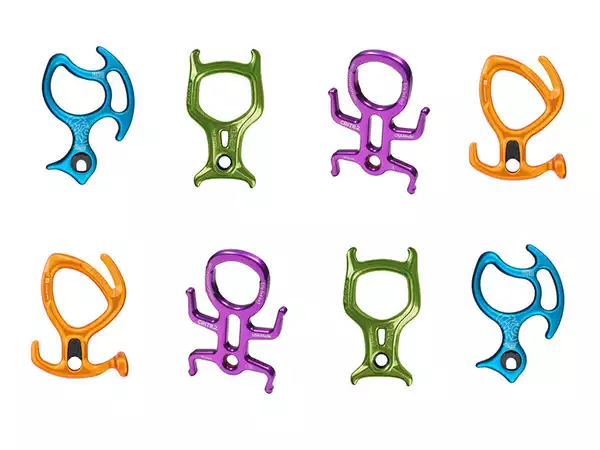
@Epiphyte Thank you for sharing insight from a different domain. Speaking of which, can you tell me why canyoneering style horned descenders do not appear to be used by cavers, or are they? Devices like these.

canyoning-descenders-review-comparison-600-d9fbf4dec.webp
 
I am going to have to give this careful consideration. I carry a knife but taking it out while aloft is a last resort. I don't want to be paralyzed because I flinched when a wasp landed on me or something else equally ignominious.


I am not sure I read your tone right. Are you suggesting it is either excessive or pointless to use binoculars for this purpose? It was suggested here and elsewhere, e.g. I think in The Tree Climber's Companion, though I would need to check.


@evo That's an interesting drill that I shall try if I can.

@Epiphyte Thank you for sharing insight from a different domain. Speaking of which, can you tell me why canyoneering style horned descenders do not appear to be used by cavers, or are they? Devices like these.

canyoning-descenders-review-comparison-600-d9fbf4dec.webp
Rope twist. We often have intermediate anchors on a single vertical section in order to keep out of waterfalls, or away from delicate formations, or to protect our skinny ropes from abrasion on the cave surfaces, so having devices that produce a twist in the rope is a no go.
 

New threads New posts

Kask Stihl NORTHEASTERN Arborists Wesspur TreeStuff.com Teufelberger Westminster X-Rigging Teufelberger
Back
Top Bottom