Trees and Climate Change

Tree Lady

Participating member
With the widespread decline and death of many species, what can we do to help?
I've been thinking assisted migration, but maybe entirely new species are needed.

https://www.wired.com/story/hardiest-trees-urban-inferno-heat-cities/

People are often asking me for shade tree recommendations. Definitely much to consider, so researching many trees and thinking about growing seeds of hardy varieties to plant locally.
 
With the widespread decline and death of many species, what can we do to help?
I've been thinking assisted migration, but maybe entirely new species are needed.

https://www.wired.com/story/hardiest-trees-urban-inferno-heat-cities/

People are often asking me for shade tree recommendations. Definitely much to consider, so researching many trees and thinking about growing seeds of hardy varieties to plant locally.
I have been planting blue oak acorns to play with, but I intend to have that as a staple of my nursery.
 
I've had recent thoughts of ash trees. All the older ash, and old growth, are dying out. That's a given. I've also noticed there are a number a healthy, live, unaffected, saplings. There are a few dozen on my homestead. They are predicted to become extinct. I don't think this will happen. Perhaps this is even just a cycle. I'm leaving the ones I have growing, and only removing those with bad structure.

I think off planting different species in pots for replants. Hickory, chestnut, beech, and walnut are some I would candidate.
 
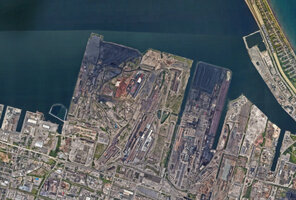
a few years ago a friend of mine contracted a forester to do a survey of a relative's property for a conservation/stewardship tax scheme, and i spoke with him a few times. he had some very radical notions about urban forestry. for context, we live in hamilton ontario which for much of the 20th century was home to a canadian steel company and the mill dominates the harbour. the steel-making stopped years ago, now they just make coke. the yellow haze of pollution hangs over the city hemmed in by the surrounding escarpment. looking at the industrial quarter via aerial photography now its like a giant scar:
industrial.jpg
after one sojourn to the property and retiring for drinks afterward we got to talking about land management and reclamation, and the forester said if he had the option he'd plant tree of heaven all over the site. tremendously aggressive and tolerant of both soil and air pollution, he said it would be the first stage of a generations-long project of rehabilitation in order to someday re-establish a healthy sustainable ecology. my friend and i, both working at a botanic garden devoted to conservation and wetland stewardship, were agog at his suggestions. but now, years later, i often think about what he said.

we're in a difficult position. the competing pressures of unlivable climate, biodiversity loss, and the need for urban greening have to be balanced. if we did like that forester said and mass planted tree of heaven we would successfully green a harsh environment. but it would come at the cost of biodiversity, the mass displacement of existing species evolved in this area, introduction of a monoculture (always high risk), and likely spread of an aggressive invasive species far beyond the bounds of the original planting area, and a massive labour expenditure in control of that invasive. maybe he would say thats the cost of doing business, maybe in a hundred years theyre not going to ask how it was done but how much canopy was grown. this invites much broader questions about the future which i wont go into here.

the question of invasive species also becomes complicated by the concept of lag periods. how many plants that we have introduced already which arent a problem now will become a problem in the future? not being able to know that in advance makes introduction of new species even more fraught:
Published: 08 February 2024 Invading plants remain undetected in a lag phase while they explore suitable climates

personally my views on the use of non-native plants in the landscape have softened over the years. once upon a time i would have said not to even bother with non-natives, but experience and necessity (both ecological and economic) have pushed me to a more permissive stance. we've created harsh landscapes, but plants have adapted to similar conditions. i happened to watch this recently with much interest:
an old abandoned airstrip in new york city, a big concrete oven. and after decades of neglect, a variety of plants have colonized the area. without direct intervention, an invasive-heavy mix of plants, so here he does something before he walks away: he drops some echinacea seeds in the hopes they germinate and establish and begin contributing to this small ecosystem. just like our ancestors tens of thousands of years ago before the rise of agriculture, spreading seeds deliberately along our migration routes so upon our return voyages we have desirable plants to forage from.

assisted migration and pushing the boundaries of hardiness zones, creation and exploitation of microclimates, the use of non-native plant species, they all have to be in the toolkit for us to create and sustain urban landscapes, but they must go hand in hand with observation, clear judgment, and the willingness to acknowledge and rectify mistakes

 
I’ve thought about the ailanthus/acceptance of invasives as well, as early as today when I saw a large tree of heaven thriving where many would not. Ultimately I think it’s a pretty rash decision as these types of plants don’t play the same ecological role as our native species do. Can animals learn? Maybe some can start seeing introduced species as habitat or food but I don’t think all will.

The easy answer in a forestry setting is Aspen to regenerate a large area.

I also think there are better alternatives. I’m incredibly curious about the Umbrella Magnolia that has naturalized a small area of Long Island and about to plant out one of my collected trees for the first time. I do think our native species do better than we give them credit for, Im reminded of this every day in NYC.
 
Last edited:
a few years ago a friend of mine contracted a forester to do a survey of a relative's property for a conservation/stewardship tax scheme, and i spoke with him a few times. he had some very radical notions about urban forestry. for context, we live in hamilton ontario which for much of the 20th century was home to a canadian steel company and the mill dominates the harbour. the steel-making stopped years ago, now they just make coke. the yellow haze of pollution hangs over the city hemmed in by the surrounding escarpment. looking at the industrial quarter via aerial photography now its like a giant scar:
View attachment 94059
after one sojourn to the property and retiring for drinks afterward we got to talking about land management and reclamation, and the forester said if he had the option he'd plant tree of heaven all over the site. tremendously aggressive and tolerant of both soil and air pollution, he said it would be the first stage of a generations-long project of rehabilitation in order to someday re-establish a healthy sustainable ecology. my friend and i, both working at a botanic garden devoted to conservation and wetland stewardship, were agog at his suggestions. but now, years later, i often think about what he said.

we're in a difficult position. the competing pressures of unlivable climate, biodiversity loss, and the need for urban greening have to be balanced. if we did like that forester said and mass planted tree of heaven we would successfully green a harsh environment. but it would come at the cost of biodiversity, the mass displacement of existing species evolved in this area, introduction of a monoculture (always high risk), and likely spread of an aggressive invasive species far beyond the bounds of the original planting area, and a massive labour expenditure in control of that invasive. maybe he would say thats the cost of doing business, maybe in a hundred years theyre not going to ask how it was done but how much canopy was grown. this invites much broader questions about the future which i wont go into here.

the question of invasive species also becomes complicated by the concept of lag periods. how many plants that we have introduced already which arent a problem now will become a problem in the future? not being able to know that in advance makes introduction of new species even more fraught:
Published: 08 February 2024 Invading plants remain undetected in a lag phase while they explore suitable climates

personally my views on the use of non-native plants in the landscape have softened over the years. once upon a time i would have said not to even bother with non-natives, but experience and necessity (both ecological and economic) have pushed me to a more permissive stance. we've created harsh landscapes, but plants have adapted to similar conditions. i happened to watch this recently with much interest:
an old abandoned airstrip in new york city, a big concrete oven. and after decades of neglect, a variety of plants have colonized the area. without direct intervention, an invasive-heavy mix of plants, so here he does something before he walks away: he drops some echinacea seeds in the hopes they germinate and establish and begin contributing to this small ecosystem. just like our ancestors tens of thousands of years ago before the rise of agriculture, spreading seeds deliberately along our migration routes so upon our return voyages we have desirable plants to forage from.

assisted migration and pushing the boundaries of hardiness zones, creation and exploitation of microclimates, the use of non-native plant species, they all have to be in the toolkit for us to create and sustain urban landscapes, but they must go hand in hand with observation, clear judgment, and the willingness to acknowledge and rectify mistakes
Very well written, can tell you’ve chewed on this a while!
 
I also think there are better alternatives.
There are robust frontier species in every locality and they will be different for the various regions we live in. Where I am, black locust, black walnut and tuliptree can turn into a forest just as quickly as ailanthus without the nasty side effects. Aspen? That would not work here.

Sometimes it isn’t that the species composition needs to change, but rather a particular grove was used to one condition and 100 years pass and those conditions change. A white oak that was in Zone 6 in 1924 and Zone 7 today is understandably going to have a hard time adjusting to those changes, but that doesn’t mean the species composition of new saplings needs to look much different. White oaks, yes let’s keep em coming here. We probably should stop planting sugar maples and Norway spruces though, *in my region*, for just a couple examples.

This is a great question.
 
I think this is a great idea to think about. I’m of the notion that we need to really understand our local ecosystem and climatic conditions and attempt to plan ahead for what would logically move north in coming years. I’m not a fan of species that have been proven to be invasive, despite their ability to put on a lot of growth very quickly, because the end game is not to grow new trees in an at risk ecosystem but to provide for all the life that depends on those trees. It’s not about biomass at the end of the day, it’s about useable biomass and there are a lot of logical choices just south of everywhere…Black locust shows up aggressively up where I am, and while I don’t hate the tree, it has these unintended consequences of bringing in a bunch of nitrogen to soils that historically don’t rely on or need it, and there can be a real cascade effect to these kinds of introductions. My two cents!
 
Black locust shows up aggressively up where I am, and while I don’t hate the tree, it has these unintended consequences of bringing in a bunch of nitrogen to soils that historically don’t rely on or need it, and there can be a real cascade effect to these kinds of introductions.
Are you saying the added nitrogen would be a detriment to the next wave of trees?

Robinia is so versatile unto itself, not just a means to an end. Excellent firewood and building material, animal fodder, and delicious flowers. Fully expecting the collapse of civilization in my lifetime and I’ll be pretty excited about all the locust around me.
 
Keep in mind, you cannot just grab something from a more southerly zone and expect it to thrive. Most climate models, while predicting a higher average temperature, still expect extreme colds to be similar to what they have historically been...just longer times between those low dips. But if that means its every 20 years instead of every 10 (just an example...not actually attempting to present a model here!), then that means you loose those not-cold-hardy-enough trees every 20 years instead of every 10 years...which means they are more expensive to remove. The challenge is finding trees that are both cold tolerant AND heat tolerant. That's why Sugar maple may be taking it on the chin - it cannot take the heat, but is OK with the cold. (Maybe...its currently thriving in most woodland settings around here due to lack of management and its shade tolerance!)
 
we had one of the coldest Arctic blasts than we have had in a long time. Coupled with some decent wind chill. I’m seeing more winter damage than I’ve seen in quite a while, even in thick old plantings that have sustained for decades.
Here it’s not the wild temperature projections that have me worried it’s the projected rainfall amounts (and related fires).
We are projected to be decently WETTER in the winter months and DRAMATICALLY drier. If the last few years have been any indication we are in for months without any measurable rainfall 3 or so. We use to get a few grand downpours throughout the summer, these have ceased. That coupled with our soils and higher humidity we have limited options
 
Keep in mind, you cannot just grab something from a more southerly zone and expect it to thrive. Most climate models, while predicting a higher average temperature, still expect extreme colds to be similar to what they have historically been...just longer times between those low dips. But if that means its every 20 years instead of every 10 (just an example...not actually attempting to present a model here!), then that means you loose those not-cold-hardy-enough trees every 20 years instead of every 10 years...which means they are more expensive to remove. The challenge is finding trees that are both cold tolerant AND heat tolerant. That's why Sugar maple may be taking it on the chin - it cannot take the heat, but is OK with the cold. (Maybe...its currently thriving in most woodland settings around here due to lack of management and its shade tolerance!)
last year someone told me 'learn to love acer negundo' and i was like.. god damnit lol
 
Are you saying the added nitrogen would be a detriment to the next wave of trees?

Robinia is so versatile unto itself, not just a means to an end. Excellent firewood and building material, animal fodder, and delicious flowers. Fully expecting the collapse of civilization in my lifetime and I’ll be pretty excited about all the locust around me.
I am also expecting said collapse! so I hear you. They’re flowering right now where I am, and am definitely seeing that benefit. But, they’ve done a couple studies that show the makeup of understory trees changing when black locusts show up, though there’s only so much information. But the general idea is that forests which don’t rely on a lot nitrogen, which I believe is a lot of the northeast, will change in unpredictable ways when a big, fast growing nitrogen fixing tree shows up en masse because trees are the dominant lifeform in most of places. Just makes me concerned when people start tinkering with really complicated natural systems.
 
Keep in mind, you cannot just grab something from a more southerly zone and expect it to thrive. Most climate models, while predicting a higher average temperature, still expect extreme colds to be similar to what they have historically been...just longer times between those low dips. But if that means its every 20 years instead of every 10 (just an example...not actually attempting to present a model here!), then that means you loose those not-cold-hardy-enough trees every 20 years instead of every 10 years...which means they are more expensive to remove. The challenge is finding trees that are both cold tolerant AND heat tolerant. That's why Sugar maple may be taking it on the chin - it cannot take the heat, but is OK with the cold. (Maybe...its currently thriving in most woodland settings around here due to lack of management and its shade tolerance!)
That’s a really interesting way to look at it. It seems like this would really narrow the trees that make sense to plant in response to climate changes. We had some deep negative temperatures in late May last year that wiped out new leaves on all the more “southerly” trees but then it was a hot and wet summer.
 
They’re flowering right now where I am, and am definitely seeing that benefit
My house is surrounded on 2 sides by BL. Most are big majestic old growth. When they're in bloom, they're most beautiful. I fully concur on that benefit. On the west side, it's a bit of a hill with some scattered rocks. Not much ground maintenance is done there. There are bushes along with some scattered young cherry saplings popped up. My north boundary is dominated by white pines. They were planted a couple decades ago, as a wind break. Under those are more cherry saplings and the ash I posted about previously.

The BL need to come out. Most are threatening the house, old growth included. I plan to keep one that's in a good spot. They're some damn pretty in bloom. The white pine also need to go. Some have a lot of dead in them and, they border the neighbors field full of Angus. They drop limbs regularly. I'm looking to keep their Angus in their field. One downed fence and they'll be roaming here.
 
My house is surrounded on 2 sides by BL. Most are big majestic old growth. When they're in bloom, they're most beautiful. I fully concur on that benefit. On the west side, it's a bit of a hill with some scattered rocks. Not much ground maintenance is done there. There are bushes along with some scattered young cherry saplings popped up. My north boundary is dominated by white pines. They were planted a couple decades ago, as a wind break. Under those are more cherry saplings and the ash I posted about previously.

The BL need to come out. Most are threatening the house, old growth included. I plan to keep one that's in a good spot. They're some damn pretty in bloom. The white pine also need to go. Some have a lot of dead in them and, they border the neighbors field full of Angus. They drop limbs regularly. I'm looking to keep their Angus in their field. One downed fence and they'll be roaming here.
That’s tough. I’ve climbed a couple really old and giant black locusts but they really have a tendency to split and fail unfortunately. White pines are a difficult one too. They’re fast which I guess is good for the windbreak, but they’re another tree that has an overstated importance because they’re basically field trees that win out against other field trees like poplar and birch. Cherries sound good! And locusts do have a neat, different structure which is nice too.
 
That’s tough. I’ve climbed a couple really old and giant black locusts but they really have a tendency to split and fail unfortunately. White pines are a difficult one too. They’re fast which I guess is good for the windbreak, but they’re another tree that has an overstated importance because they’re basically field trees that win out against other field trees like poplar and birch. Cherries sound good! And locusts do have a neat, different structure which is nice too.
No doubt on the splitting these monsters develop. 3 of mine are and one of them is the second biggest. One half is aimed directly for the house. Good news is, it's been like that for quite some time. Bad news is, the time bomb is ticking.
 
But, they’ve done a couple studies that show the makeup of understory trees changing when black locusts show up, though there’s only so much information.
Wow! Interesting. Any chance you remember where you read that?
Keep in mind, you cannot just grab something from a more southerly zone and expect it to thrive. Most climate models, while predicting a higher average temperature, still expect extreme colds to be similar to what they have historically been...just longer times between those low dips.
Such a good point. Also it was brought to my attention that the angle of the sun does not change in anything we do so there are certain limitations there as well, as far as how many growing days a region is going to have. Pecan, for example, is still going to have a tough time being a good food production tree in my region for that reason, even though it will grow here.
 

New threads New posts

Back
Top Bottom