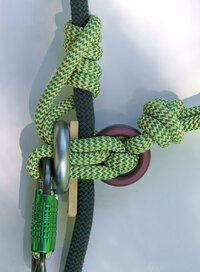
Sticht Hitch

Not sure your idea’s extra friction is needed.
I am lost here.

Is it not the case that extended descending on the original Sticht Hitch configuration puts too much heat and wear into the upper wraps, which is why there are all of these alternative ways and places to add friction including the one you just showed in #338?

Do you mean my proposal's extra friction is not needed in combination with these existing alternatives? I had not intended for it to be combined, but hoped it would stand alone.

Or do you mean that by itself it produced too much friction?
 
The wraps would still be taking a lot of the load when using your device, and it would extend the hitch, and be harder to tend.
Being able to completely transfer the weight to a device and off the cord is my goal, like in #324, or #338.
 
The wraps would still be taking a lot of the load when using your device, and it would extend the hitch, and be harder to tend.
Being able to completely transfer the weight to a device and off the cord is my goal, like in #324, or #338.
Okay, if the goal is a complete transfer this is clearly not suitable. I see value in something that is able to descend a tight line without having to "down Prusik" so maybe this is worth parallel development. If you choose not to pursue it I may.

What do you mean by "it would extend the hitch?" You previously noted "and you are right about the easy tending."
 
I stuffed a bit of scrap wood into the hitch in the place I envision my friction bar going. As I did not contour it to fit the ring it sticks out a 1/4" and no part of it sits inside the ring so there's no room to carve a groove. Does this clarify anything?

friction bar location.jpg
 
@Brocky I thought I had a working hitch, as above but without the scrap wood, but I tried it "low and slow" today and had a failure: when I used a foot ascender the hitch would not catch. I could stretch the hitch by hand and it would grab and hold, but left alone it would slide. I tightened the hitch, then again, and it held but became very hard to tend.

I know I am not tying the hitch to your specification as I found kany22's form to stabilize the ring better, but if anything I thought the lack of a cross could cause it to bind if cord pulled out the front under load, not lead it to slip.

I think it may be the (inappropriate) rope I am using which changes diameter noticeably when loaded. Any idea what else would cause this? I'll try again tomorrow on Sterling HTP and use your form to see if the result is different.
 
It might be that the bottom section is causing too much friction so that the wraps can’t grab, or too stiff of hitch cord.
 
It seems to be holding today in the same configuration. The hitch cord is starting to fuzz up just a bit. Could that be all that was needed? I have not needed to break in cord for a classic Prusik to hold but this is obviously rather different.

Something you’ve probably noticed is that brand new hitch cord needs to break in a little bit before you know what you need to do with the way you tie your hitch to get the best performance.
-AJ
 
It seems to be holding today in the same configuration. The hitch cord is starting to fuzz up just a bit. Could that be all that was needed? I have not needed to break in cord for a classic Prusik to hold but this is obviously rather different.

Yes a Pusik Hitch is configured to set and hold that's all. Once you get into hitches that need to perform as adjustable hitches under load the variables explode.

I don't think what you're describing has anything to do with breaking in the hitch cord (or climbing line).

Important factors to consider for a functional adjustable (under load) hitch system:
a. hitch cord construction and diameter
b. climbing line construction and diameter

Sterling HTP (you mentioned possibly trying that) is not a great choice for the foundation of a multicender climbing system. The Sticht Hitch is acting as a multicender. The HTP core has been behaving badly for many climbers using multicenders. Been a while but you could probably find some discussion about that on the 'Buzz.

As far as the problem with a hitch not grabbing SRT (or SRS depending on what you call it) if there is load on the line from a foot ascender, the hitch may not grab, the hitch needs to be taking all the load to grab consistently.

This is a very subtle aspect of climbing SRT with a hitch and a foot ascender. I you sit back on the hitch during ascent you need to lift your foot slightly so your leg is not loading up the line at the moment you want the hitch to grab. I think experienced climbers do this automatically without realizing what an important moment that is in the climbing motion.

Typically climbers are not sitting back on the hitch during ascent cycles, only when they stop to rest, or for any other reason. If a climber sits back on or loads up the hitch every cycle during ascent they have to be more aware of lifting the their foot ascender up a little so the hitch (if well configured) grabs.
-AJ

 
...I tried it "low and slow" today and had a failure: when I used a foot ascender the hitch would not catch. I could stretch the hitch by hand and it would grab and hold, but left alone it would slide. I tightened the hitch, then again, and it held but became very hard to tend.

This is the clue to the problem you're having: "when I used a foot ascender the hitch would not catch".

I've seen new climbers creating this problem with their foot ascender several times. Less so DdRT, more so SRT.
-AJ
 
Sterling HTP (you mentioned possibly trying that) is not a great choice for the foundation of a multicender climbing system. The Sticht Hitch is acting as a multicender. The HTP core has been behaving badly for many climbers using multicenders. Been a while but you could probably find some discussion about that on the 'Buzz.


-AJ
Can you expand on that, please?
 
Thanks moss. These are subtle but very important details that aren't in The Tree Climber's Companion.
Mileage varies depending how well the climbing hitch is tuned. Too tight it grabs no matter what but too much drag on ascent. On the looser side low drag on ascent but more likely the hitch won’t set if the foot ascender is loading too hard on the tail at the moment of sitback.
-AJ
 

New threads New posts

Kask Stihl NORTHEASTERN Arborists Wesspur TreeStuff.com Teufelberger Westminster X-Rigging Teufelberger
Back
Top Bottom