Bend radius for rigging

Feels a bit nuts to say that a sling rated for almost 25K lb is undersized, but with heavy, terminal rigging, once you get into shock loading and such dynamics, it really is.
If the block is tied tight to the tree stem the forces get large quickly. And don't we all want to tie it as tightly as possible???
In setting up a hammock, some people try to tie the hammock straps as tightly as possible to the trees. This is a huge mistake. Ideal is having the hammock straps on a 30-degree rise from hammock to tree. At that angle a 200-pound body puts 200 pounds of strain on each strap. If I tighten it up so the rise on each end is only 15 degrees the strain on each strap is 386 pounds, almost double the downward force.
If, God forbid, I tighten it to only 5 degrees of rise on each strap, then each strap is holding 1,147 pounds of force, over five times the downward force. (See hammock forces calculator at www.theultimatehang.com.)
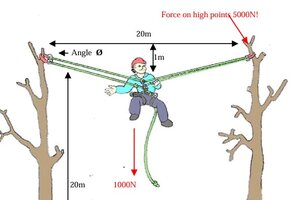
Using the numbers in the above diagram -
-- a 500-pound log held in place through a block
-- exerts 1,000 pounds of force on the rope/strap holding the block.
If that rope/strap is cinched very tightly to the tree and it takes a 95-degree turn at the cinch, rising only 5 degrees, then the force on that rope/strap is over 5,000 pounds.

NOTE: SEE FOLLOWING DISCUSSION WHICH SHOWS THIS LINE OF REASONING IS WRONG!
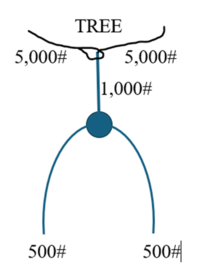
1710193757665.png
 
Last edited:
That's the first time I've ever seen a crack at the math of how trunk cinching works. Gold star! With your math, visualize how such an anchor can a) hold and b) abused, strip the bark off a tree.

Now some complication. Ideal you hit 90 deg - ain't gonna happen. You hit 95 or whatever on your initial tie - ok - but when you load it (unless it's an SRT base tie exactly up the side of the trunk) it also comes out at an angle from pure vertical - ok, mods the angle a tad but in reality there is some slippage and rearranging under shock load (catching the log). When I tried to emulate the HSE report drop tests I found the slippage and self retweaking of the knot on the spar was good for x2 reduction of peak tip loading i.e. if I dropped on a fresh tied hitch tip force was lower than a previously loaded hitch.

That brings up the loading topic numerically. There's rules of thumb etc but the worst claimed is 20x log weight or 20G's. IIRC I strived to replicate HSE's 10G's at the tip. In perspective, if you log sized at 1/10 rope strength , 10 x 1/10 = 1 at the tip and your sling is an eye type "one size up" you're only say 50% under sling mbs - and that's neglecting Dan's math!! So there could be some benefit to someone having a closer look at the exact detail at the throat of the rig tip sling. Maybe real angles are less than 95/5 deg (?) break out the vids time

edit - trying to find the X rings video dropping the car, anyone know where it is? probably close up of the sling throat
 
Last edited:
Feels a bit nuts to say that a sling rated for almost 25K lb is undersized, but with heavy, terminal rigging, once you get into shock loading and such dynamics, it really is.
Don't forget about knots in the lowering line reducing their failure point..

I keep it simple.. I rig with true Blue... 1/2 inch rated at 7,400.... If I'm rigging big enough to require more strength, I just put a second true blue on it. It's been a while since I negative rigged a big stem. Those are normally going to be crane jobs anymore..

And I don't subscribe to the keeping forces on the rigging line under 10% SWL. I most often keep it under 20%, but prefer to just replace rigging lines fairly often, rather than worry about SWL. When rigging heavy: knots matter. I always go with a doubled bowline pretty much as S.O. P. and always on anything with weight. When negative rigging heavy, it's best to avoid the marl or half hitch in front of the running bowline. Better to notch the back of the tree to keep the line from slipping. And keep the block up tight to the cut. All these little things matter when you want to break the "rules"...
 
That's the first time I've ever seen a crack at the math of how trunk cinching works. Gold star!
@Bart_ I'm wondering how the old sling angle charts from the crane industry translate into comparable examples with deadeye slings on spars in cow or timber hitch setups. I really hadn't thought about it before. I see how it would translate for a round sling of the perfect length stretched around the spar in a basket configuration,with both ends clipped together and a block hanging off there, but I don't understand the analogous
situation with a deadeye sling. Thoughts?

1000001964.gif
 
Last edited:
That's the first time I've ever seen a crack at the math of how trunk cinching works.
The above math makes a LOT of assumptions in areas where I am ignorant.
The numbers are based on forces of highlines and hammocks. I found two more diagrams (below) that illustrate.
However ... does the friction at the tie-off diminish these forces?
I sure love using an ultra-sling with a rigging ring as a system to hang a rigging block. They are tough!
1710279498716.jpeg

1710279532460.jpeg
(Artwork from "Working the Angles" by Joe Harris, published by Victorian Tree Industry Association.)
 
The above math makes a LOT of assumptions in areas where I am ignorant.
The numbers are based on forces of highlines and hammocks. I found two more diagrams (below) that illustrate.
I've studied deflection angle charts before, but it never occurred to me that they would apply to deadeye slings. Deflection is a tensioned rope between 2 anchors, being pulled sideways somewhere in the middle...
 
Last edited:
It feels like deflection-adjacent to me, but not the same thing. And if it is the same thing and it applies to rigging slings, then it would have to also apply to the rope itself, when tied to a piece hanging in the rigging....
 
I think with decent closeups of blocks/rings/slings in action the accuracy of 5 deg (per side?) could be verified or tweaked. It is indeed the good old pulling sideways on a tensioned rope geometry or if you label the crane sling lift on the crane side for visualization of "at the block" tension.

When I say 10 G's at the tip, that's (neglecting bend losses over the block/ring) 5 G's tension in the rig line, 5G on each side makes 10 at the tip - snubbing of the log per HSE test method. That would be 20% rig line swl log sizing. (or 20% mbs if you're a risky cowboy) The eye opener is feeding the 10G value into the sling geometry which amplifies it in the legs of the sling. Bend losses just make the tensions unequal a bit in the two legs of the rig line, or more than a bit if you're using aerial friction.

I haven't found good video footage yet. For some reason helmet cameras are always looking at the backside of the cut ;)

Good or bad news is that each half of the stem choke is a little under 1/2 wrap "bollard" friction to spread the load peak out there. Weak point is the three way joint at the sling knot/throat.

edit - Muggs, tying a deadeye tight to the stem creates the worst case, pulling sideways on an almost completely straight rope - highest tension amplification in the sling legs, leg being each rope segment heading off around the stem from the knot. Maybe slop/slack tightening saves deadeyes?
 
Last edited:
it never occurred to me that they would apply to deadeye slings
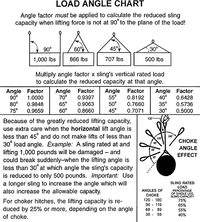
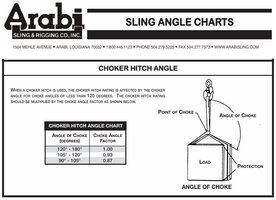
It appears there is a difference between pressures on deadeye slings and forces on highlines. Below is a chart for crane work with choking slings. Forces don't appear to be nearly as extreme as for highlines.
Muggs, your definition - "Deflection is a tensioned rope between 2 anchors, being pulled sideways somewhere in the middle" suggests that maybe I need to look at the situation sideways. The "tensioned rope" goes from the block to one side of the tree, and it is being "deflected" by the choking end of the rope.
Using that perspective, the numbers in your "choke angle effect" diagram above, and the following "choker hitch angle" diagram make more sense.
1710298205697.jpeg
 
Their safe operation recommendations based on ? they risk accepted. Ring, knot, pulley, or illustrated point of choke the symmetric vectors add up and for beyond 120 - 120 -120 deg the flattened angle legs (the rope whose midpoint is being pulled on directly sideways) get higher tension than the single sideways-pulling-guy, per the found charts. You could even splice it and have the same vector math. Limits - pull sideways (deflect) on a perfectly straight rope the tension multiplication is infinite, or move the diagram point of choke a half mile upwards and the tension in the "deflected" rope ends will be half the applied deflect force. Trig or trig generated tables the vector addition is the same.

Another thing their diagram shows is that if you set the choke point right against the load/box, when lifted the choke point will slide and equalize out to a position more like they drew in the diagram. More complication.


Now if you set your block not centered but on the side like you're trying to pull start the tree trunk all the nice symmetrical charts and diagrams go out the window. That's pulling sideways (deflect) on a rope midpoint but no longer in a perpendicular direction, instead at some angle. The vectors can be solved, but at what gain for what mental pain?

I propose that establishing what tension amplification occurs in commonly used setups is where the value lies.
 
If the block is tied tight to the tree stem the forces get large quickly. And don't we all want to tie it as tightly as possible???
In setting up a hammock, some people try to tie the hammock straps as tightly as possible to the trees. This is a huge mistake. Ideal is having the hammock straps on a 30-degree rise from hammock to tree. At that angle a 200-pound body puts 200 pounds of strain on each strap. If I tighten it up so the rise on each end is only 15 degrees the strain on each strap is 386 pounds, almost double the downward force.
If, God forbid, I tighten it to only 5 degrees of rise on each strap, then each strap is holding 1,147 pounds of force, over five times the downward force. (See hammock forces calculator at www.theultimatehang.com.)
Using the numbers in the above diagram -
-- a 500-pound log held in place through a block
-- exerts 1,000 pounds of force on the rope/strap holding the block.
If that rope/strap is cinched very tightly to the tree and it takes a 95-degree turn at the cinch, rising only 5 degrees, then the force on that rope/strap is over 5,000 pounds.
View attachment 93034
IN the real world you can't tie a sling that tightly.. "5 degrees when loaded".. that's a fictional world.. in the real world slings aren't tied to tight.. they're tied too loose.. every foot of play adds two feet of drop to the piece... those nnumbers add up quick too.
 
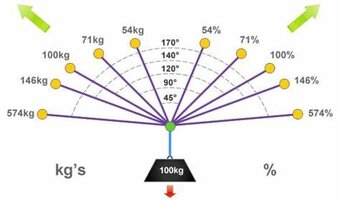
Found a couple of instructional videos showing the block side of the cut with varied info. Varying degrees of tightness, even one where a branch collar held up one side higher. It only takes 30 degrees of tilt to get the 120-120-120 unity gain situation, so leg tilt ranges 0 - 30 deg are of interest. I'd venture I saw 20 deg of tilt on a loose setup. Per Dan's chart 10 deg of tilt is x1.46 tension in the legs - just about around one size up on the sling :)

There was a cow hitch on an x ring sling where the "legs" were quadrupled vs the single strand going to the ring, although technically the eye splice on the ring is 2 pieces worth of rope thick. It was tied tight probably getting to the 5 deg tilt range under load. Guess. It was tied so tight it looked to me like the rig line might rub the legs. Wish there was more hard data.

Came across another video where heavy rigging on a single ring was temperature measured, not instantaneously, but after however many seconds of cool off that it took to get out the handheld IR meter and it showed about 60 deg F rise. If your ring is 100 deg F on a summer day in the sun and you take it to 160 deg F begs consideration. both for the rope and the sling. But again, wish there was more hard data i.e. perhaps on a 2 ring rig tip setup.
 
All the math to me is 'simply' the same here and everywhere.
The aligned directional dimension (cos=100%)
>>and it's non(e) of the crossing dimension (cos=0%)
as purebred extremes, as knowns that are totally void of each other as each other's non(e).
>>only possible values of force etc. expression are between full potential and non(e) as purebred parents
The pattern of change between these dimensions as growth of 1 displaces against it's non(e) is not easy static incremental
>>But rather an UNIVERSAL bell curve of change, but that is always the same.
>>that value pair cos:sin are snapshot coordinates of the bell curve of change defining patterns of change of 1non displacing against the other.
.
Loss of rope column efficiency is from rope deforming from the aligned dimension towards crossing dimension.
>>Giving drip in cos(aligned dimension inheritance%)
>>and raise in sine(crossing dimension inheritance %).
So I think of cos as efficiency of alignment to force etc. 'co(lumn)sine helped me keep it straight in head. Sine as the %of non dimension inherited as co(lumn)sine dimension decreased.
.
Light and non of dark are also not incremental steps of change between
>>but rather same mixtures of light dimension and non of dark mixed to gradient, as anything else.
>>most organically to cos:sine scales of change of parental dimension inheritance.
>>as a hybrid gradient inherit so much light and dark dimensions per cosine:sine value pair of inheritance %s
Distance is easiest to see intro to gradients between full and non(e); as a starting, not ending point. Force is reciprocal, as distance that could have been, so same formula works, but then in all else too.
.
As any change between yin/yang dimensions of opposites.
Sound, speed, wind, electric etc. etc. all the same math of changes, applied between range of full potential and non(e) is value pair cos:sin UNIVERSALLY to movements of galaxies and their atoms, miniscule Earth simply inherits this as any other.
So i always say
This is at the corner of where East meets West.
.
Happy PI day 3.14.
Peace.
 
Has anyone here broken a rigging sling?

Anyone even heard of a riggign sling failure?
Found a couple of instructional videos showing the block side of the cut with varied info. Varying degrees of tightness, even one where a branch collar held up one side higher. It only takes 30 degrees of tilt to get the 120-120-120 unity gain situation, so leg tilt ranges 0 - 30 deg are of interest. I'd venture I saw 20 deg of tilt on a loose setup. Per Dan's chart 10 deg of tilt is x1.46 tension in the legs - just about around one size up on the sling :)

There was a cow hitch on an x ring sling where the "legs" were quadrupled vs the single strand going to the ring, although technically the eye splice on the ring is 2 pieces worth of rope thick. It was tied tight probably getting to the 5 deg tilt range under load. Guess. It was tied so tight it looked to me like the rig line might rub the legs. Wish there was more hard data.

Came across another video where heavy rigging on a single ring was temperature measured, not instantaneously, but after however many seconds of cool off that it took to get out the handheld IR meter and it showed about 60 deg F rise. If your ring is 100 deg F on a summer day in the sun and you take it to 160 deg F begs consideration. both for the rope and the sling. But again, wish there was more hard data i.e. perhaps on a 2 ring rig tip setup.
Got links to those videos? I'd like to see a sling with 5 degrees of deflection under load...

Think about a cow hitch... the sling is doubled as it makes the turn around the stem. YOur angle of deflection becomes meaningless, when the line is doubled such that the weak point on the sling would be at the turn around the sling or below the turn... just spit balling.. please correct me if that doesn't make sense...

Tough to get a timber hitch so tight that deflection is an issues..

If you're slamming big wood, I hope you're not using the below configuration...

IMO.. you guys are over-thinking this one.. rigging sling failure is not a problem to be solved in this industry... You're fighting windmills. Nothing wrong with that, but there are other issues that may be a better use of your time and energy..
 
In negative rigging, slings are subjected to serious abuse and massive loads, and yes they absolutely break. I think slings are a bit of an afterthought for a lot of guys, myself included for a large part of my career. They are easy to forget about and take for granted...
 
In negative rigging, slings are subjected to serious abuse and massive loads, and yes they absolutely break. I think slings are a bit of an afterthought for a lot of guys, myself included for a large part of my career. They are easy to forget about and take for granted...
did you ever break one?

I haven't

Who do you know that has broken a sling?

Have you ever put a dyno on a negative rigging system?

I have...


ps... The lowering line was locked off as part of this experiment, meaning there was no run in the system
 
Last edited:

wow way to fling mud and jump to conclusions. Mark mentioned to his groundie ‘told ya that rope was going to break’ caption said it was an old rope.
So the rope WAS the main contributor to the failure. And not the block placement on his double whip
 
wow way to fling mud and jump to conclusions. Mark mentioned to his groundie ‘told ya that rope was going to break’ caption said it was an old rope.
So the rope WAS the main contributor to the failure. And not the block placement on his double whip
so you would think... but do the math on extra feet of drop in tht scenario... That block looks like it' 2 feet or more belwo the cut.. that adds 4' of extra fall to the system.. do the math on that... you could make an argument for either case, but given the existing equpment used, the variable that could have been changed was the block placement... That's worth thinking about .. angle of the sling isn't... And it looks like the rope actually broke at the ring that was used on the falling top.. That's something else to consider... the bend radius at the ring may have created a weakness in the rope greater than the force it supposedly was saving... So perhaps the real lesson (besides not using old dry ropes which is self evident) is not t use rigging rings in this scenario.. Use blocks for double whip... thoughts? @Mark Chisholm

ps.. @evo It looks like he was eithger experimenting or actually trying to break the rop on purpose given the lawn only obstacle
 
I’m not going to deny the block wasn’t choked up to the face. Looks like it is a pocket sling, and a branch collar was in the way.
I’m curious where the rope actually broke as it flung a short chunk away.
Slings held nicely, looked like a heavy piece (rarely work in oaks and constantly impressed by their weight). Wasn’t that a 1/2” line?
It’s not worth my time to argue but that wasn’t a new shiney line that broke and it was called…

A Humboldt wouldn’t have done that ;)
 

New threads New posts

Kask Stihl NORTHEASTERN Arborists Wesspur TreeStuff.com Teufelberger Westminster X-Rigging Teufelberger
Back
Top Bottom