TheTreeSpyder
Branched out member
- Location
- Florida>>> USA
When said handed down, meant surviving chain of custody to that point written;
yes that which was used at the time.
i think Ashley shows seeing these great friends slipping away around the corner of the 1900 century mark and trying to capture his present and what losses he already was seeing before all gone. Was trying to seek out and find to preserve things lost even before his own time, and then his time too, to avert further loss.
Thank Goodness !!!!! His work is a key pivotal, so that we would be further behind , not ahead without ABoK.
i think our intellect, even connecting/stringing together ideas/properties/amount evolved with knotting as a most formable material of utility. Nothing else could take rock and stick for hammer, so to spear, with rope handles, hung on rope belt, with clothes tied on eventually even skins tied to feets as shoes evolved.
.
i think round host is key, and takes things from a distance to a degree perspective.
But, a smaller host would concentrate same wear stress to smaller area, and so expresses wear more emphatically and most noticeable if shared out to RT/'double bearing'(ABoK) on host.
Side Note also while here: small host with Bag/Groundline of nip above center crossing of Clove form, has more chance of riding higher into/towards greatest/greater nip region of the 2/1 pulley pull position at apex of arc. May even be better than double bury nip of Constrictor to side sometimes; especially if also folded/bunched as a slip to express even more boldly at the key nip point of top nip(lesson#1663 as greater/greatest nip more than #1662,1664) in Bag.
A HH spaced away from host pulls along not across SPart support column like a prefixing HH in Killick, then seizing or perhaps even friction hitch to keep HH floating off host if can as it buffers force to the seam of seizing/friction hitch, both forms that would deform primary support column of SPart the least/if at all. This increase in efficiency/strength from more inline legs, of more towards 2 independent legs of support w/o deforming primary, at a loss then of some grip on host that a single Turn slid down the SPart and shearing across SPart column would give more of.
.
i think this model is as the BullsEyes(termination) similar to later "Shells" and then DeadEyes(dead as in non turning pulley type position of redirect) presented in ABoK. The BullsEye is/was simply roundish oval to thread around and seize back to self making a strong seam w/o harsh bending/deforming of SPart to weaken, so then attack next weak point of not a smaller, harsher connection/termination but softer diffused/larger round than self or rail etc. So this is what i see in BullsEyes, DeadEyes and Shells: larger diffused, softer round joint/termination after not bending SPart otherwise.
Believe taught can't capitalize on
.
lesson#1720 :
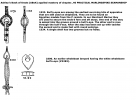
"The ROUND TURN AND Two HALF HITCHES
is named by Steel in 1794. If a spar is small a round turn is preferable to a single turn. It makes a stronger knot and dissipates the wear."
&
lesson #1669 with RT around SPart
"The FIGURE-EIGHT HITCH and round turn If the rope is weak and the hoist is heavy, a Round Turn on the Standing Part adds materially to the strength of the knot."
.
At the same time. i figured this would be/named as due to further loss of tension from RT friction on host(rather than single/simple Turn) not enough /as much to grip SPart w/RT for the #1669 effect that would pull more along the SPart as a support column more like splice or rack, than shearing across same SPart support column with a simple/single Turn like in Half Hitch at Samson angle.
.
i do believe as i have played with this , that i do see some more proper along the SPart column pull by RT on SPart(#1669) even after RT on host(#1720), when positioned as for BullsEye #1533 of holy grail of not pulling across 'sacred' SPart as primary support column, but along with it instead most properly reaching for 2x strength if could. That leaves the arc as the Achille's Heel, so softened by larger round and perhaps also spreading out wear as shown in lesson#1720 for more surviving/stronger knot by consideration of less wear on the now double bearing on the opposing side of host from load pull.
Always a pleasure and expansion, ty.
yes that which was used at the time.
i think Ashley shows seeing these great friends slipping away around the corner of the 1900 century mark and trying to capture his present and what losses he already was seeing before all gone. Was trying to seek out and find to preserve things lost even before his own time, and then his time too, to avert further loss.
Thank Goodness !!!!! His work is a key pivotal, so that we would be further behind , not ahead without ABoK.
i think our intellect, even connecting/stringing together ideas/properties/amount evolved with knotting as a most formable material of utility. Nothing else could take rock and stick for hammer, so to spear, with rope handles, hung on rope belt, with clothes tied on eventually even skins tied to feets as shoes evolved.
.
i think round host is key, and takes things from a distance to a degree perspective.
But, a smaller host would concentrate same wear stress to smaller area, and so expresses wear more emphatically and most noticeable if shared out to RT/'double bearing'(ABoK) on host.
Side Note also while here: small host with Bag/Groundline of nip above center crossing of Clove form, has more chance of riding higher into/towards greatest/greater nip region of the 2/1 pulley pull position at apex of arc. May even be better than double bury nip of Constrictor to side sometimes; especially if also folded/bunched as a slip to express even more boldly at the key nip point of top nip(lesson#1663 as greater/greatest nip more than #1662,1664) in Bag.
i look at this particular effect as a single or double Half Hitch(HH) slides down the firepole of SPart to seat at host and shear again across the SPart as a support column at ~90o/Samson angle on pillar. the direction of pull in usage of the HH makes all the difference, such as a termination HH pull across at 90 or a continuation/bend type of prefixing a Timber to make Killick that pulls along , not across a length.I can't find it in a quick image-search now, but there is a now pretty old (1980s?) knots-strength table produced IIRC by Samson showing --unusually, despite its relevance!-- the Anchor Bend (aka "Fish.BEND") & 2HHitches (again, IIRC, it was this sans a "round turn") for both a 5/8" ring & a 4" (?!) spar in, hmmm, 1/4"(?!) rope :: the former was weaker on the ring, and a bit stronger on the spar. .:. My surmise (all I got) is that on the larger dia. object the Anchor Bend pulled out enough tail so that its SPart ran pretty straight into tangent contact & around, whereas the 2HHs would give some bite into the SPart and have more weakening (though IIRC the diff. wasn't all so much).
Interestingly, in his first writing on knots --The Sailor & His Knots(?)-- in 1926 A. opined that the Anchor Bend should be finished w/HH and then the tail seized to the SPart ; that this would ensure that the turns didn't tighten around the anchor and ... have that wanted double bearing, really, more like a double eye knot than an hitch. --though this opinion seems to have been forgotten on writing ABoK decade plus later.
A HH spaced away from host pulls along not across SPart support column like a prefixing HH in Killick, then seizing or perhaps even friction hitch to keep HH floating off host if can as it buffers force to the seam of seizing/friction hitch, both forms that would deform primary support column of SPart the least/if at all. This increase in efficiency/strength from more inline legs, of more towards 2 independent legs of support w/o deforming primary, at a loss then of some grip on host that a single Turn slid down the SPart and shearing across SPart column would give more of.
.
i think this model is as the BullsEyes(termination) similar to later "Shells" and then DeadEyes(dead as in non turning pulley type position of redirect) presented in ABoK. The BullsEye is/was simply roundish oval to thread around and seize back to self making a strong seam w/o harsh bending/deforming of SPart to weaken, so then attack next weak point of not a smaller, harsher connection/termination but softer diffused/larger round than self or rail etc. So this is what i see in BullsEyes, DeadEyes and Shells: larger diffused, softer round joint/termination after not bending SPart otherwise.
knudeNoggin lends can't maximize both lessons at once w/RT on host and SPart.
kN can't make sense of what he's doing in this sentence! (-;
*kN*
Believe taught can't capitalize on
.
lesson#1720 :
"The ROUND TURN AND Two HALF HITCHES
is named by Steel in 1794. If a spar is small a round turn is preferable to a single turn. It makes a stronger knot and dissipates the wear."
&
lesson #1669 with RT around SPart
"The FIGURE-EIGHT HITCH and round turn If the rope is weak and the hoist is heavy, a Round Turn on the Standing Part adds materially to the strength of the knot."
.
At the same time. i figured this would be/named as due to further loss of tension from RT friction on host(rather than single/simple Turn) not enough /as much to grip SPart w/RT for the #1669 effect that would pull more along the SPart as a support column more like splice or rack, than shearing across same SPart support column with a simple/single Turn like in Half Hitch at Samson angle.
.
i do believe as i have played with this , that i do see some more proper along the SPart column pull by RT on SPart(#1669) even after RT on host(#1720), when positioned as for BullsEye #1533 of holy grail of not pulling across 'sacred' SPart as primary support column, but along with it instead most properly reaching for 2x strength if could. That leaves the arc as the Achille's Heel, so softened by larger round and perhaps also spreading out wear as shown in lesson#1720 for more surviving/stronger knot by consideration of less wear on the now double bearing on the opposing side of host from load pull.
Always a pleasure and expansion, ty.
Last edited: