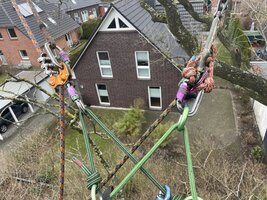
alternating between SRT and DdRT

While I am a luddite and would encounter brain pain trying to use all the options you've presented I do appreciate that you've made the effort to work through all this stuff, from your point of view being here nor there to me. Refreshing to see thoughtful contribution. Once in a while real gems come out of efforts like this. I see criticism as a positive tool, to be expected so don't take offense, just part of the game.

One point. On a basal anchor the elasticity of the rope allows for a tiny rope sawing action on the cambium at the crotch. Some trees in the spring have delicate bark and damage can occur. This was a thing pointed out about SRT back in the early days. I've seen it (guilty!) Usually not a problem. But still worlds better than natural crotch DRT rope sawing action.

On a rare occasion I've stood with weight distributed on both legs on pantin and haas on an SRT line instead of breaking out girth hitched loop slings - score one for the knee ascender :) (when a stem was featureless)
 
Last edited:
One point. On a basal anchor the elasticity of the rope allows for a tiny rope sawing action on the cambium at the crotch. Some trees in the spring have delicate bark and damage can occur. This was a thing pointed out about SRT back in the early days. I've seen it (guilty!) Usually not a problem. But still worlds better than natural crotch DRT rope sawing action.

good point. Even installing your climb line can damage the cambium in sensitive trees so using a canopy anchor won't prevent it either. But a friction saver does and is remotely retrievable. And you can SRT off a friction saver all day long.

Reminds me of this recent post:

Post in thread 'How do you “ethically” ascend redwoods with weak anchor branches?'
https://www.treebuzz.com/forum/thre...s-with-weak-anchor-branches.41953/post-703982
 
On a rare occasion I've stood with weight distributed on both legs on pantin and haas on an SRT line instead of breaking out girth hitched loop slings - score one for the knee ascender :) (when a stem was featureless)
Absolutely valid so long as you get a secure working position with both hands free. Still I try to prevent shock loading on the toothed-cam ascenders. Some folks will redirect off their hand ascender too. Probably fine in most situations but a violent enough bounce may damage the rope.
 
I appreciate these pictures. I blend SRT and DdRT all the time, although usually on separate lines. I might give a few of these tricks a go. I do like the idea of two foot ascenders, I can see that as a really efficient ascent system. Dragging around both legs in order to ascend might get old for me though.

I took the pinto off my pulley saver ages ago. A rigging ring is much easier on the biceps and shoulders.
 
I took the pinto off my pulley saver ages ago. A rigging ring is much easier on the biceps and shoulders.

why do you think that? when you are pulling yourself in, a pulley is your friend (less energy wasted due to friction). it just might make descending less smooth and will burn your hitchcords faster.
what am i missing?
 
...
Realistically, DdRT is much easier on the body and lends itself to longevity for the climber,...

do I need to use two foot ascenders all the time? no, you can do that for the 60' initial descent taking big steps,...

You could also spike your line at any time creating two static legs and climb with both foot ascenders...

Snunyabizness, thanks for taking the time to post all the different techniques you have been experimenting with. You never know what will come floating to the top if you don't stir the pot a bit.

Your first statement on DdRT being "much" easier on the body and improving longevity, has been proven wrong in studies by Brian Kane and anecdotally by me. It is why all other rope access disciplines use SRT systems. Also, doing "big steps" repeatedly on long climbs is going to eventually cause problems.

Regarding your last statement on the use of two foot ascenders, do you use just one primary multisender attached to one line or both? What foot ascenders do you prefer to use?
 
why do you think that? when you are pulling yourself in, a pulley is your friend (less energy wasted due to friction). it just might make descending less smooth and will burn your hitchcords faster.
what am i missing?
Back when I tried a pulley I noticed it took a lot more energy told hold myself up momentarily while I tended the slack and exacerbated some elbow pains I was having.
 
Back when I tried a pulley I noticed it took a lot more energy told hold myself up momentarily while I tended the slack and exacerbated some elbow pains I was having.
I agree with that. I’ve tried a pulley, and have a crane tie-in that was made with a pulley. Seemed like a great idea, but it actually made climbing harder because it’s so smooth. With a foot ascender or two to hold me up it probably wouldn’t be so bad, but I’ll stick to a ring on the next tie-in or friction saver I use.
 
Surprising how much difference less friction makes, also changes the way the hitch works I remember.
Whenever I teach a class on topics similar to this, when it comes to friction in the system I drive home the point that friction means holding work. Wherever there is friction, some of the load is being held there. In the example of the floating false crotch with pulley, less friction at the pully compared to rings means the load must be held somewhere else. It gets held by our arms as we tend slack or gets held in our hitch as we just hang there or decend. That means more work our arms and hitch are doing. A pulley tie in point seems like a good idea but always seems to make me work harder because I have to hold more of my own weight at parts of the climb.
 
why do you think that? when you are pulling yourself in, a pulley is your friend (less energy wasted due to friction). it just might make descending less smooth and will burn your hitchcords faster.
what am i missing?
Others have already answered it. Rings offer very little friction loss on the haul but introduce enough friction to facilitate slack tending.

Rings are buttery smooth and the small amount of friction actually reduces the load placed on the hitch.
 
Whenever I teach a class on topics similar to this, when it comes to friction in the system I drive home the point that friction means holding work. Wherever there is friction, some of the load is being held there. In the example of the floating false crotch with pulley, less friction at the pully compared to rings means the load must be held somewhere else. It gets held by our arms as we tend slack or gets held in our hitch as we just hang there or decend. That means more work our arms and hitch are doing. A pulley tie in point seems like a good idea but always seems to make me work harder because I have to hold more of my own weight at parts of the climb.
great way to explain it! the big benefit of climbing on the petzl spin is the single direction pulley removes friction as you would expect of a pulley, but adds enough friction on the holding/tending and release phases to run it with easy finger pressure so it doesn't destroy your hands and biceps
 

New threads New posts

Kask Stihl NORTHEASTERN Arborists Wesspur TreeStuff.com Teufelberger Westminster X-Rigging Teufelberger
Back
Top Bottom