Munter hitch for lowering limbs

Once steel bars for rappel racks became available, a lot of folks (including me) didn't want people rappeling their ropes with aluminum bars due to the rope staining and mess on your hands. Here's an old rack with aluminum bars. The groove on the 2nd bar is all rope wear.
View attachment 82465
Is it just me, or doesnt aluminum dust give a little extra slickness to the line?
 
Not that I've noticed, but when vertical caving, the aluminum is often applied in conjunction with dirt and mud.
Speaking of caving, my ole boss once was given a non locking oval carabiner that had a single rack barrel. I think it was a smc, it never left my mind as a great simple self rigging solution or a replacement for a f-8 revolver / munter
It wasn’t quite this old and all aluminum

 
Last edited:
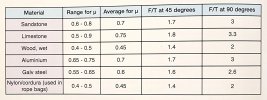
I was unable to find that friction coefficient info for wood/steel/aluminum in either of your mentioned papers. Like Dan says, real world experience with natural crotching contradicts that.

Considering that harder/denser materials have lower friction coefficient numbers and surface texture is a friction increaser, it doesn't make sense that highly polished aluminum rings would have more friction than a fir branch.

While not rope, I did find in https://mechguru.com/machine-design/typical-coefficient-of-friction-values-for-common-materials/ "Typical Coefficient of Friction Values for Common Materials" that kinetic friction coefficients for leather ontop metal is 0.25 while leather ontop wood is roughly double at 0.52.

Aluminum got consistently higher numbers than steel in the other material combinations. Maybe that's why the alloy bollard on the GRCS takes less wraps and runs so much smoother than the smaller diameter chromoly porta-wrap we use more often. I always thought it is because of the bigger diameter. Do they make steel bollards for the GRCS..? It would be awesome to compare and verify this.


my main point was, that diameter increase does not increase friction.

i couldnt find the friction coefficient in life on a line, either. you can definitly find it in "i like to move it" (atm only in german) i will ask muck about that, where they found that data. for me it does'nt contradict real life. i think often times, when you climb ddrt on a natural crotch, your rope will have more contact with the bark that it will have running through a ring&ring. not running clean through the fork.

when i'm comparing natural crotch rigging with taking wraps on portawraps or my hobbs device, 1 1/2 wraps on hobbs has more breaking force than 1 1/2 wraps on porty than
1 1/2 wraps on natural crotch. of course rope weight makes it harder to compare.

greetings
 
Speaking of caving, my ole boss once was given a non locking oval carabiner that had a single rack barrel. I think it was a smc, it never left my mind as a great simple self rigging solution or a replacement for a f-8 revolver / munter
It wasn’t quite this old and all aluminum

You use two of the carabiner + brake bar rigs connected with a ring to provide enough friction for rappelling. At least that's the way I did it back in the early 80s. It wasn't my gear, belonged to a friend who rock climbed.
 
i couldnt find the friction coefficient in life on a line, either. you can definitly find it in "i like to move it" (atm only in german) i will ask muck about that, where they found that data. for me it does'nt contradict real life. i think often times, when you climb ddrt on a natural crotch, your rope will have more contact with the bark that it will have running through a ring&ring. not running clean through the fork.
Page 66 of "Life On A Line". But no idea where they found those numbers.

20220620_080445.jpg
 
Life on a Line is a remarkable background work, original version was free.
.
Radial friction compounds; different compared to linear/flat friction linear progression.
Both use the same standard CoF numbers for mated surfaces available at several sites , even gov tables as accepted standards. EngineeringToolbox table example.
.
For round capstan frictions etc. tho, you take that same flat linear mated surfaces CoF rating (above) X pi (as to now have a radial friction CoF value for the same 2 mated surfaces in table) X number of 180 degree units (like 1 stroke at that CoF each, 2nd 180 stroke would be completing a mechanical cycle) instead of a multiplier of contact distance like would think.*
Then, this sum is a COMPOUNDING EXPONET of 2.718281828....Euler's number (the E key on many calculators as a defined math constant like PI); approx. Logarithm of 1 as used similarly in calc compounding interest, population growth, decay etc. Euler also publicised mathematicians PI symbol usage outside the math geek club to the public and many other contributions as well.
.
Linear/flat friction is simpler calc weight, friction, distance. Simplest flat model see the direction of linear movement as cosine(target work)and friction as 90 degree tangent sine(byproduct of cos work achieved model). Separate dedicated uses of cos/sine, ONLY sine factor used for friction. Radial friction on capstan is different animal right there, cuz uses cos+sine together to power radial friction instead. i say again, ALL physical displacements against space or force can be decoded to cos/sine as the Natural organic pattern of expression for displacements. Every change or even potential to, can be shown as a displacement(key term). And radial is always different than linear considerations in all of this.
.
This radial cos+sine in arc is same science that makes bridge and dome arcs so good, the arch in architecture, and the linear cos or sine used separately is the weakness; in all materials. Stone (w)as most sensitive sensor/witness to this w/deflected tension tolerance (sine) only 10% of compression(cosine of downward force load value) on horizontal. To work in stone so, they had to find the arc or crumble!
.
i put this together some time ago, radial friction table most matching topic. Spreadcheat
I found .25 nylon/aluminum CoF and few others relevant to rope as stated,(nylon/steel .4, hemp/wood .5 etc.)but honestly sources have faded out. Including this very comprehensive work to this topic:
"Mechanics of Friction in Rope Rescue " -Dr. Stephen Attaway
.
* The calc of capstan frictions are by degree not linear distance, so smaller capstan varies to harsher rope arc and the same frictions but heat byproduct concentrated into smaller area. Aluminum is better heatsink than steel, wood an insulator of course. If electrical conductor or insulator is same for thermal; except diamond as thermal conductor but electrical insulator )

 
Last edited:
Page 66 of "Life On A Line". But no idea where they found those numbers.

View attachment 82489
I'm having a hard time picturing aluminum and sandstone having very similar CoF's. Regardless of material, surface finish has to greatly influence CoF. My dining room table and deck are both wood, but the CoF's are vastly different. Likewise for polished stone versus a rock outcrop. Without knowing more about the testing procedures, I don't put any faith in those numbers.
 
Sorry about my late arrival to this discussion, but I did want to reply to the original question regarding the use of the munter hitch.

I use it almost everyday for lightweight (<500 lbs) an aluminum hms caribiner, 3/16” amsteel, & 7/16” tubular webbing from the tree. Carry this system with me in any decent tree and has saved my tail more than once.

I don’t subscribe to Grog’s Munter & super munter terminology, instead I call them munter, double munter, triple… you get the idea. I find that a quad munter will never pull through without attention on any piece I am willing to take on it. One of the real beauties of this setup is leaving the third munter loose when taking a top. It will drag with friction to a stop at a predetermined point. Another benefit of using the multi munter is that the carabiner can be opened and the friction released one munter at a time.

Regarding the wear issue with aluminum carabiners, they get trashed by the fiction. Wear out about 3/year.
 

New threads New posts

Kask Stihl NORTHEASTERN Arborists Wesspur TreeStuff.com Teufelberger Westminster X-Rigging Teufelberger
Back
Top Bottom