Munter hitch for lowering limbs

i've had covers (doublebraid) milk alot from hitches (while climbing). never found that the cover/core moved excessivly during natural crotch rigging. i think natural crotch rigging will fry your rope, any rope. never found the core to be the problem unless the cover was shredded.

bark has lower friction than steel and less heat absorption but i think bend radius is seldom the problem.

i tried uploading a picture of a dissected double braid used for natural crotch rigging. burnt cover, core in good shape.

friedrich
 
‘Friction Saver’ was a bad name choice for the devices. Too bad we can’t get in the etymological time machine and change the name

The beauty of any friction device is the uniformity it gives to rigging. They take the art out of lowering and make rigging totally science.

Only groundies of a certain age can shift smoothly into ‘take three wraps’ mode if a device isn’t handy. They probably still have Manila rope slivers in their hands too
 
‘Friction Saver’ was a bad name choice for the devices.
I'm not much of a DdRT guy, but seems like Rope Saver would have been a better name choice if you didn't want something more mundane and descriptive like Ring and Ring Anchor Strap.

Don't even get me started on arborists hijacking the term "quickie."
 
I have zero hard data, but my intuition and observations have led me to think the opposite is true. Is a friction saver actually a friction increaser? Please enlighten me.
according to a graph in "i like to move it" by m. oppolzer and t. wahls (they state "life on a line" as their source) the frictioncoefficient of green wood is 0,45 (i cant find the fancy greek letter). steel is 0,6, aluminium is 0,7. as i understand it this is one part of data necessary for the euler-eytelwein-formula wich can be used to figure out how much friction a certain rope will have taking whatever many wraps around a bollard of whatever material. what i found interesting is that it is not important how large the bollard is, one round turn around a 2 inch bollard will have the same friction as one round turn around a 10 inch bollard. i think this is one reason why some people complain that a smaller portawrap will "bite" more, but the truth is they think that it will have less friction with any given wraps, so they take one wrap more..

friedrich
 
Is my understanding of frictional forces really screwed up? I though that the amount of friction was proportional to the area of contact for a given surface. Is that wrong?
Friction is independent of contact area. Think about a car tire on pavement. With a skinny tire, the contact patch is small so the car's weight exerts a high pressure on the contact patch. With a big wide tire, the contact patch might have twice the area, but the pressure per unit area is half as much, so the traction is about the same. (Wider tires do often provide better traction, but mainly due to softer composition.)
 
In a rope bending over a device there are two energy absorbers. Classic surface skidding friction, and internal energy to bend the plastic fibres plus shuffling the fibres inside the rope.

In my friction testing these were lumped together as you cannot separate them. I used the bollard equation to make mu values. I found steel and aluminum about same.

I still stand by the idea that whatever friction device is used, it applies to the cover. The tendency of a rope to milk, stay milked or subsequently un-milk itself is an interesting topic. What about kern mantle vs double braid? Tight or loose construction? From a physics viewpoint wouldn't the same energy of differential core/cover loading have to occur for the same applied friction load? Whether it's pinched in a grigri or spread out on a bollard? You can't have friction without tension and normal force and the normal force plus chinese finger trap prevent slippage/milking. Can you imagine how tight the chinese finger trap is going over a natty crotch? Maybe there's some quick math with braid angle, diameter etc to calculate squeeze force, throw in a coefficient of friction and get an estimate of core to cover binding force. Dan, I lob the gauntlet your way;) If you're bored ;)

And I'm still having trouble with clean factory lubricated smooth fibres shifting a little being comparable to massive surface sliding on rough dirt laden bark. The lubricated fibres probably shift as much going around a small pulley. Just visualize it. With good rope design it's probably very small.


A smaller bollard may bite harder because the rope deformation component is higher. This effect is seen in bending a rope around smaller vs larger radii biners etc.
 
A smaller bollard may bite harder because the rope deformation component is higher. This effect is seen in bending a rope around smaller vs larger radii biners etc.
yes, i think the smaller bollard will cause more friction due to "pinching" the rope but less friction in surface area, bigger bollards will cause less friction in "pinching" but more surface area friction. so you end up with the same friction for amount of wraps.

friedrich
 
yes, i think the smaller bollard will cause more friction due to "pinching" the rope but less friction in surface area, bigger bollards will cause less friction in "pinching" but more surface area friction. so you end up with the same friction for amount of wraps.

friedrich
Friction is independent of contact surface area for a given force. Increasing the surface area by X amount reduces the contact pressure to 1/X, for a net effect of zero. This is a proven physical concept demonstrated by the simplest of experiments.
 
Last edited:
Interesting thoughts @Bart_
For the finger trap effect (CFTE), initially I pictured it as being highly dependent on elongation. Elongation reduces the cross sectional area so the cover grabs the core more tightly. But the CFTE really seems to come about from the cover being pulled on a fixed diameter core. If the core is also stretching and getting smaller, the CFTE might not be very strong. Rope construction, relative strength and elongation of cover v. core, compressibility of the core, etc. probably all have effects.

I'm still pondering the CFTE for a rope over a limb/bollard/pulley. How does it vary since the top, bottom and sides of the rope experience different forces.
 
Friction is independent of contact surface area for a given force. Increasing the surface area by X amount reduces the contact pressure to 1/X, for a net effect of zero. This is a proven physical concept demonstrated by the simplest of experiments.
i guess i should've stayed in school, i could'nt take the sitting around part..

around where i "grew up" as an arborist most people did'nt take this for granted. even reg coates stated years ago (i think somewhere on this forum) that the hobbs lowering device only has one fairlead because the drum has a narrow diameter, and one wrap less or more is enough fine tuning..
so for me, when i realized that a half wrap on my 24 cm diameter bollard won't have the same breaking force like 1 1/2 wrap on my portawrap, well it amazed me.

same thing with throwline taking two wraps around a small branch, crazy friction.

sorry if thats boring to some.

friedrich
 
according to a graph in "i like to move it" by m. oppolzer and t. wahls (they state "life on a line" as their source) the frictioncoefficient of green wood is 0,45 (i cant find the fancy greek letter). steel is 0,6, aluminium is 0,7. as i understand it this is one part of data necessary for the euler-eytelwein-formula wich can be used to figure out how much friction a certain rope will have taking whatever many wraps around a bollard of whatever material. what i found interesting is that it is not important how large the bollard is, one round turn around a 2 inch bollard will have the same friction as one round turn around a 10 inch bollard. i think this is one reason why some people complain that a smaller portawrap will "bite" more, but the truth is they think that it will have less friction with any given wraps, so they take
according to a graph in "i like to move it" by m. oppolzer and t. wahls (they state "life on a line" as their source) the frictioncoefficient of green wood is 0,45 (i cant find the fancy greek letter). steel is 0,6, aluminium is 0,7. as i understand it this is one part of data necessary for the euler-eytelwein-formula wich can be used to figure out how much friction a certain rope will have taking whatever many wraps around a bollard of whatever material. what i found interesting is that it is not important how large the bollard is, one round turn around a 2 inch bollard will have the same friction as one round turn around a 10 inch bollard. i think this is one reason why some people complain that a smaller portawrap will "bite" more, but the truth is they think that it will have less friction with any given wraps, so they take one wrap more..

friedrich
I was unable to find that friction coefficient info for wood/steel/aluminum in either of your mentioned papers. Like Dan says, real world experience with natural crotching contradicts that.

Considering that harder/denser materials have lower friction coefficient numbers and surface texture is a friction increaser, it doesn't make sense that highly polished aluminum rings would have more friction than a fir branch.

While not rope, I did find in https://mechguru.com/machine-design/typical-coefficient-of-friction-values-for-common-materials/ "Typical Coefficient of Friction Values for Common Materials" that kinetic friction coefficients for leather ontop metal is 0.25 while leather ontop wood is roughly double at 0.52.

Aluminum got consistently higher numbers than steel in the other material combinations. Maybe that's why the alloy bollard on the GRCS takes less wraps and runs so much smoother than the smaller diameter chromoly porta-wrap we use more often. I always thought it is because of the bigger diameter. Do they make steel bollards for the GRCS..? It would be awesome to compare and verify this.
 
I was unable to find that friction coefficient info for wood/steel/aluminum in either of your mentioned papers. Like Dan says, real world experience with natural crotching contradicts that.

Considering that harder/denser materials have lower friction coefficient numbers and surface texture is a friction increaser, it doesn't make sense that highly polished aluminum rings would have more friction than a fir branch.

While not rope, I did find in https://mechguru.com/machine-design/typical-coefficient-of-friction-values-for-common-materials/ "Typical Coefficient of Friction Values for Common Materials" that kinetic friction coefficients for leather ontop metal is 0.25 while leather ontop wood is roughly double at 0.52.

Aluminum got consistently higher numbers than steel in the other material combinations. Maybe that's why the alloy bollard on the GRCS takes less wraps and runs so much smoother than the smaller diameter chromoly porta-wrap we use more often. I always thought it is because of the bigger diameter. Do they make steel bollards for the GRCS..? It would be awesome to compare and verify this.
Interesting I have a couple of thoughts

Smoothly Polished bark and fresh green (still wet) wood can have very little friction. Anyone who had done some oldschool rigging can tell you that. Compared to equal diameter steel or aluminum?
Friction saver rings are very thin and very little surface area on the rope. They obviously break the 4:1 rule!

Now anyone that has run quite a bit of rope across bare aluminum can tell you that it wears onto the rope. (And rope handlers hands!). I would guess this is going to change the friction coefficient acting like a graphite lube.
 
Now anyone that has run quite a bit of rope across bare aluminum can tell you that it wears onto the rope. (And rope handlers hands!). I would guess this is going to change the friction coefficient acting like a graphite lube.
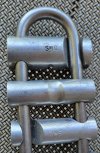
Once steel bars for rappel racks became available, a lot of folks (including me) didn't want people rappeling their ropes with aluminum bars due to the rope staining and mess on your hands. Here's an old rack with aluminum bars. The groove on the 2nd bar is all rope wear.
20220619_094532.jpg
 
Friction is independent of contact area. Think about a car tire on pavement. With a skinny tire, the contact patch is small so the car's weight exerts a high pressure on the contact patch. With a big wide tire, the contact patch might have twice the area, but the pressure per unit area is half as much, so the traction is about the same. (Wider tires do often provide better traction, but mainly due to softer composition.)
DB3F1FB9-293B-4D7A-8FA0-B8CF6EBB378B.png
 

New threads New posts

Kask Stihl NORTHEASTERN Arborists Wesspur TreeStuff.com Teufelberger Westminster X-Rigging Teufelberger
Back
Top Bottom