New HitchHikerXF

The distinctive c shape that you seem to be focused on is a fairly common feature of friction hitches. I went through the first one hundred hitches I have and found that 63 had the c shape. 39 had the c in front of the rope, 2 were behind, 16 had the top part of the c in front, the Knut included here, and 6 with the bottom part in front of rope.
There were 18 with a straight section going from the top to the bottom, the Knut included here also. This is the feature I used as a starting point to make new hitches. I started with the straight leg, made the wraps, and tried different twists, turnings, and routings on the first half variations.
The Knut H is a variation of my Knut Variation A, so clearly based on the straight leg feature.
Root question then is why do you think you can change the name of a hitch I created and named?
 
I went through the first one hundred hitches I have and
You mean there's a 2nd 100 ... ?! !! (-;
...
Root question then is why do you think you can change the name of a hitch I created and named?
Eh, hopes for improvement could be a cause; then there's the view that knots exist to be discovered, not created. YMMV.
Names, though, work in cases of limited number, then it just gets exhausting --reach for a decoder ring! (The other day I realized, of the not-first 300 eye knots I'd recently discovered, put into the "Twin Bowlines" (better name for the general structure, "shared-eye joints") structure, it amounts to 300! (<-additive factorial) distinct *knots* = 45_150 !! Dang if I'm a-namin' the lot! (or illustrating them; the eye knots have been done, and the use in a shared-eye joint won't change them.)

((-;
 
Root question then is why do you think you can change the name of a hitch I created and named?
This is really silly!
Answer: Because it resembles the hitch as it was shown to me, thus, long name is a modified Catalan...and it does NOT resemble a Knut.
There are many that deserve credit for the knots we have. I have numerous times mention your contribution in my videos and comments.
As has been suggested, and I'm as serious as I can be, start a thread called Brocky's Named Hitches. You can put your 8x10 photos there of every iteration of a knot you can come up with. Create a naming convention for all the turns, tucks, nibs, bights, over and under, clockwise and counter clockwise revolutions that you can think of.
Create the names so that we can reference the diagrams with dates and names and give you all the credit you deserve or want.
Put your © symbol1648327163718.png
on your artwork (but good luck claiming copyright to a knot) and stake your claim so that we don't have to debate this. This is the very last I will waste another brain cell on this discussion.

 
Last edited:
I have continued to respond to this thread because the hitch that is used in the manual and tied on the device is the Knut H. You had a clear understanding of the two hitches as shown in your hhx video. Now somehow, according to your repeated responses, the two have melted, melded together mysteriously.
At first I wanted the credit for originating and only wanted to correct the mistake. After realizing you were attempting to rewrite history and reality to better suit you somehow, Richard’s Reality, the focus changed. I’m not looking for credit, you don’t need to reference me any more, in fact I would prefer you didn’t. You also repeatedly stated the H looks nothing like the Knut, but that is all you did, repeat the same thing over and over, never trying to clarify what you were talking about. I tried to explain it to you, but was ignored. The Knut resembles the H, which resembles the Catalan, and all three resemble many other hitches.
It is called the Knut H, your thoughts, feelings, and comfort level have nothing to do with the price of tea in China, or the name I gave it.
This will be my last post in this thread.
Have a nice day Dick

 
I have continued to respond to this thread because the hitch that is used in the manual and tied on the device is the Knut H. You had a clear understanding of the two hitches as shown in your hhx video. Now somehow, according to your repeated responses, the two have melted, melded together mysteriously.
At first I wanted the credit for originating and only wanted to correct the mistake. After realizing you were attempting to rewrite history and reality to better suit you somehow, Richard’s Reality, the focus changed. I’m not looking for credit, you don’t need to reference me any more, in fact I would prefer you didn’t. You also repeatedly stated the H looks nothing like the Knut, but that is all you did, repeat the same thing over and over, never trying to clarify what you were talking about. I tried to explain it to you, but was ignored. The Knut resembles the H, which resembles the Catalan, and all three resemble many other hitches.
It is called the Knut H, your thoughts, feelings, and comfort level have nothing to do with the price of tea in China, or the name I gave it.
This will be my last post in this thread.
Have a nice day Dick

Good, because you were beginning to piss me off Brocky. Some of us are actually interested in purchasing the HHFX, and would love to hear more from Richard, and get some feedback from some working pro’s.
 
Hello Richard,

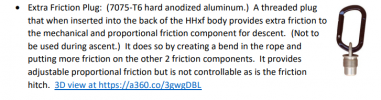
The Hitchhiker XF has a screw plug that places additional tension on the rope during descent.

Can you talk for a moment about the relationship between the plug and the prusik? How tight should the prusik be? How do they interact most effectively?

Thank you.
 
Hello Richard,

The Hitchhiker XF has a screw plug that places additional tension on the rope during descent.

Can you talk for a moment about the relationship between the plug and the prusik? How tight should the prusik be? How do they interact most effectively?

Thank you.
The eXtra Friction is only used on descent or for more secure positioning. I tie my hitch so that it will prevent creep just above my weight. 5 wraps 9 mm RIT and I creep, 6 wraps is perfect and loose enough that it ascends with little resistance and engages reliably. A hitch is a beautiful thing for individual preference and suitability to multiple conditions. So if I added an additional load I would need additional friction, again, so many variables but adding the friction plug does that by adding a third friction point and a slight bend in the rope. Start with just enough to engage the climbing line and see how the hitch cord responds. If you add too much you just won't descend so back it off to your preference. For long descents it will take some of the friction off of the hitch cord and consequently heat and wear. The plug is dynamic, you can adjust it during a descent to get it where you need or want it.
Hope that helps.
 
The eXtra Friction is only used on descent or for more secure positioning. I tie my hitch so that it will prevent creep just above my weight. 5 wraps 9 mm RIT and I creep, 6 wraps is perfect and loose enough that it ascends with little resistance and engages reliably. A hitch is a beautiful thing for individual preference and suitability to multiple conditions. So if I added an additional load I would need additional friction, again, so many variables but adding the friction plug does that by adding a third friction point and a slight bend in the rope. Start with just enough to engage the climbing line and see how the hitch cord responds. If you add too much you just won't descend so back it off to your preference. For long descents it will take some of the friction off of the hitch cord and consequently heat and wear. The plug is dynamic, you can adjust it during a descent to get it where you need or want it.
Hope that helps.
Perfect. Thank you.
 
I should probably point out that this is not a rigging device. It is intended for climbers and associated loads. So if the friction plug is applied to the maximum extent it will prevent the rope from passing thru under those intended loads and those loads will not be great enough to damage the rope. As was shown in the bench testing, if the friction plug is inserted fully, it will hold the rope until the rope starts to fail and at much greater loads than would be subjected by a climber.
Secondly, even if the friction plug adds additional friction on a long or fast descent, care should still be taken with the amount of heat generated. Whether a device is fully mechanical or hybrid such as the HHxf, ENERGY must be dissipated and in this case, it will be in the form of heat. Textile to textile, textile to metal, or fibers moving within the rope caused by a bending movement within the rope, all generate heat in some form that must be dispersed.
Below clips from the HHxf Manual.

1648640744386.png

1648640823563.png
 
Last edited:
Im curious about Your addition of the friction plug. I climbed on the HH1 and HH2 for a while and did not personally notice a need for additional friction with those devices.

Is there something about the materials or design that necessitate The plug? Or is it more of a nice add on? If it's an add on, how much additional cost is related to the plug, and would you consider offering a streamlined version in the future?

Really appreciate your many contributions to the climbing community, thanks fir all your hard work and innovation
 
Im curious about Your addition of the friction plug. I climbed on the HH1 and HH2 for a while and did not personally notice a need for additional friction with those devices.

Is there something about the materials or design that necessitate The plug? Or is it more of a nice add on? If it's an add on, how much additional cost is related to the plug, and would you consider offering a streamlined version in the future?

Really appreciate your many contributions to the climbing community, thanks fir all your hard work and innovation
Hello SeanRuel,

I know you aren’t directing this to me but let me share that I climbed some 200’ Redwoods last week. The descent was long. Having the plug in place would have taken the heat buildup off the hitch.
 
My 2 cents. Good hitch cord, that is rated for high temperatures, is perfectly capable of taking the heat. It was designed to do just that. Any melted fibers that you find on a hitch almost always come from the climbing rope itself.
 
Im curious about Your addition of the friction plug. I climbed on the HH1 and HH2 for a while and did not personally notice a need for additional friction with those devices.

Is there something about the materials or design that necessitate The plug? Or is it more of a nice add on? If it's an add on, how much additional cost is related to the plug, and would you consider offering a streamlined version in the future?

Really appreciate your many contributions to the climbing community, thanks fir all your hard work and innovation
The eXtra friction plug shifts more friction to the body of the HHxf for long descents, more secure positioning or extra loads. Descents require the dissipation of energy and in the cases of our climbing devices it is transformed into heat and wear. I think we would all agree that metal does not wear as fast as a textile so there is that. Arimid fibers can take a lot of heat but even if they do they will be next to a polyester or nylon fiber so likely will glaze that as it goes past. Heat transfer is very fast and the chance of just flying over the nylon with a heat resistant aramid fiber without damage to the climbing line is not a risk to take.
The HHxf comes with 4 types of cord so a user can find what suits them best. Poly on Poly will feel different than Arimid on Poly etc. It is totally up to the user, type of climbing line and cord interacts with the weight of the climber and many other variable to provide ultimate choice. What one climber likes may not be perfect for another. The hitch I tie will slip or start to creep at about 20% above my weight. There are some reasons I find that a good thing, besides making the hitch smooth. One is that it would lessen any shock load if, heaven forbid, I end up with one or even an excessive load. Watched an example this week of someone getting crushed with their lanyard.
Another, if I need to take another climber down with me that same hitch that worked perfect for me now will creep. I could add a munter or some other friction but then my hand is dedicated to that. Adding the friction solves that.
So, if I'm making a long or final descent to the ground, I add the friction, not much heat on my hand, less wear, smooth easy to release hitch and I get a lot more life out of my hitch, not that 4.5' of hitch cord breaks the bank.
Oh, one more, when I'm sleeping in my hammock, I add the eXtra friction, the extra security makes me sleep better.
Hope that helps.
 
...and because I know someone will write, just go with a, fill in the blank mechanical...
I don't have "big top exposure", I don't worry about something collapsing in a 3:1 or other other MA, or re-direct or dragging my tail over a branch. I don't have a spring to break, get weak, stick or otherwise fail to engage when I need it.

Hitch cord for me most of the time.
 
Finally got to try the HHXF today on a little rec climb at a nearby park. Largish Sycamore on a frequently gusty but sunny day. I forgot my Swiva-biner at home so I attached directly to my bridge ring which worked just fine. The HHXF tended very well on the way up. I climbed on Yale Blaze and used the 8mm RIT which turned out to be a great combo. I had no need to adjust my hitch throughout the climb and the RIT released easily and grabbed reliably with no creep. I also tried out a new lanyard I sewed over the winter, made from some 3/8" yacht line with a dyneema core. Worked great and very light. Canopy tie, advance canopy anchor, install pull-down line, enjoy the view, do some deadwood removal, descend. Nothing fancy but a very enjoyable hour to myself.
 

New threads New posts

Kask Stihl NORTHEASTERN Arborists Wesspur TreeStuff.com Teufelberger Westminster X-Rigging Teufelberger
Back

Top Bottom