












Navigation
Install the app
How to install the app on iOS
Follow along with the video below to see how to install our site as a web app on your home screen.
Note: This feature may not be available in some browsers.
More options
You are using an out of date browser. It may not display this or other websites correctly.
You should upgrade or use an alternative browser.
You should upgrade or use an alternative browser.
Knots for joining two ropes for life support
- Thread starter Phil
- Start date


RyTheTreeGuy
Branched out member
- Location
- Canada
Came across this article. Does this look like what you're referring to with the retraced 8 but without the bite?

Euro-Death Knot (Flat Figure-8) Mysteriously Fails
Many climbers use and love the European Death Knot (EDK), believing that it is the best knot for tying two ropes together. The knot can, however, flip and roll down the rope, coming completely untied.rockandice.com
I am not entirely sure if it is the same, however a quick google search has allowed me to come to the conclusion that a flat 8 is very different (and dangerous) then a figure 8 (flemish) bend. My resources are from a quick internet search so take it for what it is worth?? As far as I have been taught and through research the figure 8 bend is very popular and a very strong way to join similar sized diameter of rope

Steve Connally
Been here much more than a while
- Location
- Suffolk, Virginia
The figure 8 bend is the standard for tech rescue. Although in my region its called a tracer 8.

- Location
- Retired in Minneapolis
I learned it as a 'figure eight follow through'
And..only in Minnesota...Duck...Duck...Gray duck
And..only in Minnesota...Duck...Duck...Gray duck

Jan_
Participating member
- Location
- Rheinland-Pfalz ,Germany
This is a pic of how I have done it once, a figure eight retraced with the other rope and stopper knots on the ends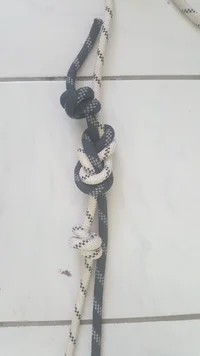

climbstihl
Branched out member
- Location
- Germany
I think it would be better to tie the fishermans knots around the standing end instead of using them as a stopper.This is a pic of how I have done it once, a figure eight retraced with the other rope and stopper knots on the endsView attachment 59443

RyanCafferky
Been here a while
- Location
- Hood River, Oregon
Just a flat overhand knot with both ropes works just fine for this application. Rock climbers use that knot all the time for joining ropes before rappelling. It is often preferred for this because it stays flat and doesn’t hang up on edges as easily. This is referred to as the European Death Knot but that is a misnomer.
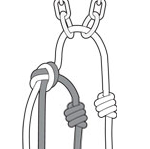
 www.climbing.com
Double sheet bend is another great one and one that I use a lot for this application.
Double fishermens is strong but can be difficult to untie after loading.
Learn This: Preferred Knots for Rappelling
The knot I use to tie together two ropes for a rappel—and one we commonly use in guides’ training at the AMGA—is the flat overhand. This knot has been called a number of things (including the Euro death knot) and has at times been unfairly demonized.
Double sheet bend is another great one and one that I use a lot for this application.
Double fishermens is strong but can be difficult to untie after loading.
Steve Connally
Been here much more than a while
- Location
- Suffolk, Virginia
Didn't you take SPRAT a few years ago? What was their preferred method?Just a flat overhand knot with both ropes works just fine for this application. Rock climbers use that knot all the time for joining ropes before rappelling. It is often preferred for this because it stays flat and doesn’t hang up on edges as easily. This is referred to as the European Death Knot but that is a misnomer.
Learn This: Preferred Knots for Rappelling
The knot I use to tie together two ropes for a rappel—and one we commonly use in guides’ training at the AMGA—is the flat overhand. This knot has been called a number of things (including the Euro death knot) and has at times been unfairly demonized.
Double sheet bend is another great one and one that I use a lot for this application.
Double fishermens is strong but can be difficult to untie after loading.

southsoundtree
Been here much more than a while
- Location
- Olympia, WA
A properly tied, dressed and SET EDK,
not that flat 8 on icy-ropes,
is a winner.
I'll butt a second over-hand with both ropes up against the EDK, if I'm not super-impressed with two different constructions/ sizes of rope mating up nicely. It can't roll. Just a bit higher profile, while remaining, importantly, asymmetrical.
I'll sometimes use a 9mm HTP tied to my 1/2" line to reduce bounce, and sawing at natural crotches with thinner bark, when base-tying tall trees.
not that flat 8 on icy-ropes,
is a winner.
I'll butt a second over-hand with both ropes up against the EDK, if I'm not super-impressed with two different constructions/ sizes of rope mating up nicely. It can't roll. Just a bit higher profile, while remaining, importantly, asymmetrical.
I'll sometimes use a 9mm HTP tied to my 1/2" line to reduce bounce, and sawing at natural crotches with thinner bark, when base-tying tall trees.

Had to look up the Zeppelin bend. Thought it was the same as the Hunter's but the copy specifically says it is not. I'm a big fan of the Hunter's and would use it for life support without any worry. Learned the Yosemite bowline from Jepson, always breakable even when loaded heavy, fantastic for so many applications. For heavier rigging the bowline on a bight can be easily undone after insane tension, but that's a bulky one in your situation. I would also consider a Carrick bend if the tension remains constant once set. Bends like Carrick and sheet bend hold up okay if taut but if they're slacked and shaken they slip. Gonna try the double sheet-bend with dbl barrel tie-offs, I've never tied it that way, haven't tied sheet bends in awhile.
The two DFL option in this situation (I'm seeing a grapevine knot when I think 2 DFL's) wouldn't be my choice because I've always found it tedious to undo after even moderate loading. Figure 8 traced, I hear it's a go-to for rescue operations... It would take me too long to tie that, I never do those.
Really cool suggestion to insert a fid to keep riggings less tiresome to break. I haven't yet learned to splice, I don't have any fids, but I'll search for more info on that.
The two DFL option in this situation (I'm seeing a grapevine knot when I think 2 DFL's) wouldn't be my choice because I've always found it tedious to undo after even moderate loading. Figure 8 traced, I hear it's a go-to for rescue operations... It would take me too long to tie that, I never do those.
Really cool suggestion to insert a fid to keep riggings less tiresome to break. I haven't yet learned to splice, I don't have any fids, but I'll search for more info on that.
Last edited:
Chaplain242
Branched out member
Had to look up the Zeppelin bend. Thought it was the same as the Hunter's but the copy specifically says it is not. I'm a big fan of the Hunter's and would use it for life support without any worry. Learned the Yosemite bowline from Jepson, always breakable even when loaded heavy, fantastic for so many applications. For heavier rigging the bowline on a bight can be easily undone after insane tension, but that's a bulky one in your situation. I would also consider a Carrick bend if the tension remains constant once set. Bends like Carrick and sheet bend hold up okay if taut but if they're slacked and shaken they slip. Gonna try the double sheet-bend with dbl barrel tie-offs, I've never tied it that way, haven't tied sheet bends in awhile.
The two DFL option in this situation (I'm seeing a grapevine knot when I think 2 DFL's) wouldn't be my choice because I've always found it tedious to undo after even moderate loading. Figure 8 traced, I hear it's a go-to for rescue operations... It would take me too long to tie that, I never do those.
Really cool suggestion to insert a fid to keep riggings less tiresome to break. I haven't yet learned to splice, I don't have any fids, but I'll search for more info on that.
It’s a makeshift fid - I use a dead stick usually about 5/8 inch to inch diameter without stubs (smooth) so can pull out easy and disassemble knot easy...

Jehinten
Been here much more than a while
- Location
- Evansville
I've used the stick trick a few times, I've found that it doesn't really have to be smooth because you can break the stick inside the knot and remove both pieces. But doing it this way does require it to be a stick that's fairly easily broken.
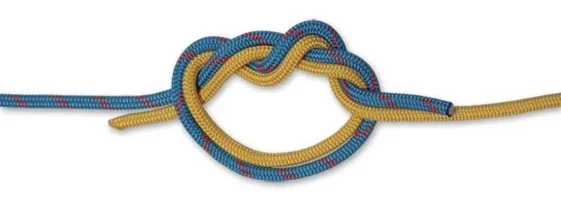
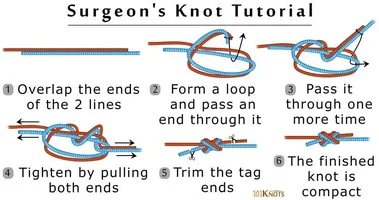
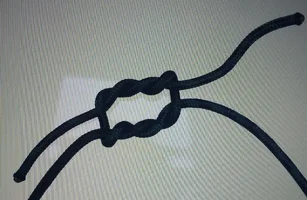
Kind of off-topic I know, but the surgeon's bend, as a rigging bend the way I learned it (pic called SurgeonsBend) is excellent for being breakable after heavy loading. I learned it as right over left, twist both ends in opposite directions 360* until 4 intersections are formed. Then switch order and do left over right, repeat, twist both ends simultaneously 360* in opposite rotation, forming another balancing 4 intersections. Then set tightly and balanced.
Not to say that it's unsuitable for life support, but it needs to be set very carefully in critical applications. The pic called "SurgeonsKnot" is not what I learned from Morrow, but I'd use it for utility connections cause it's super fast. Same idea when tied on a bight is a surgeon's loop. Pic called Step4 is yet another variation.
Not to say that it's unsuitable for life support, but it needs to be set very carefully in critical applications. The pic called "SurgeonsKnot" is not what I learned from Morrow, but I'd use it for utility connections cause it's super fast. Same idea when tied on a bight is a surgeon's loop. Pic called Step4 is yet another variation.
Attachments
Last edited:
southsoundtree
Been here much more than a while
- Location
- Olympia, WA
Break the stick out of the knot, ezpz.It’s a makeshift fid - I use a dead stick usually about 5/8 inch to inch diameter without stubs (smooth) so can pull out easy and disassemble knot easy...
Chaplain242
Branched out member
Break the stick out of the knot, ezpz.
I tend to have very hard hardwood sticks available, and untying a welded knot would be easier , but yes if available...
southsoundtree
Been here much more than a while
- Location
- Olympia, WA
1/4" to 3/8" stick would possibly be slack enough to until.
Choose a dead stick with enough solidity to not be crushed and broken, but can be bent and broken.
Choose a dead stick with enough solidity to not be crushed and broken, but can be bent and broken.

- Location
- Beaver county
I use zeppelin bend if I plan on untying the two ropes or a double fisherman's if I want to keep them tied permanently
- Location
- US
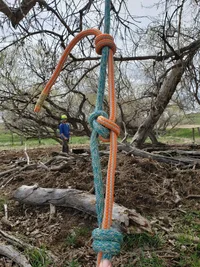
I recently had to tie two ropes together because the tree I was in was just a bit too large, I used the zeppelin bend and then tied off the ends with double fisherman's to back em up, worked great! Of course I didn't sinch the double fisherman's super tight so they could be Un done easily.

Crimsonking
Been here a while
My preference is a Blake’s with a double overhand or butterfly below.

Richard Mumford-yoyoman
Been here a while
- Location
- Atlanta GA
Zeppelin bend.












New threads New posts
-
test
-

-
-
-
-
 Light 14 or 16" narrow kerf bar for 200t or 201t
- Started by southsoundtree
- Replies: 9
-








