Knots for joining two ropes for life support

Agree, but I for one feel that restraint is an area worth studying for an arborist, but so is dynamic testing. I have spoken to witnesses of dynamic rope accidents and those scenarios can apply to treework as much as anything else.

To be honest as far as accidents go, I have seen more accidents to do with habitual/casual mistaken use of equipment ( ie no visual check before committing), false positive evaluation of condition of equipment (she will be right approach) than failure of new non-faulty ropes... and I don’t often see regular all encompassing discussions about those... these are discussed in review of stories shared if at all (many near misses and accidents are not discussed due to regulatory body consequences, even insurance implications in some industries - aircraft industry regulations actually don’t take a big stick approach to ensure the maximum safety level can be reached by hearing a large proportion of accident/near miss accounts...)

One look at Facebook groups blindly criticising the victim of a near miss or accident ensures that many stories aren’t shared and who knows (but God) how much valuable information isn’t taken into account regarding techniques/equipment....

I agree. I'm concerned with dynamic loading scenarios for climbers but it is the lesser of the risks we face.
-AJ
 
Good old school valuable tree buzz conversation going on right here!

I agree that there should be a distinction between life support knots and rigging.

I’ve seen a few rigging knots fail, never a life support knot fail.

I agree rapid loading to high loads must weaken a knot more than slowly pulling on a break test machine.

Why do knots fail? Bend radius, friction, and heat. The first is controlled by the choice of knot, the other two not so much. Friction and heat generated would very well likely by increased with rapid loading, thereby inducing rapid heat generation in a very localized area.
 
Last edited:
Good old school valuable tree buzz conversation going on right here!

I agree that there should be a distinction between life support knots and rigging.

I’ve seen a few rigging knots fail, never a life support knot fail.

I agree rapid loading to high loads must weaken a knot more than slowly pulling on a break test machine.

Why do knots fail? Bend radius, friction, and heat. The first is controlled by the choice of knot, the other two not so much. Friction and heat generated would very well likely by increased with rapid loading, thereby inducing rapid heat generation in a very localized area.

I was psyched to see chaos theory referenced in regard to the complex dynamics involved in knot failure. If a butterfly flaps its wings in Brazil will a double-fisherman’s fail one way or the other on Richard’s pull test bed? First we need to isolate a butterfly in Brazil and work from there. Richard are you ready?
-AJ
 
Why do knots fail? Bend radius, friction, and heat. The first is controlled by the choice of knot, the other two not so much. Friction and heat generated would very well likely by increased with rapid loading, thereby inducing rapid heat generation in a very localized area.

Interesting. In fishing knots in monofilament and braid, we often say that "a knot needs to slip before it will fail." Don't know whether that's true in every case, but it seems that they usually slip, then bite, and it's that "biting" (pinching/cutting action) that typically causes the failure...

Also, and this never occurred to me except all at once in a flash, a knot (in monofilament, anyway) is nothing more than a way of controlling and applying friction, and friction is what keeps it from slipping as well as from breaking.
 
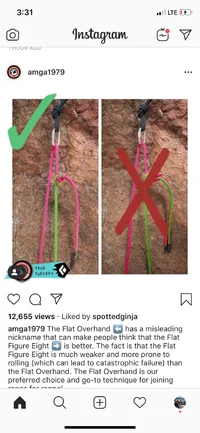
Not sure I understand this, in large part because the "X" covers the picture of what's wrong...can anyone clue me in on what this is all about? (I don't "do" Instagram any more than FB or Pinterest or Twitter or anything else, so that may be my difficulty...)

It's showing the right and "wrong" way to tie a Flat Overhand Knot, the photo with the X over it is a Flat Figure 8 which the original Instagram poster is indicating is unsafe. This appears to be a rock/canyoning or alpine use, this is not something I'd ever setup for tree climbing. Not sure what the point of the post is.
-AJ
 
It's showing the right and "wrong" way to tie a Flat Overhand Knot, the photo with the X over it is a Flat Figure 8 which the original Instagram poster is indicating is unsafe. This appears to be a rock/canyoning or alpine use, this is not something I'd ever setup for tree climbing. Not sure what the point of the post is.
-AJ

the point of that post is to show a proper way to attach two life support lines, which is what the original post was asking about. The AMGA or American Mountain Guide Association is the accreditation organization for guides in the US and is internationally recognized. That post shows the correct knot to use when joining two ropes together for a double rope rappel, or the correct way to attach two life support lines.
 
Thanks, Westondeutsch, FWIW, I found this which discusses the issue:


As a noob, I would have otherwise avoided something called the "European Death Knot" just as I might avoid the "Circle of Death"...
 
Concerning how testing is done, I agree with the point that Richard’s tests are relevant because they test real world configurations and used gear. None of us are climbing on new gear after its first use (a little hyperbolic, I know). I also have been thinking for a few years about dynamic testing, because, as evo said, it is sure to change the behavior of the configurations we use. For example, I’ve wanted to know what a line will do in a dynamic fall when munter hitched to the biner of a redirect sling. Another scenario is the quickie retrievable redirect, with all its sharp bends.

So yes, there is room for more testing styles to give us a better understanding of our systems in dynamic scenarios. And yes, slow testing does give insight into our systems, especially when done with used gear in normal setups. The control was established with new gear by manufacturers.

Do we all get participation trophies now?
 
the point of that post is to show a proper way to attach two life support lines, which is what the original post was asking about. The AMGA or American Mountain Guide Association is the accreditation organization for guides in the US and is internationally recognized. That post shows the correct knot to use when joining two ropes together for a double rope rappel, or the correct way to attach two life support lines.

I was being facetious, definitely on topic. Very few tree climbers will use either of these knots to join lines for life support.
-AJ
 
  • Like
Reactions: evo
I was psyched to see chaos theory referenced in regard to the complex dynamics involved in knot failure. If a butterfly flaps its wings in Brazil will a double-fisherman’s fail one way or the other on Richard’s pull test bed? First we need to isolate a butterfly in Brazil and work from there. Richard are you ready?
-AJ
ROAD TRIP! let’s play
 
I was being facetious, definitely on topic. Very few tree climbers will use either of these knots to join lines for life support.
-AJ
,
Is that due to tree height?

Base-tie rescue system?

I've run 1/2" x 120' rope on my climbing side of the PSP, and smaller, 80' HTP on the Base-tie side. EDK, butted against an EDK. Won't going roll that out, I don't think.
 
,
Is that due to tree height?

Base-tie rescue system?

I've run 1/2" x 120' rope on my climbing side of the PSP, and smaller, 80' HTP on the Base-tie side. EDK, butted against an EDK. Won't going roll that out, I don't think.

I think it's just the general culture of working tree climbers, typically use double fisherman's or Zeppelin bend. No doubt there are tree climbers using a variety of joining knots/bends.
-AJ
 
i hope Agent Smith (and knudeKnoggin) find the way back around.
.
>>all/both views at the extreme end of rope theory and actual (and passionate)usage.
>>still much to be l-earned on back and forth on many things!
.
i'm sure in many ways he is right, in actual human load usage against these lines
>>many other rope involved injuries than overloaded life line! >>especially from static load
>>high range of knots are efficient enough to leave enough 'strength in a 7k line to support a 200#man if correctly tied. Perhaps can't make a correctly tied knot that would be recommended; that wouldn't pass the test; especially doubled over; especially with friction hitch in chain to add extra dynamic response.
.
But in our work, we might Zer0 out crane platform and plot for most efficiency thru chain of connections and process as to not impact, domino etc. into a s(h)ituation, especially with list of multipliers would try to keep low; AND bombproof support points for high angle rigging against impacts.
>>And in an everyday/must guard against complacency more than lack of practice scenario
>>mostly on small budgets with as close to grunt labor as may see these days, but then we aren't doctors, lawyers, engineers, teachers etc. either!
Then taught/preach don't need as strong a line for own carcass as load; but of course be even MORE reverently scrupulous in trusted assembly standards NOT LESS with any/let alone own life on line.
.
So, to our logic; efficiency/strength is big consideration in any conversation on rope etc. Most lifeline is fave termination and friction hitch/device; rest is rigging; except sometimes on more creative .
efficiency/strength is just another way to measure the scenario, and if nothing else; chasing it has brought us very far!
 
Not sure if anyone is still watching this thread but to ask a follow up question to the original: what do people use to join the end of one line to the middle of another (again, for life support)? I think I’ve seen a sheet bend-like bowline with Yosemite tie off used before. Any other options?
 
Not sure if anyone is still watching this thread but to ask a follow up question to the original: what do people use to join the end of one line to the middle of another (again, for life support)? I think I’ve seen a sheet bend-like bowline with Yosemite tie off used before. Any other options?
That is a strange scenario. Hardware to an alpine butterfly for something less directionally biased than a Blake's hitch? If I'm gonna run down one, I like my climbing hitches with a spike below.
 
That is a strange scenario. Hardware to an alpine butterfly for something less directionally biased than a Blake's hitch? If I'm gonna run down one, I like my climbing hitches with a spike below.

Thanks for the response. Trying to do it without hardware, to avoid bombing it out the tree. I’ve been using a thimble prussik and bowline with Yosemite tie off to eye of prussik, which works fine just wondering if there’s a quicker/easier way.

The application is connecting a secondary srs line to the primary, base-tied, srs line. If you make this connection behind the primary TIP (i.e. the standing end, close to the TIP), then you can retrieve the double srs system without passing the knot/prussik through a crotch, among other benefits. But, tying a knot in the standing end of a base-tied srs system is a pain, so just thinking about cleaning that part up/simplifying it.
 
Thanks for the response. Trying to do it without hardware, to avoid bombing it out the tree. I’ve been using a thimble prussik and bowline with Yosemite tie off to eye of prussik, which works fine just wondering if there’s a quicker/easier way.

The application is connecting a secondary srs line to the primary, base-tied, srs line. If you make this connection behind the primary TIP (i.e. the standing end, close to the TIP), then you can retrieve the double srs system without passing the knot/prussik through a crotch, among other benefits. But, tying a knot in the standing end of a base-tied srs system is a pain, so just thinking about cleaning that part up/simplifying it.
That sounds like a butterfly with a screw link job to me.
 

New threads New posts

Kask Stihl NORTHEASTERN Arborists Wesspur TreeStuff.com Teufelberger Westminster X-Rigging Teufelberger
Back
Top Bottom