Documenting my hand-sewn eye process

And the setup, and the research and development, and the scrap/waste, and the employee training, and their perks/holiday pay/benefits. Maintenance, programming and more.
...and very important, the down right expertise. Owning a Ferrari does not mean you know how to drive. (Hell, I had to look up how to spell Ferrari)
P.S. I own a little Nissan Versa, lol
 
Last edited:
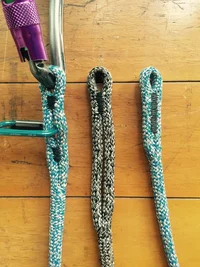
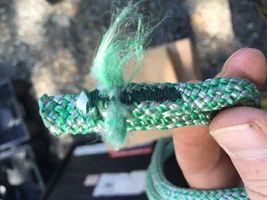
I 'accidently' stitched up a thimble loop today. When I started, I was just curious how well the Bee Line would fit the thimble I had and after my earlier "break testing" of the Marlow #4 twine, if it would fit the speedy stitcher needles I had. It all fit so I figured I would round off and polish the needle's chisel edges and make a few stitches to see how it went and brush up on using the SS. It was all working so I kept stitching...not thinking about how I would like the end stubs to be permanently whipped or taped and not thinking to put a piece of shrink tube on. After the stitching was done, I ended up whipping the frayed ends to the loop and 'painted' the splice with MaxiJacket to give it a little protection.

It ain't pretty, but for the application, with 110 stitches, the strength should be there. I made four passes with each pass being wider and at a lower angle. I definitely have to work of uniformity on stitching. For an accidental first effort, I'm happy.

Is everyone using the standard lock stitch as shown in the speedy stitcher instructions or is anyone using a hand stitching needle and passing it down through one side, up through the other and round and round?

View attachment 30933

I know this post of mine is probably out of sequence with the current postings. I've just rediscovered this thread that I once read a part of, but then lost track of. I'm in the process of reading it through from the beginning, and I'm currently on page 3 of the thread, which is where I pulled gmcttr's post from.

I just wanted to say I really liked this post, and especially the question he posed at the end about using a hand stitching needle to make a sewn splice.

His question may have already been addressed in later posts beyond page 3 of this thread that I have not yet read; I justed wanted to say thanks for asking the question, as I thought it was an important one.

It seems to me, maybe wrongly, that using a hand stitching needle might produce a stronger sewn splice, because it might tend to pull the two halves together harder than does the standard Speedy Stitcher method. I don't know for sure, just guessing here.

I have not yet tried to sew a splice with the Speedy Stitcher for a piece of climbing hitch cord. I have used the Speedy Stitcher to make up an SRT tending harness out of one inch tubular webbing, but that's all, so far.

Tim
 
Tim, the stitching on my hand stitched eyes made with the speedy stitcher (sewing awl) is very tight, the stitching and cordage are like rock when it's done. It's different than flat stitching with a sewing awl, I pull on both legs of the stitching by hand after the awl makes the lock stitch, that way I lock every stitch tightly. If I'm doing a lot of cordage stitching I end up wrapping electrical tape on the fingers that do the most pull on the tighten up, the thread digs into the skin too much if I don't.
-AJ
 
Thanks for this post, Moss. So if I'm hearing you right, you think the Speedy Stitcher kicks ass over a single needle being passed through the cordage and back again, correct?

Thanks for your time, and just in case I have not told you before, I think you do really beautiful work.

Tim
 
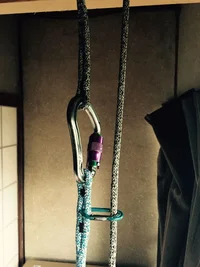
Thanks for such an interesting thread. I tried hand stitching for the first time today, I needed to capture an accessory biner in a long eye for my twin rope, what d'yall think of this stitched into a normal class 1 db splice?
 

Attachments

  • image.webp
    image.webp
    502.6 KB · Views: 182
  • image.webp
    image.webp
    403.3 KB · Views: 167
Thanks for this post, Moss. So if I'm hearing you right, you think the Speedy Stitcher kicks ass over a single needle being passed through the cordage and back again

Without a doubt. When you're sewing an eye and get to the second or third pass it really helps to be using a sewing awl/speedy stitcher, the handle makes it much much easier to push the needle through.

Thanks,
-AJ
 
Tim, ..... the stitching and cordage are like rock when it's done. It's different than flat stitching with a sewing awl, .....
-AJ

moss is the man when it comes to stitched eyes and he makes a good point about the stitch being "rock hard".
It is not just the capturing of threads but the tightness within the entire jacket that holds and provides the ultimate strength to the eye. That comes from powering (pushing) the needle into rope, not just from pulling the thread tight.
 
Thanks for such an interesting thread. I tried hand stitching for the first time today, I needed to capture an accessory biner in a long eye for my twin rope, what d'yall think of this stitched into a normal class 1 db splice?
That looks good to me, for the purpose. The only possible issue I could see is the two legs of the eye being unbalanced in tension when they're stitched. I'm guessing it would be fairly easy to hold the eye under slight tension to balance it while the sewing process is initiated.
 
Why are eyes not stitched from this side?
Good question! Immediately, I can imagine it would put a properly placed lock stitch in "free air" between the two rope sections. That might allow more lateral movement between them.

The traditional splice puts the lock within the center of the rope.

Makes me wonder why not both? Perhaps because it's too easy for an industrial bar tack sewing machine to make 3 passes on a single plane.

I'd love to see what your splice breaks at!
 
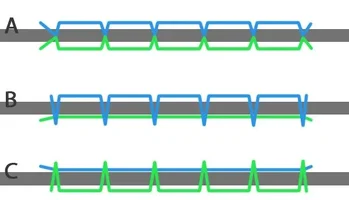
Why are eyes not stitched from this side?

I have an assumption...

The aim at (machine) sewing is to have a balanced tension between the upper and the lower thread (shown at A). This means the crossing of the threads should be exactly in the middle of the material (fabric, rope, whatever) and this gives the maximum stability to the stitching. Stitching from aside would result in crossing of threads between both ropes and therefore outside of any material.

Does it make sense?

fadenspannung.webp
 
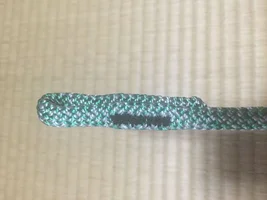
It's funny, I made this stitched attachment in order to test something on the other end of the rope and it became more interesting. It broke at 13.04kn. I'll make it into an eye trap and see how that goes.
 

Attachments

  • image.webp
    image.webp
    214.8 KB · Views: 162
It's funny, I made this stitched attachment in order to test something on the other end of the rope and it became more interesting. It broke at 13.04kn. I'll make it into an eye trap and see how that goes.
Interesting, for sure. I feel that sewing machines (or hand sewing, for that matter) could open up so many new possibilities.
 
While I have a good grasp of splicing, of tapering, compression and the friction that involves it I have no intuitive clue about stitching. In one way I am interested but I could also wash my hands of it, my splicing philosophy is one that tries to return the rope to near as possible to its original state, stitching feels as though an intrusion takes place rather than a petroleum symbiosis.
 
While I have a good grasp of splicing, of tapering, compression and the friction that involves it I have no intuitive clue about stitching. In one way I am interested but I could also wash my hands of it, my splicing philosophy is one that tries to return the rope to near as possible to its original state, stitching feels as though an intrusion takes place rather than a petroleum symbiosis.

Different ways to look at it, there's room for both but stitching will overall never replace splicing. With an eye-2-eye hitch cord a stitched eye changes the characteristics of the cordage the least. I think of stitching more as a weave into the cordage than an intrusion. The right approach (stitching or splicing) for the use.
-AJ
 
Different ways to look at it, ....With an eye-2-eye hitch cord a stitched eye changes the characteristics of the cordage the least...

So agree AJ, my preference is a sewn eye. I think that there is a place for both although personally I find few places I would rather have a splice. Hand stitching is certainly time consuming with a big learning and testing curve.
I find a sewn eye so much more compact with less influence close to the eye.
 
What percentage loss in strength does a good stitch give?
Yup, stitched ropes are useful, I use them too, infact I'm designing my trt system based on combo's of both.
I'm intrigued by stitching and want to learn more. My first 5 attempts felt hitnmiss to say the least.
 

New threads New posts

Kask Stihl NORTHEASTERN Arborists Wesspur TreeStuff.com Teufelberger Westminster X-Rigging Teufelberger
Back
Top Bottom