Documenting my hand-sewn eye process

been following this thread for awhile and im thinkning about trying this out for size. can you explain the whole angle thing?? and the lock sitches or continual direction? i plan on using my speedy stitcher so it would be lock sitches right??
thanks!
Have fun, but please please please test your sewn eyes by pulling to failure on a professional test machine with recorded data before hanging your life on them. That's what this thread is all about.

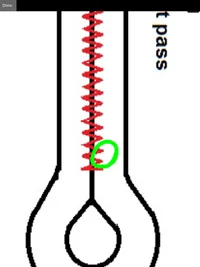
So, if you are to make a 22.5 degree angle on pass 2, the bisect (11.25 degrees) will be perpendicular to the rope. In other words, if the rope is cut with scissors, the cut is perpendicular to the rope.

I'm interested to see your results. Best of luck.
 
sorry for the late response. so when you talk about the angle you mean the gap between stitches (green circle in picture)? so the first pass is 22.5 then the second is 11.25 which would place the second row inbetween the first pass. the the third (I'm assumin final) pass is made as dense as possible with smallest angle possible, wider that the orignial two as to cover the all the stitches?

if the picture gmcttr posted, it looks like the first pass is so close to the seam that its the cover only? is the second pass a little wider?
 

Attachments

  • image.webp
    image.webp
    47.6 KB · Views: 90
The first pass is basically a "basting stitch" to keep everything in place for the subsequent passes. I catch core strands with it but not a lot of them. The second pass is wider than the first and the third pass is wider than the second. At that point the added material makes the rope so dense that you won't be able to get a fourth pass in it even if you wanted to.
 
Just ordered some tritech to attempt to sew. I'm going to have it broken afterward. We'll see if i can get a grip on this skill or if I'm going to have to hire sewn eyes done for me. I'm all for DIY, but I'm also aware that this may be beyond my limitations. I've got craft skill in a few areas, but even stitching has always been a challenge for me. I may have to wait for next winter to develop this particular craft.
 
Just ordered some tritech to attempt to sew. I'm going to have it broken afterward. We'll see if i can get a grip on this skill or if I'm going to have to hire sewn eyes done for me. I'm all for DIY, but I'm also aware that this may be beyond my limitations. I've got craft skill in a few areas, but even stitching has always been a challenge for me. I may have to wait for next winter to develop this particular craft.
Its a process to learn for sure. There are some little tricks that make it easier to work with all the length of thread while making the lock stitch. I use about a full wingspan of thread for three passes, and the work feels like it gets quicker as you use up the thread towards the end of the third pass. Just be patient, methodical, and always be in a comfortable place for the work.

Best of luck!
 
how hard do ya'll pull on the lock stitches?
Agreed. Maybe around 5 - 7 lbs.? It's a wild guess, but snug. The more stitched you lay in, the better that tension will hold on its own. The first pass takes more diligence in maintaining tension than the second and third passes.
 
And make sure you bury the "lock" (where the thread from each side loops together) in the center of the rope. Not on the surface.
 
As far as stitch width goes with each pass, basting stitch, 2nd pass (twice the density of the basting pass) and final pass (as close together as is practical) I insert the needle at the center point of the cordage width. As you stitch the first and second pass you'll notice the cordage cover tightens and rolls inward, the stitch width decreases, ends up being slightly less then reaching the center width point. With the final pass the cordage will be tightened and stable enough that it won't roll in any more. You should be able to maintain the final pass stitch width reaching or slightly exceeding the center point of the cordage width. If that makes sense ;-)

I've been climbing on my v2 method (pre-compressing the cordage) hand-sewn eye saddle bridge, climbing rope eyes, lanyard eyes and hitch cord eyes for more than a year. The cordage is all wearing out, the stitches look new in comparison. Not surprising, if they're covered with shrink tubing there's going to be no abrasion.

The diameter of the Globe 2000 bridge cordage is too narrow to fit in 3 passes of the heavy black thread so I used the waxed polyester that comes with the Speedy Stitcher. Been holding up nicely even though the shrink tubing as been beat up on the ends by the bridge ring hitting it. Same with 8mm hitch cord, I don't use the heavier black thread, not enough room in 8mm cordage to fit all 3 passes.
-AJ

16604055844_f9b1751ba3_z.jpg
 
Last edited:
That's some nice work. Yet another thing I want to give a shot. Really great to be able to see finished product and stitching methods on the forums. You guys are the bomb.
 
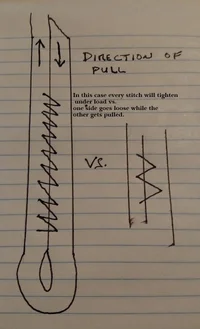
Here is something to consider.
Hand stitching vs. machine, try to take advantage of the fact that with the hand, you can do things that a machine cannot and turn what may be considered a negative into a positive.
By hand it is difficult to have the consistency and beauty that a machine can do, that may not be a bad thing as with the inconsistency more fibers are pulled into the stitch.
A machine can be very consistent in the tension of the stitch but cannot vary the zigzag.
By hand you are able to change the angle of every zigzag so that each stitch gets pulled when a load is applied. In other words, with a normal zigzag pattern, only one side is really holding the load but a sewing machine is able to apply enough pressure and put them close enough together that it is not an issue. By hand it may be.
Excuse my quick art, I am not an artist!

Hand stitch.webp
 
when ya'll go for the second or third pass, is it all one long continuous thread, or do you do each pass seperately? how do you terminate the sitching?

for compression while stitching, could i just use a bench vice? can you compress it too much?
 

New threads New posts

Kask Stihl NORTHEASTERN Arborists Wesspur TreeStuff.com Teufelberger Westminster X-Rigging Teufelberger
Back
Top Bottom