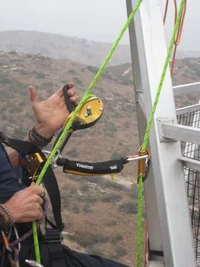
Yo-Yo (RADS) for working?

What are your concerns using the grigri?

I use the system here and there but never really got behind the idea of putting a 2:1 into an srt system when the main reason to do srt is for efficency, speed and ergonomics. To me, a rads system doesn't fit these qualifications.
 
used this system alot in the past when i was just getting started. I had no problem with it but like everything elese there is a time and place for it. It is def not a speedy ascend.
 
I am a fan of SRT, but I have some concerns that I will try to work out in my system. As for Yo-Yo, its not as fast or efficient as SRT but it is way easier (and faster for me)than DDRT. I am just not sure about the GG because it really wasn't designed to be used like this. I wonder if it would hold up to the ware and tare. Also, I am pretty programmed to "ascenders" needing a back-up. Is the GG considered a ascender, thus needing a back-up? I assume not, but why?

I agree with you FT, I probably wont use this day in and day out, but I am wondering if you could. I see this being very useful for certain situations, but I want to try it out more. It may not work well all the time, but I am going to experiment some more.

PU, the GG is already in my gear bag and unfortunately our budget doesn't allow the Eddy. Maybe in the next year or so.
 
Are you talking about using a Camp Yo-Yo with a RAD system?
thinking.gif
 
The Eddy is my choice on my RAD system in trees , but i also have a Petzl I'D for my Rad sysytem on our tower work inspection..

Later in SO-CAL
 

Attachments

  • 198572-Picture342.webp
    198572-Picture342.webp
    36.6 KB · Views: 144
I think which device you are using for RADS is a very personal decision.
Use the device you are comfortable with.
Gri-Gri, Eddy, ID are all work fine.

A friend of mine swears on the Gri-Gri, my personal choice is the Trango Cinch.

But for long ascents i only use croll, ascension and a pantin because it is so much faster.
 
"the rads system is a one to one system. all you need to do is put a foot loop on your ascender. bam. one to one."

The footloop does go on the ascender, but the system is pretty much a 2:1.


"Are you talking about using a Camp Yo-Yo with a RAD system?"

No, sorry for the confusing title. I use the GG and a Petzl Ascension.

"I think which device you are using for RADS is a very personal decision.
Use the device you are comfortable with."
"But for long ascents i only use croll, ascension and a pantin because it is so much faster."

I agree with both statements.
 
The RADS, or YoYo is a 1:1 on the foot loop(s) and a theoretical 3:1 on the down rope, and it is an SRT method.

I thought it was a 2:1 on the down rope myself at first, and from a person pulling from the ground, i.e. not the climber, it would be a 2:1. But since the pull line is 'attached' to the climber, there are three strands supporting the climbers weight, hence a 3:1, just like the DDRT is a 2:1 to the climber, but a 1:1 to a person on the ground pulling the climber.

I climb almost exclusively on RADS. It's a compromise system that's more efficient than DDRT and less efficient than a Texas or Frog sit-stands. But then those are less efficient than rope walkers.

All else being equal, I'd probably climb on a Texas, but the RADS offers things the sit-stands and rope walkers don't - simplicity, minimal equipment, up and down/in and out capability, ascending with hands only, pretty easily I might add, and last the RADS provides probably the fastest escape possible if you have to get out of the tree.

I know some will say DDRT is faster for escape, and I would agree with conditions. The main condition is will your doubled rope let you reach the ground in a single pitch?

A buddy of mine was high in a pine tree when a storm with wind pretty much came up fast and out of nowhere. He started down on his DDRT only to learn near the bottom of the tree, he had run out of rope. Fortunately he was low enough to drop. Had he been on a RADS, he wouldn't have had the problem in the first place.

With any system other than RADS, you pretty much have to carry gear for two systems, SRT and DDRT in the tree. With the RADS, you basically only need the RADS, but like last night on a limb walk, I used the Grigri for my main rope and did a trad DDRT tie-in for a balance line - only piece of gear needed was a biner.

 
Like others have said, any of the descenders would work. With any of them the limitation is the descent speed. The smaller devices can't dissipate heat quick enough.

The advantage of RADS over almost any other ascent system is that the climber can descend without a changeover in case of an emergency.

The Eddy is my first choice for the RADS for many reasons.

RADS shifts between a 1:1 and 2:1 depending on what part of the motion the climber is doing.

Combining the Eddy for the lower and a Shunt with a release is a really smooth setup. I don't have the pics of this setup on this computer but I'll try to remember to post them when I'm at home.
 
Thanks for all of the comments so far on this topic so far. I am still wondering if anyone sees any problems with using this as a working system on a fairly regular basis?
 
Until I found the Unicender I used RADS for work almost all of the time.

When I did an SRT workshop in Sweden one of the guys had been using RADS for years. He was soooo smooth on ascent and working in the tree.

Be sure to tie stopper knots on your down rope when you're working with a new system.
 
When you use it for working, do you just unclip from the hand ascender and work like normal? I suppose there is no reason to tie a knot below your hand ascender. I have worked a DDRT off of the hand ascender after ascending SRT and you have to do all of that backup stuff to make sure your hand ascender wont fail and it just seems too simple to just unclip from the ascender and work with RADS.

By the way, do you really have to be tied into the hand ascender? If you can work off of the GG then it doesnt seem necessary to be tied into the hand ascender while ascending.
 
[ QUOTE ]
...RADS shifts between a 1:1 and 2:1 depending on what part of the motion the climber is doing....

[/ QUOTE ]

Tom,
RADS is never a theoretical 2:1, it is a theoretical 3:1 to the climber. I debated this extensively once taking the 2:1 side until I realized it is a 1:1 on the leg(s) and 3:1 on the pull down.

It would be a 2:1 if some one is pulling on the down rope from the ground.
 
Ron,

Your word is good enough for me :)

The upper ascender isn't really an attachment point. You could have a tether attached though for more security. I've never done that, I trust my equipment the same as I trusted my hitches...no backup there.
 
[ QUOTE ]
When you use it for working, do you just unclip from the hand ascender and work like normal? I suppose there is no reason to tie a knot below your hand ascender. I have worked a DDRT off of the hand ascender after ascending SRT and you have to do all of that backup stuff to make sure your hand ascender wont fail and it just seems too simple to just unclip from the ascender and work with RADS.

By the way, do you really have to be tied into the hand ascender? If you can work off of the GG then it doesnt seem necessary to be tied into the hand ascender while ascending.

[/ QUOTE ]

I suspect the backup to a RADS is more personal than a preferred practice. If you don't tether from the ascender to your harness, you have your life hanging on one piece of gear, the Grigri. OTOH, I have never heard of a Grigri failing to the point that it produced an uncontrolled or unrestrained fall or drop. In fact, I've never heard of any kind of failure of a Grigri in a RADS application.

Lately, largely because of Tom's view that I read some time back, I have been climbing without my normal tether backup. One thing that I noticed though, is that when I used the tether, I could remove the ascender and simply let it hang from the tether. Of course this provides a drop-proof too. If I remove the ascender and drop it the tether will catch it; without the tether, it falls to the ground.

But, at least for me, the tether is not transparent, i.e. it is one more thing that can get in the way. So to deal with that, I adopted the practice of clipping the foot loop to my belt before removing the ascender. That too provides a catch in case of a drop. However, that does require an 'act' to do that; in a hurry, one could forget to attach the foot ascender and if the same 'hurry' caused a drop, the ascender would be gone.

So, I'm considering reviving the tether as both a life support back up and a convenience. It is just fast to remove the ascender and drop it. Then you just simply reinstall it as needed.
 
The way I look at it is RADS is 1:1 except your right arm (if that's the one pulling rope) is getting 3:1. Your left arm and leg are doing it 1:1. Pretty much what Ron said looked at a different way.

I don't like using a tether on the ascender. There are many situations where you have tight squeezes and it's nice to be able to push the ascender up around a branch further than a tether would allow.

The only reason for me to leave a tether on is when I want the flexibility to switch back and forth between a RADS and a Tree Frog during a climb, ie: long open stretches = Tree Frog, bushwhack through deadwood on a conifer = RADS. It's quick and easy to switch between the two systems.
-moss
 
I believe the GriGri/ RADS to have at place. Rope/ Rapid ascent and descent system by name shows that it fills a different role than an ascending system like srt with ascenders, as an example.

The RADS is better in that in an emergency you can descend as fast as you need to, without any concern of burn through on a hitch.

I've been trying to express the importance of an emergency escape system to a customers and climbers alike lately (talked to a bunch at a NATS aerial rescue training.) The one climber said that they run into bees a lot (and they've been extra bad this year up in western WA state).

One time while rock climbing my friend climbed onto a 70' boulder up one way to be able to rappel off of a tree to access the top anchors of another rock route (equivalent to transfering from one tree to another). We started hearing a strange sound from above, and realized it was bees/ hornets/wasps that were disturbed in the tree by the rappelling (vibration?). We started seeing insects. My friend descended quickly. Within about a minute there was cloud of insects up top, and it was audible probably for 500' at least. It was MAD how may insects were riled up, probably 1000 or 2000.

So, while the RADS might not be the best, most efficient ascending system, it has other benefits, so its not apples to apples comparison. Seems like the unicender offers some of the best of both (from the little that I know of it, treedimensional put up an info video about it on YouTube).
 

New threads New posts

Back
Top Bottom