NickfromWI
Participating member
- Location
- Los Angeles, CA
Ok, the guys at Yale have been working on a rope for military purposes. They've been designing/testing it for like 2 years now. I talked to them a while ago and we think this thing might be a great rigging line. It's the world's first triple-braid!
The cover is not for strength, it's just for chafe and UV protection. It's basically a suped-up pretty version of XTC.
The 2nd layer is a high-tech material called Seblon. It's like nylon. Stretchy. The cool part is that the recoil is very slow. Like if you stretched a rubberband until it broke...but when it broke it didn't snap back. It slowly returns to it's original length. However, it is stronger than some of the high-modulus lines (like technora).
Then the core is PBO/Xylon (same stuff they use for their PoBon rope. SUPER STRONG. It's degrades quickly in sunlight but that's not an issue since it's covered by TWO covers!!!!!
This is a rope for dumping BIG LOADS!!! You can shock load the hell out of this thing. Basically how it works is as the load is applied, the Seblon takes the weight. It stretches to absorb the shock. After the load is brought to near static, the PBO/Xylon holds the strength as you lower the piece.
Once you get it to the ground and untie it (splices are better here), the Seblan begins it's slow recoil. By the time you get the line hauled back up to climber/bucket operator it will be at it's original length and ready to go for another run!
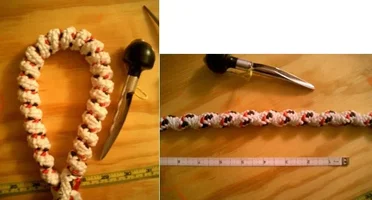
The splice is crucial. The PBO/Xylon does not react well in the knotting. How do you splice a triple-braid rope? Well, I'm not allowed to talk about that yet. We put a lot of work in to refining this splice. Yale did permit me to show you pictures of the just about finished splice.
So, the question is...would you use this? The rope would not cost very much. The Seblon is actually cheaper that polypropylene (the cheap plasticky stuff they use to make water ski pull lines). The outer cover is just polyester and the PBO/Xylon is expensive but the diameter is so thin, the price isn't crazy. A 200' piece of 7/16ths might run about $335.00. Sounds like a lot but Sherrill sells 200' of 3/4" stablebraid for $269.00
There are two sizes...7/16ths and 5/8ths. That's all they have now. The smaller size has an ABS of 29,600lbs. But get this...due to the complicated contruction, Yale is reccomending a .75:1 working load limit. This means that with this rope, you can easily and safely shock load a piece that weighs 22,200lbs!!! AND, to make it even better, it still has all it's same shock absorbing traits at loads as small as 800lbs!!! With one line, you can minimize shock to all your other equipment, the tree, and whoever is running the rope.
I got to do a bit of testing with it...not in a tree, though. It's crazy stuff. It looks squishy but feels only a bit different than 3-strand while it's running through your hands.
So the question is...would you use it? This might be the Zubat of rigging lines.
The fun part....The name they are thinking about using is Yale XXX. They showed me a picture of a magazine ad (that will suposedly soon be on their website)...it looks like the movie-posters you see at the theatre...where the credits are at the bottom, there is some technical info. Then over to the side, the rating is....you guessed it...XXX
love
nick
The cover is not for strength, it's just for chafe and UV protection. It's basically a suped-up pretty version of XTC.
The 2nd layer is a high-tech material called Seblon. It's like nylon. Stretchy. The cool part is that the recoil is very slow. Like if you stretched a rubberband until it broke...but when it broke it didn't snap back. It slowly returns to it's original length. However, it is stronger than some of the high-modulus lines (like technora).
Then the core is PBO/Xylon (same stuff they use for their PoBon rope. SUPER STRONG. It's degrades quickly in sunlight but that's not an issue since it's covered by TWO covers!!!!!
This is a rope for dumping BIG LOADS!!! You can shock load the hell out of this thing. Basically how it works is as the load is applied, the Seblon takes the weight. It stretches to absorb the shock. After the load is brought to near static, the PBO/Xylon holds the strength as you lower the piece.
Once you get it to the ground and untie it (splices are better here), the Seblan begins it's slow recoil. By the time you get the line hauled back up to climber/bucket operator it will be at it's original length and ready to go for another run!
The splice is crucial. The PBO/Xylon does not react well in the knotting. How do you splice a triple-braid rope? Well, I'm not allowed to talk about that yet. We put a lot of work in to refining this splice. Yale did permit me to show you pictures of the just about finished splice.
So, the question is...would you use this? The rope would not cost very much. The Seblon is actually cheaper that polypropylene (the cheap plasticky stuff they use to make water ski pull lines). The outer cover is just polyester and the PBO/Xylon is expensive but the diameter is so thin, the price isn't crazy. A 200' piece of 7/16ths might run about $335.00. Sounds like a lot but Sherrill sells 200' of 3/4" stablebraid for $269.00
There are two sizes...7/16ths and 5/8ths. That's all they have now. The smaller size has an ABS of 29,600lbs. But get this...due to the complicated contruction, Yale is reccomending a .75:1 working load limit. This means that with this rope, you can easily and safely shock load a piece that weighs 22,200lbs!!! AND, to make it even better, it still has all it's same shock absorbing traits at loads as small as 800lbs!!! With one line, you can minimize shock to all your other equipment, the tree, and whoever is running the rope.
I got to do a bit of testing with it...not in a tree, though. It's crazy stuff. It looks squishy but feels only a bit different than 3-strand while it's running through your hands.
So the question is...would you use it? This might be the Zubat of rigging lines.
The fun part....The name they are thinking about using is Yale XXX. They showed me a picture of a magazine ad (that will suposedly soon be on their website)...it looks like the movie-posters you see at the theatre...where the credits are at the bottom, there is some technical info. Then over to the side, the rating is....you guessed it...XXX
love
nick