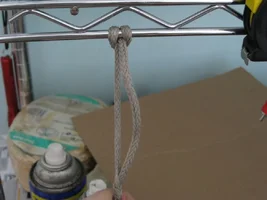
Worn saddle bridge pics

Yes, I can give more details. I sell them for $35!!! ;)

Just kidding. It's a simple eye-eye sling made with locked brummels. I pull the core out and throw it away (actually I save it for other things, but you get the point). Then I splice the cover as if it were a single braid, then stitch it, then dip the whole thing in 2 coats of Maxijacket coating.

As far as 16 strand, I never tried to see how short I could go. Maybe 14" or so?

love
nick
 
[ QUOTE ]
Good looking knife, is it a benchmade?

[/ QUOTE ]

Yep
cool.gif
 
Yes. Just one. It broke at over 5,500 pounds. I was super happy with that. I was willing to climb on it if it was at least 2,500 pounds since I hear most harnesses can't even handle that.

love
nick
 
[ QUOTE ]
Has anyone used 5/16 amsteel for a bridge with locking brummels? Should I have any concerns?

[/ QUOTE ]

Yeah, I tried it. Dyneema handled the abrasion better than vectran and technora did, but it still didn't last as long as polyester does.

How long are the tails buried in your Amsteel bridge?

love
nick
 
Don't use it for a bridge. Maybe a rigging sling or for lifting applications.

Keep in mind that dyneema melts easily compared to almost all other rope fibers that tree climbers typically use.

love
nick
 
I keep meaning to replace my bridge with Amsteel Blue, with or without a cover. You can make your splice more secure by making the eyes big enough to girth-hitch to the saddle rings. MUCH more secure.

I did a break test on a 3/16 Amsteel Blue sling where one end had a nice long bury and the other had a very short 2-inch tapered bury but a large eye. The large eye was girth-hitched to the pulling shackle whereas the small eye was attached directly to the other shackle.

A 2-inch tapered bury in Amsteel Blue would never survive much of a pull in the case of a simple eye connected to a pin or carabiner. The girth hitch changes everything. The splice did not pull apart. Instead, the girth hitch cut itself in half at 3486 pounds (nominal strength of 3/16 rope is 5400 lbs).
 
[ QUOTE ]
I keep meaning to replace my bridge with Amsteel Blue, with or without a cover. You can make your splice more secure by making the eyes big enough to girth-hitch to the saddle rings. MUCH more secure.

I did a break test on a 3/16 Amsteel Blue sling where one end had a nice long bury and the other had a very short 2-inch tapered bury but a large eye. The large eye was girth-hitched to the pulling shackle whereas the small eye was attached directly to the other shackle.

A 2-inch tapered bury in Amsteel Blue would never survive much of a pull in the case of a simple eye connected to a pin or carabiner. The girth hitch changes everything. The splice did not pull apart. Instead, the girth hitch cut itself in half at 3486 pounds (nominal strength of 3/16 rope is 5400 lbs).

[/ QUOTE ]

The only thing this suggests to me is to NOT girth hitch.
It seems like you're saying that a girth hitch loads a splice more evenly than just an eye, which makes absolutely no sense.
 
[ QUOTE ]
The only thing this suggests to me is to NOT girth hitch. It seems like you're saying that a girth hitch loads a splice more evenly than just an eye, which makes absolutely no sense.

[/ QUOTE ]

If you have a simple eye around a pin under heavy load such that the splice is just starting to slip apart, the two legs of the eye are not under equal loads at that moment. For the splice to slip, the rope must also move around the pin. The friction as it does so greatly reduces the load on the buried leg. I have done a number of tests that show for steel and aluminum pins and carabiners you can expect the friction around the pin to cause the two legs to share the force in about a 2:1 ratio. This is just a rough rule of thumb, but it means even for a simple eye the buried leg, at failure, has only half the tension of the other leg.

With a girth hitch instead of a simple eye, there a whole lot more friction separating the two legs of the eye because the rope travels a much longer friction path. When this structure is loaded just to the point of slippage, the ratio of forces is more like 100:1 (I have measured anywhere from 81:1 to about 200:1). Because of all the friction, there is very little force available to actually extract the bury. This is why in the experiment I cited above, the bury was not extracted. Had it been a simple eye, it would have come apart very easily.
 
I kind of see what you're saying, but, if the girth hitch introduces more friction would it not be easier to load one leg more than the other? If you "cycle" a girth hitch enough you could create a situation like in this pic. If it were just an eye you couldn't. Besides, what's the point in proving that splices don't work right when you don't splice them right?
 

Attachments

  • 213234-girthhitch.webp
    213234-girthhitch.webp
    33.6 KB · Views: 114
[ QUOTE ]
I kind of see what you're saying, but, if the girth hitch introduces more friction would it not be easier to load one leg more than the other? If you "cycle" a girth hitch enough you could create a situation like in this pic. If it were just an eye you couldn't...

[/ QUOTE ]

Your point about cycling is a good one, and your photo illustrates the point perfectly. If each cycle at the high point caused slippage to begin, and at the low point allowed the rope to become completely slack, then the splice should slowly walk apart over many cycles. But this would apply to a simple eye as well. Incidentally, my earlier point about the unequal distribution of forces on the two legs can be applied to your photo. If you were to hang a 10-lb weight from the slack leg in the photo, you would have to pull down on the other leg with somewhere between 800 and 2000 lbs in order to get the 10-lb weight to start moving up. A girth hitch makes a terrible pulley.

In the first photo I show a spliced eye in 3/16-inch Amsteel Blue that is girth-hitched to a link. This configuration could probably relax completely after each tension cycle, so it might creep apart if the bury were very short.

4338238049_118388aedf.jpg


On the other hand, the girth hitch might undergo a permanent change under high tension so that all slippage would stop. The second photo shows the identical hitch with a much smaller eye. The "bridge" of the hitch still crosses both legs of the eye, but one leg is inside the other because the bridge is directly over the splice. Under heavy tension, the bridge creates a serious dent in the splice. Even better, the throat of the splice is not only under heavy tension but it is bent around the steel link. These two things together tend to lock up the splice and provide far greater holding power than the simple straight bury shown in the first photo. I haven't done experiments to prove it, but I suspect this configuration would be highly resistant to creep.

4338238127_1b9cc636e9.jpg

There are lots of twists and turns to this story--I bring it up just to remind people that a splice can't really be understood in isolation; how the eye is hooked up has a great deal to do with how the splice will perform.

 
[ QUOTE ]
Nick
How much was the double esterlon strength compromised with the lose of the core?

[/ QUOTE ]

1/2" Double Esterlon comes in somewheres around 10,000 pounds MBS. I pulled the core out and was able to get the cover to break at around 5,500 pounds.

The cover and core indivivually could withstand about 6,000 pounds each if spliced in a more normal configuration. They don't work together perfectly as a double braid rope, so they have a shared breaking
strength of about 10K

love
nick
 
[ QUOTE ]
(...)I am no longer doing production climbing on a daily basis (...)

[/ QUOTE ]

Does it mean I can beat you in footlock now? Badly?
 

New threads New posts

Back
Top Bottom