Working Around Electricity

OK OK I have a spanner and I'm throwing it in the works ...

Is it the voltage that kills you or the Amps?

See, remember those whizzy electro toy things that you could put your hands around and watch the sparks ... apparently voltage on it's own doesn't do much... like static electricity.

But current or amps is deadly.

Now, I'm not a sparky etc just wondering.

And what is the correlation between voltage and amps out on the street?

Like a 11kv line vs a 275kv line ... what sort of current or amps are in those lines?? I think your home (240v) over here only has around 12 or 15 amps ... but how does all this work???
 
Watts are what's being carried in the wires. For a given wattage the voltage and current are proportionate. Raise the voltage and the amps (current) go(es) down. Lower the voltage and they rise. In AC, (K)VA=Watts and the amount of power available in a set of lines would initially be determined by the capacity (in KVA) of the transformer (and associated switching gear) supplying them (assuming of course the upstream supply to that transformer is sufficient), and by the amount of consumption more closely downstream from it than where you are.

Seems I've heard something lately about Direct Current being used for transmission now in some places but am not sure what the current (haha!) method is being used to step the voltages up/down. The beauty of AC is transformers for isolation/voltage-change; for DC it's somewhat more complicated than a couple of coils of wire in close proximity.

Even though it doesn't really add much to this discussion you might want to read the article on electric shock at Wikipedia. I disagree with the notion presented there that "electrocute" is applicable to anything accidental. The word means "execute with electricity" with "execute" meaning "capitally punish".

I was a bit more fortunate than Topsy (see the "video" link near the bottom of the page) when one time I was showering and unbeknownst to me the cord had fallen out of my electric razor and into the tub. The water suddenly felt strangely "alive" for some reason, then I noticed the cord end so I stepped out of the tub and unplugged the cord (a small mobile home before the requirement for GFCI outlets in such locations).
 
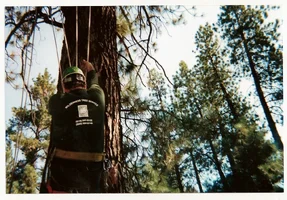
I have nightmares about the buzzing on the pines when we get within ten feet of them.Remember a bucket worker hanging over the side of the bucket dead from being shocked many years ago in the pines at big bear.........
be carefull it happens quick and without mercy...robdog
 

Attachments

  • 45418-DEADWOODINGPONDEROSAS014.webp
    45418-DEADWOODINGPONDEROSAS014.webp
    208.4 KB · Views: 52
[ QUOTE ]
I have nightmares about the buzzing on the pines when we get within ten feet of them.Remember a bucket worker hanging over the side of the bucket dead from being shocked many years ago in the pines at big bear.........
be carefull it happens quick and without mercy...robdog

[/ QUOTE ]


[ QUOTE ]
Thanks for the insight. Very well thought out post. If I may ask, what is your background or job title? It sounds like you have had extensive training in electrical awareness. Are you a lineman? Or line-clearance arborist?

Not really a matter. What you say makes sense. I have one question in my mind though. Is there a difference in potential when talking about resistance? Can potential be stepped up if wet, greasy or dirty?

[/ QUOTE ]

As for my credentials to mutter, I was a union A card electrician for 41 years and just received a retirement gift of a big-[use a better word] knife from Local 134. In my time, I was certified in high voltage cable splicing, supervised about 70 men in building Sears Tower, and supervised the construction of the first 345KV switchyard in Chicago.

More importantly, I've survived a couple of serious encounters with dame electricity that can be informative here in addition to the excellent references already provided.


1) It was a little past 4:30 on Friday and I wanted to finish splicing a new circuit in a box in a ceiling at a downtown office building in Chicago. I was standing on the next-to-the-top step of an aluminum ladder, had pushed myself well inside the false ceiling and was trying to join the new wire onto a twisted splice that was hot. I had to hold the spliced wires by their insulation with my right hand, and twist the bare ends with linesman's pliers in my left hand.

Not being left-handed was awkward, and I accidentally touched the energized pliers to my right thumb and created a current path from that hand through my arms and chest, and out the back of my left hand to a ceiling support wire.

I don't remember any pain, but my arms were vibrating and I couldn't let go of the pliers or the wires. I distinctly remember thinking, "This is how I'm going to die", and was very clear mentally about what was going on. I couldn't breathe, I couldn't even squeak, and there was no question that I was suffocating. A drunken Irish carpenter was singing in the next room, and I thought of the irony of how much louder he was than me, and I couldn't get his attention.

I was far enough in the ceiling to pass out and perhaps stay in the same circumstances at the risk of dying, so I concentrated on moving my feet back on the ladder step. I was surprised at how long it seemed to take, but I finally fell out of the ceiling with ceiling tiles and the ladder scattered around me.

The noise caused carpenter Clarence to stick his head in the room and chuckle at the sight. He didn't know what happened and didn't care. I sat there for a while and finally went home.

I learned a number of lessons in that ceiling and would always predispose myself later to fall out of danger when working on anything hot. I would only use my right hand and sometimes stand with my weight on one foot, so I could fall in a direction I wanted if I got in trouble.

I always checked my electrical tester every morning and did fire that bozo for telling a kid that his body could be used to tell if something was energized.

This was an example of enough current flow through my hands and arms that prevented them from releasing their grip and letting me get away. My body didn’t care what I thought or wanted. The circuit was 120 volts and the relevance here includes the hidden details of electricity nearby, you being comfortably nestled in place, and then getting tangled in some "low voltage" energized circuit.


2) In earlier incident, the only job available to my low seniority was doing HV cable splicing for a temporary power rerouting of the tower at the O'Hare airport. No one would take the job and I was too naive to be suspicious. Turned out that the HV cable pulled from manhole to manhole were all too short. Usually, everyone adds a few feet in the process of measuring and cutting, but the cable is expensive and this time it was exact—and too short.

Being naïve sometimes has advantages, and I planned to make a splice, strengthen it independently, and then pull the slack I could get out of each section to give me enough cable for the next splice. The contractor would have gone under if he tried to replace the runs, so he stayed away until I was done.

The splices were 5KV and because of the critical nature of power for the control tower, the tests were performed at 15KV by an outside company. When the technician shouted into the manhole that everything was fine, I reached to disconnect the clips and was suddenly bouncing around the manhole like a frog in a bowl making high-pitched noises.

Being naïve also has disadvantages, and I forgot to discharge the testing voltage that was stored in nearly a mile of cable. If I had been in a bucket, I would have popped out like toast from a toaster. High voltages can sometimes throw you free, but you’re also looking a few magnitudes of the forces that can kill you easily.


I’ll give one last incident because I’m back at writing again and it’s a good war story. It also fits the concerns and comments in this thread:

3) Friday, 4:30 in the afternoon, and three foremen are gathered around a panel in the switchgear room of a new downtown building in Chicago. Ron was trying to insert a 600v fuse in the clips of the panel and started to pound on the fuse with his linesman’s pliers. Right behind him, I shouted, “No!” and raised my hand to stop him. His pliers rolled from the clip and hit the steel back of the panel. The panel section vaporized and we were flung against the switchgear behind us with our silhouettes still there in the spatters of molten copper.

We were all blind from the flash and I didn’t know what would blow next because all the gear enclosures were open, so I started to drag the most injured guy, Ron, out of the room and down the stairs. I went back for Rod, the other foreman and we waited at the bottom of the stairs for help. The whole building had gone down, which was not supposed to happen, and it took some time to find us in the dark.

When flashlights finally showed up, I could see enough to cut the buried watch out of Ron’s swollen wrist and send an apprentice to get ice from the bar across the street. He returned saying they wouldn’t give him any, and I sent three men back with him to explain that we would indeed be getting ice.

My raised hand saved my eyes, and luckily, the copper in their eyes missed their corneas, but they had bad burns and were off for a short time. Ron seemed just as stupid and irresponsible when he returned, and I wondered if there was any lesson was for him on that afternoon. It didn’t matter. The job was finishing up and we all went our own ways with our own memories.


There are obvious lessons here:

Fridays and approaching quitting times are distractions in the pressures about leaving the job. Finishing in a hurry, with or without electricity, put us at risk and generally, we remember that. However, as stated by others in this thread, electricity lurks in hidden circumstances and is easily overlooked when we rush..

In the first incident, I was paralyzed from "only" 120v, but could still figure a way out of that disaster. How very smart of me. Change the circumstances ever so slightly, however, and instead of being smart, I’d just be memories for my family.

In the second incident, I was not a conscious participant in anything. My body was flung around in a violent response that ended only when it chose. Me? I now prefer something more self-controlled in my dancing near the edges of my life.

In my war story, it’s an illustration of the raw power of electricity. The fuses that shut down the building were filled with sand that turned to glass to stop the attempted infinite current flow. They did their job, but it was stupidity that started them working..

Likely no one here will be exposed to this staggering power, but the dangers are still present on a smaller scale. I’m not exactly frightened of electricity and fancy I learned as best I could. However in each incident, I wasn’t as smart as I thought, and I would have assured everyone that I knew what I was doing.

I don’t like the shield of ignorance and I don’t like arrogance of dogma. Each is an easy substitute for knowledge, real honest knowledge that can keep us safe because it is flexible and accommodate change.

As to the ever present, “It’s not the voltage, but the current that kills ya.” Clichés and platitudes aren’t ever any insulation against electricity. (I'll write later on this.)

Knowledge sometimes is—and sometimes might be. The rest of it is a crap shoot if we don’t take the time to learn, remember, and think a bit…


wulkowicz

 
The other day a relatively new engineer was working in the field with us to gain some experience and was checking a 34.5KV-4160V transformer with his megger. We had hit it earlier with the Doble and were reading a power factor of about 25 on the secondaries (even at a reduced level of 500V; turned out later it was "just" a dirty insulator on the X0 bushing). We had come back by for a visit to see what he was getting and the readings were cycling up and down. We walked around to the primary side and saw he'd bundled all three leads together with the one from his instrument; but they were on the feed side of the open switch. Yikes! Several hundred feet of 1000 MCM which was thankfully dangling free on the other end about 10' off the ground with nobody near was getting charged up with potential.

Yesterday while covering for a vacationing water well service owning buddy I was attempting to pull an old pump behind a currently empty farm house to replace it. There was a local disconnect which had long ago lost the mechanical connection from the lever to the knives, but the fuses were out. There was a porcelain light fixture mounted immediately above the well casing which I needed to remove for work clearance. I didn't have my pocket fuzzer with me but the multimeter didn't register any juice on the crusty terminals so I casually unscrewed them. Then when I stuffed the leads into the box I got a heckuva little light show. Shoulda taken the time to check; the light was being fed from the hot side of the disconnect. I thought "here I am working alone in the middle of nowhere and could have well and truly bought the farm". I'm not taking my fuzzer out of my pocket at home again...

Excessive fear of electricity is unreasonable and can be unsafe, but conversely sometimes we get too complacent, which can be even worse.
[ QUOTE ]
the buzzing on the pines

[/ QUOTE ]
Try working in a 345KV switchyard while it's drizzling out! It's enough to make you want to crawl around on your belly and hope that's low enough.
 
I heard the most common way workers get electrocuted is by a 220 volt house drop. And I assumed its because that's the one most guys are willing to take a chance with. I have. I'll bet most of us have. But I don't anymore. Its not worth it. Better safe than sorry.
Small jobs I'll pass up. Big $$? I'll call line clearance guys out to make it safe for me. It's what they're paid to do.
 
Wulkozapski glad to see ya'ere; hope-fully you will have enough time to stay and let us pick the tree side of yo'brain too!

i've often thought of electrical force flow like that of mechanical force flow; chasing and terminating at it's equal and opposite mating; only favouring the path of least resistance; but not limited to it. The sailor of force on these seas can travel to many ports; until satiated by meeting it's equal and opposite force; like all else that we know. It is this calling it follows, not only that of least resistance.

i think the talk of safe votage can make one bold when it is the amps that grill and kill! If working around a service drop to house safely takes too much time; get a free service drop the morning of; before it is the mourning of...

i remember being in tree around a house drop in the daze of wearing spikes, and feeling a tingle coming up thru lil'legs. Another youger and dumber story is climbing without ropes and climbing up side of tree towards high power lines; feeling the sweat on my back sizzling from the charge! A few years ago locally we had a boom hit a powerline, the man in direct contact died; the crew on the ground recieved shocks from being around the outriggers.

From the archives:

[ QUOTE ]
Originally posted by Tom Dunlap :
"A clean, dry rope is not conductive?".<-You'll never get a rope manufacturer to vouch for that!! Over the years of helping at EHAP training I've asked every journeyman lineman if he would ever use a rope or throwline to move a wire. They have all looked at me with "What-are-you-stupid?" eyes. None of them would ever do it so I won't either. This is the best Suspension Trauma (a companion risk to electrical shock) article that I've ever read. This one gives some ideas for rescuer and patient to consider. An arbo buddy who does tower work sent this to me: http://www.mikeholt.com/mojonewsarchive/...htm -Tom


[/ QUOTE ]

[ QUOTE ]
Originally posted by Crofter :Something I found interesting at a safety course put on by Ontario Hydro was the fact that electrical lines can move up and down 5 or 10 feet over a short period of time due to load changes on the line. The difference in temperature due to load can change the tension that much. Where you had enough clearance in the morning could put you dangerously close later in the day. Over a certain voltage requires a continuous spotter. -Frank

[/ QUOTE ]
[ QUOTE ]
Originally posted by netree :
That's why lines strung in the summer are deliberately left with some slack, so the line can contract in cold weather without breaking from too much tension. The electrical resistance of the line converts power into heat. This is why energizing a line is called "heating it up" in linemans' slang. How much the line will lengthen/shorten with varying load depends on alot of factors, such as length of span, conductor material, conductor diameter, ambient temperature and the actual load applied.

Lines will tend to lengthen with: Higher ambient temps, Aluminum conductors, High electrical loads, Smaller diameter lines (which have a higher resistance)...and shorten when the reverse is true.

Ropes should NEVER be relied upon to insulate you from electricty. NEVER NEVER NEVER!!!...Dealing with power lines requires special tools, and specialized techniques and training to do it safely. It is a task best left to those qualified to do it. PERIOD.
>It only takes one hundredth of an ampere at less that 1 volt to stop your heart. Keeping that in mind, remember that materials such as wood and rope aren't necessarily INSULATORS, but more usually RESISTORS... cutting the flow of electricity down, but not eliminating it. I can't stress enough how important the right tools and training are required to work around power lines.
>I just think it's far safer to treat anything not specifically marked as being dialectric as a possible conductor......While I have it in mind, alot of guys are under the impression that the black coating on some primary lines is insulation............-->It's not!!! It's only a weatherproofing, and is neither intended as an insulator, or to be relied upon as such. -Erik


[/ QUOTE ]

[ QUOTE ]
Originally posted by John Paul Sanborn :
Allways tie in so you will swing away...To reinfocre a point from John Ball's lecture on injuries and fatalities. Many that had electrical contact had a rescue of the initial victim, and recovery of the crew member who atempted rescue..

[/ QUOTE ]
[ QUOTE ]
Originally posted by topnotchtree :
I have witnessed an arching demonstration put on by the utility co and the union where the guy drew current through a kite string. He also stuck his hand in a rubber glove and rubbed it all over a conductor, then removed his hand and shoved a raw hot dog in a finger of the glove. Then he poked a hole in the glove finger with a sewing needle. Then touched the conductor with the glove. The hot dog was burnt to a crisp. The voltage was 4800. Line clearance guys do some crazy things, but most of us know what we can get away with safely. First of all we know how to ID the lines and get a pretty good idea of the voltage we are working with. I read somewhere in this thread where someone suggested using a handsaw to remove a hanger from a wire. Although the wood handle on the saw may not conduct, the screws on the handle that hold the blade in will get ya.....As a general rule, the bigger the insulators the more power.

[/ QUOTE ][ QUOTE ]
Originally posted by MidwestTree : If you have any questions about powerlines it is useful to attend a class. The power companies give these all the time. Alot to local (volunteer) fire depts. They usually are good programs and you might learn just one thing that could save your life. Even guys that work around them all the time should step back and rethink what they are doing.

[/ QUOTE ]
[ QUOTE ]
Originally posted by ORclimber :It is best to assume you will (get shocked/killed). There are many variables involved....Electricity follows the easiest path to ground. If going through the branch and climber is the easiest path to ground....zap! - Eric


[/ QUOTE ][ QUOTE ]
Originally posted by Dobber :There are procedures in place to trimming near energized conductors, If you are not familiar with them then you should not be in the tree.

[/ QUOTE ]

[ QUOTE ]
Originally posted by Dobber
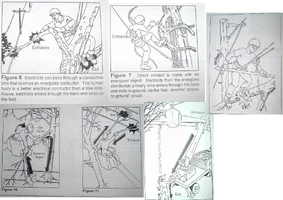
This a pic of an untrained worker after an accident. Look his name up if you like, there is lots to see if you feel like reading. his name was Lewis Wheelan, just started a summer job with a friend of his fathers who owns the contracted company. Took a hit from a fallen conductor, lost his right arm and part of both legs, due to all the scar tissue his body couldnt keep it self cool without air conditioning. When the 2003 black out happened he lost the air conditioning, causing him to slowly overheat untill he passed out and never woke up.

[/ QUOTE ]


<u> WARNING: NASTY PICTURES BELOW </u>

Burning them into your brain well; may save your and/ or your friend's life....


untitled.jpg


Img44.jpg
 

Attachments

  • 45476-line%20clearance%20-%20the%20human%20%20conductor.webp
    45476-line%20clearance%20-%20the%20human%20%20conductor.webp
    223.5 KB · Views: 44
Who's the authority?
It's funny really... I was trained in part by a vet. of 25 years in the industry who specializes in utility clearence and has for many years been the head trainer for the local/provincal hydro company. This fellow seemed to know everything about utility lines and what we were looking at with just a glance... his guidence to us was to treat every line with the up-most respect, as even 'insulated' service lines have been known to give people 'jolts'. Insulation can always contain a fault somewhere, ie. a pesky squirel or a past storm break which caused un-visible damage.

On the other hand, I now work for a guy who is a past journyman-lineman of 8 years and has been tree climbing for 18 years... unfortuneatley he is a control freak and doesn't let anyone do anything other than what he says. I did a large Sugar Maple removal two days ago which had bare primary and secondary lines running under part of the canopy and his (the "journeyman-lineman") idea was to cut small and fast and let the branches bounce off the wires. Anyhow, the bright blue flash of the top wire sagging into and contacting the lower was really pretty... luckily for him and the rest of the ground crew the wires didn't burn out and sever/break.

Long story short: if at all possible ALWAYS rig the limbs away from the wires safetly and NEVER take shortcuts when working around electricity. NEVER 'assume' and if unsure: don't contact it. Think every cut through... ie. what you want to happen and what could happen.
 
Back
Top Bottom