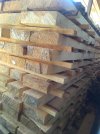
Wood seasoning for milling.

Basswood

Carpal tunnel level member
Location
Long island
I just grabbed a 4’ section of london plane to mill. It’s a medium sized piece but I didn’t get the DBH. Curious how you all determine how long to let a log sit before milling? Also does the health of the tree dictate this? These were topped a year ago just below the power lines for removal. They put out moderate epicormic growth but I wouldn’t say it was strong growth response. Would this cut down drying time?
 
in my experience (not massive but I have worked with a few different guys running mills), it hasn't been a concern about letting it dry before milling. often, folks will paint or apply wax to the butts to slow down the drying process (this reduces checking, splits in the ends).

One choice is to mill it green, and build with it green, the material will dry together evenly (it can actually tighten itself together as it shrinks). if you do this, avoid having it somewhere that the piece will dry out rapidly; keep it in a cool spot for a few seasons.

Again, this isn't bible, but generally getting it milled as soon as reasonable, and then doing a proper job stacking it (mill stickers as you go, and make sure they are the same thickness so everything lays flat). you can build a sort of mini-greenhouse kiln with plastic, or bring it to a true kiln somewhere.

If the log is gonna lay, just seal the ends up and get to it before it begins gathering moisture from being on the ground.

just general insights, others with more experience may have deeper details.

 
Is there any issue with warping if milled and built green? I need some shelving and would like to use this piece. Want to sand to get a very smooth finish.
 
the general principle will be to slow out the drying process. if it is going to be in a heated room, it may tend to warp more.

a good approach may be to go ahead and mill it, let it dry for even just a few months, could be in a garage or basement, then see how it takes to a planer.

mill it a little thicker than your final dimension and some warping won't be an issue, just some more material removal.

of course, elements like branch unions or knots will affect the warping tendency.
 
Cool. Sorry if this is redundant, but just to clarify, better to mill and then dry or leave it whole to dry and then mill? I’d think it’d dry slower as a log no?
 
As mentioned, seal the end grain.

Cut oversized, to account for shrinkage, warping, and planing.

Flat-sawn will move the most after cutting.
Quarter-sawn, the least, IIRC.


Frequently, green sawn wood is sticker- stacked, and weighted down while drying.
 
Mill and dry as boards.

If you save the log any crack will likely telegraph through the tree both up the trunk and into the center. That leads to trashing the wood.

Get it milled asap and then stickered and stacked.

Paint the ends with anything...old latex paint works too.

Get it stickered as soon as it is milled. Leaving the planks in a pile will likely start surface mold and decay...DAMHIKT LOL Cover the top of the pile with enough overhang to keep rain water out. If yo have a shady spot to stack all the better. Debark the wood before stacking. This will reduce the powder post beetle infestations.

The USFS Wood Products Lab in Wisconsin has a LOT of good information about milling and drying. There are truckloads of myths floating around about milling and drying.
 
Tom nailed it.

I’d just add for high value wood the best protection from checking is provided by coating the end grain with hot (hot enough to spread on liquid and clear) melted pure paraffin wax. For very high grade logs the ends are best coated (with what ever you are using) as soon after felling as they are dry to the touch - it reduces degradation from drying stresses and saves the trouble of painting the lumber ends after milling. Be careful with hot paraffin wax, it is very flammable.

The reason for sealing the ends is to prevent the end grain of the log or board from drying before the grain more toward the middle. If the ends can be prevented from drying faster than the rest of the piece, no stresses will develop and no cracks, splits, or checks will appear toward the ends of the dried lumber.
 
Another little quick tip is to try to make sure that you keep the pith confined to a single slab, meaning that you can see it at both ends of the same slab. Then cut the pith out of that slab(go an inch out from it on either side, so removing about a 2" chunk) and you'll have two smaller slabs that are perfectly quarter sawn. These dry the best, work the best and warp/check the least.
 
I have had a lot of Cedar milled, some Pine, Cherry and Persimmon. The best advice I can give you, is don't bother milling leaning trees. After the tension is released in the milling process, they will warp like tacos. I usually cut my logs a foot longer than I want my finished board length to be. This allows for 6" of checking on either end.
IMG_20210303_122041933.jpg
 
shouldn't that little girl be tied in?
Those are beautiful. As an apprentice miller, these results encourage me... Thanks for posting
Absolutely no offense meant. bad joke, At first glance, I thought she was a doll, literally
 
shouldn't that little girl be tied in?
Those are beautiful. As an apprentice miller, these results encourage me... Thanks for posting
Absolutely no offense meant. bad joke, At first glance, I thought she was a doll, literally
Thanks, a lot of people think my daughter is a doll. I've been blessed with beautiful children.
 
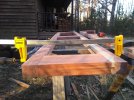
My latest project is a couple of cedar closet doors. Another milling tip, or rather preference, is to mill the top portions of the tree into 2" thick boards and the lower wider logs into 1" boards. The only reason for doing this is because I usually want my 1" stock for shelving and 2" stock for framing.
IMG_20210303_171936692.jpg
 

New threads New posts

Back
Top Bottom